Showing posts with label Cavell. Show all posts

Saturday, January 1, 2011

On Justification

"What choice can we claim over the writing, or the voice — sometimes it is manifested in a phrase — that carries conviction for us? It is not much help to say: Conviction should not be taken seriously that is not justified by argument. That sounds more like a threat (in my hearing it has typically been more than that) than like part of an argument. And then there lingers the feeling that those who recommend the look of argumentation often regard themselves as already knowing the conclusions for which they are inclined to argue. Where is the intellectual adventure, or advance, in that?"

— Stanley Cavell, Little Did I Know: Excerpts from Memory, 344

Tuesday, December 28, 2010

Leftovers

"I think it was this early that I first heard the bewildering formula, and intimidating admonition, when I had not cleaned my plate, 'There are children starving in India.' How was my fortune in having food related to their terrible misfortune in not having food? I would love to send them this food right now that I could no longer possibly eat. If in the future I eat less, will they have more? Why speak to me about this when it is too late to do anything about it? Why has this food just here just now become a rebuke to me? Are there not other grown-ups — and why not all grown-ups — who care about this? Am I ungrateful for having food? Is any contentment of mine a sign of my ignorance and of my badness? I am in no doubt that the seeds of such thoughts, as I stared at the unfinished food on my plate, became an inextinguishable part of my sense or emblem of the world's wrong. This is as clear to me as the memory seems to be of the smell and feel of the checkered oil cloth, with several small cracks in it, that covered the kitchen table where the family ate supper together. It is almost enough to make one crave philosophy."

— Stanley Cavell, Little Did I Know: Excerpts from Memory, 131

Tuesday, September 29, 2009

The contempt in kicking

"How did it become fashionable for disparagers of skepticism to tell the story of Dr. Johnson, who, receiving Bishop Berkeley's 'denial' of matter, kicked a stone, replying, 'Thus I refute you'? People who know nothing of the motives of skepticism know a version of this story. How strange a scene it offers. Why, to begin with, is kicking a hard object more a 'refutation' of immateriality than, say, sipping wine, or putting your hand on the arm of a friend, or just walking away on solid ground, or muddy ground for that matter? Why is a sensation in the toe taken to be closer to the things of the world than one in the throat or in the hand or on the sole of the foot? Does Samuel Johnson take himself to be closer to his foot than to his throat or his hand? Or is it the gesture that is important — the contempt in kicking? Emerson assigns to Johnson the saying 'You remember who kicked you.' Is Johnson's refutation accordingly to be understood as reminding the things of earth who is master, as an allegory of his contempt of philosophy left to its arrogance? Or is it — despite himself — a way of causing himself pain by the things of the world, implying that he knows they exist because he suffers from them? And, if so, had he then forgotten when he last kicked them, or brushed them by?"

— Stanley Cavell, "The World as Things" in Philosophy the Day After Tomorrow, 248

Wednesday, October 31, 2007

Office Politics


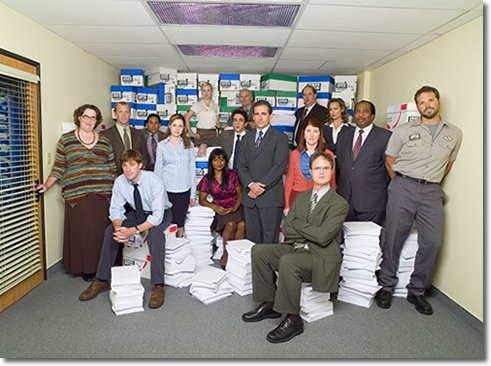
I've been watching The Office on DVD a lot lately — "binging," as Emily lovingly puts it. (It's occurred to me that, in these amorphous post-generals times, I might be indulging some weird fantasy about having a regular job again. If so, please remember to slap some sense into me the next time you see me.) It took me a long time to get into the American series, because I was so attached to the original British show, but it finally wore me down, and I've come to appreciate it on its own terms.

And as with anything that gives me real pleasure, I feel neurotically compelled to theorize a little bit about it. Here's a trial balloon: The British Office is to the American Office as Franz Kafka is to Erving Goffman. That is, the focus shifts from the mindnumbing banality and oppression inflicted on innocent office workers by idiotic superiors (Ricky Gervais' David Brent and Steve Carell's Michael Scott, respectively) to the coping mechanisms that the office workers use to live with that banality: pranks, office romances, small but significant expressions of community. All of which are an important element of the British version, but they're close to being the whole point of the American one.

Also, the characters' attitude toward the cameras is entirely different: in the British show they seem like something everyone (except for David) is subjected to, somewhat unwillingly; in the American one they're playfully acknowledged, even directly involved in the action (as when the camera operator directs Pam's attention to intrigue going on between Dwight and Angela). The impulse in the American Office is always toward inclusion, socialization, communal ritual (however unwelcome) above personal anomie: closeness at any cost.

To me this says a lot about the American attitude towards work, circa early 21st century: specifically, that it ought to be above all a lifestyle, and a socius. (This is an idea held by David Brent in the British show too, but there it's obviously a PC fiction, something everybody but him can plainly see; whereas the American show agrees with Michael that an office should be a community, but just thinks he goes about fostering it all wrong.) There are so many American TV shows about work, and about high-pressure jobs in particular (all doctor shows, all lawyer shows, The West Wing, 3o Rock, etc. etc.), where this vision of job-as-community is even easier to see; in fact, one thing that's refreshing and appealing about The Office is it's almost unique in being about a low-pressure job. Everything about the show is low-stakes, modest, unassuming: but rather than being experienced as degraded and humiliating, the mundanity of the office is exactly what gives pleasure, or allows the possibility of it.

(Just for the sake of probity, I am now issuing a spoiler alert.) The British Office ends with David Brent becoming a (minor) celebrity, in a literalization of the mock-documentary format of the show as a whole. Though this scarcely works out better for him than being a regional manager, it does read, in context, as a necessary dramaturgical move away from the temporary situation of the office, which Merchant and Gervais evidently considered exhausted after just twelve episodes. It's hard to imagine the American version allowing itself this way out, both because it's in the nature of American television shows to keep their premises humming indefinitely, and because, ultimately, the American office doesn't seem like such a bad place to be. (This difference also, if you think about it, reverses some of the standard commonplaces about American "escapism" and celebrity obsession.)

Not sure what valuation to put on this: Stockholm Syndrome or simple realism? Stanley Cavell said "the fact of television" is an acknowledgment of "the uninhabitability of the world," and one might say that the British Office works by extending this terrible fact to the workplace, the American Office by using the workplace to ward it off. But then again we do all have to work, somehow, don't we, and get along with each other in the process? Either way there seems to be something (not uniquely, but distinctively) American about the show's Weltanschaaung. Probably Elizabeth Bishop — who hardly worked a day in her life — said it best: "All the untidy activity continues, / Awful but cheerful."

Tuesday, September 11, 2007

Erving Goffman, the 50s and Literature

Sociology: what is it good for? For students of literature, that is. I'm pondering this question as generals loom. Still on my list, yet to be cracked, are Pierre Bourdieu's Distinction and Jurgen Habermas' The Structural Transformation of the Public Sphere — both works that have already influenced my thinking via my hazy preconceptions of what they are likely to say, but which I must admit I'm scared to actually confront. And even more scared to have to talk about in front of a committee who might actually know something about them.

One sociology book I have managed to read, however, as previously mentioned, is Erving Goffman's The Presentation of Self in Everyday Life. I have some ideas about how I might eventually be able to work this into a developing thesis idea about the social self-presentation of poets and the genealogy that stretches from Eliot to Auden to Ashbery, but I will leave those aside for another day. In the meantime, I'll just give a sketch of some first impressions of Goffman, in the hope that they might lead to something more fruitful later.

I was turned on to Goffman originally by Jeff Nunokawa, who used a little bit of I think Frame Analysis in his Victorian novel seminar as a conceptual framework to talk about "awayness" and the evasion of the social totality (Jeff, in his own personal conceptual system, plays Goffman off against Foucault). He is (still?) highly regarded as a sociologist who facilitated a paradigm shift within the discipline from the macro- to the micro- level, i.e. studying not broad social trends or "laws" but actual human behavior as collected by experts in the field operating similarly to anthropologists.

Anyway, The Presentation of Self is a weird, crafty, idiosyncratic little book that is equal parts empirical survey, philosophical treatise, etiquette guide and public relations manual. Its basic subject is "the art of impression management": how people strive to make other people feel a certain way about them, or to limit or control the information others have about them. (This theme gets its best literary expression, to my knowledge anyway, in the works of David Foster Wallace.) To this end, Goffman uses "some language of the stage," speaking of performances, backstage areas, rehearsals and improvisations, etc., only to retract this conceit on the second-to-last page in a headspinning rhetorical move: "The claim that all the world's a stage is sufficiently commonplace for readers to be familiar with its limitations and tolerant of its presentation" (254) — that is, this very claim, on which the whole book has been based, was itself an impression-management strategy. It made me slap my forehead when I read it.

Though Goffman focuses on real-time interactions and thus is naturally led to use theatrical terminology, the manipulations he describes could just as well be those of a novelist, or a poet, both of whom also work by carefully controlling the amount of information, both literary and extra-literary, given to the audience of their work. In fact, one thing that distinguishes Goffman from sociologists past (Weber, Durkheim) and future (Bourdieu) is his conscious literariness. Not only is his own prose style economical and attractive, clearly learned from reading short stories and New Yorker profiles, but he often takes his clinching examples from literary sources: some of the authors he quotes from at length include Kenneth Burke (25, 175, 194), Henry Mayhew (41), Kafka (96), Warren Miller (97), Evelyn Waugh (101), Orwell (122), Melville (137), Gore Vidal (193) and Mary McCarthy (219) (as well as stuff like Character, Manner and Customs in the People of India and Ebony magazine). And it must be admitted that he sometimes comes off like a frustrated novelist himself ("So, too, members of the team must not exploit their presence in the front region in order to stage their own show, as do, for example, marriageable stenographers who sometimes encumber their office surroundings with a lush undergrowth of high fashion," 214). There's a lot of that sort of thing, sometimes a little too much: a number of Goffman's categories seem like opportunities for examples rather than helpful distinctions in their own right.
Goffman is also, noticeably, a creature of the 50s, receptive to the literary and intellectual influences of that time. One of the more interesting features of Goffman's book are its periodic mentions of Jean-Paul Sartre and Simone de Beauvoir. Sartre's Being and Nothingness supplies a description of a waiter in a café who "is playing at being a waiter in a café": "The child plays with his body in order to explore it, to take inventory of it; the waiter in the café plays with his condition in order to realize it" (76). De Beauvoir's The Second Sex is quoted a few times to describe the attitude of women (problematically labelled "woman," a usage not followed by Goffman) to their performances in the presence of men: "Confronting man woman is always play-acting; she lies when she makes believe that she accepts her status as the inessential other … With other women, a woman is behind the scenes; she is polishing her equipment, but not in battle; she is getting her costume together, preparing her make-up, laying out her tactics…" (113).

On the one hand, Goffman's quotations from Sartre and De Beauvoir clearly have something to do with the widespread popularity of Existentialism in America in the 50s; this vogue both explains why the quotes impressed Goffman and why he feels they will bolster his argument with a "lay" "literary" reader. But in another sense Sartre seems an odd choice of hero, given that Goffman (a) doesn't seem to be much interested in metaphysics, or abstract thinking of any kind, and (b) avoids any explicit discussion of politics. And yet Sartre and De Beauvoir were also associated with and influenced by Maurice Merleau-Ponty, author of The Structure of Behavior and The Phenomenology of Perception — both Goffman-ish titles. And while I don't know squat about phenomenology — just that it was also being enthusiastically received in the art critical world at about this time, by Michael Fried for instance, and that it made my eyes glaze over in college — it's clearly this aspect of Existentialism, and not so much its concern with "being" or "commitment," that interested Goffman.

Well, how about this. A vogue for phenomenology suits a sudden awareness of an explosion of phenomena: and that's what the affluence of the American postwar economy, with all its attendant cultural renaissances, produced. And there was apparently also an explosion of sociological research conducted and published in the 1950s (much of it, I think, under Goffman's supervision). Reading The Presentation of Self in Everyday Life you get the feeling that we have so much more data on 1950s America than we do on any previous society. While Goffman occasionally dips back into earlier eras (often Victorian or eighteenth-century England) for his examples, he rarely "historicizes" in the sense of accounting for changes in values or social agreements from one period to another. I would have to think that this close focus on the current day was fairly radical for the field of sociology, which, in its development out of Hegelian philosophy and traditional social history, would have been interested in nothing so much as epochal change. My question is, how much of Goffman's contentment with "now" was tied to a general sense in the America of the 50s that, after centuries of talking around the subject, everyday life itself was finally being discovered, a notion that is connected both to the public events of the time — the Kinsey Report comes up in passim — and the gradual permeation of such intellectual events as Freudianism and phenomenology into American life? It's a notion, at any rate, that prepares the way for Confessionalism, and for the Beat poets.

A final question. Can Goffman meaningfully be called a Modernist, or even placed in respect to the intellectual influence of Modernism? This is tricky. His literary sources (with a few interesting exceptions, like Kafka) are straight-ahead novelistic realism, because that's where the source of the best information lies. He shows little concern with language, and much with physicality and expression, making his work hard to subsume under the heading of "the linguistic turn" that is often seen to be Modernism's theoretical counterpart. (On the other hand, it suggests points of contact with the later Wittgenstein.) In his concern with "everyday life" rather than "culture," with the facts of contemporary social life rather than what it evolved out of or might be tending toward, he is not at all in the semi-metaphysical tradition of Eliot, Leavis and Raymond Williams. But clearly he's in no way a throwback to 19th century intellectual traditions either: he engages with Freud, with Simmel and Durkheim, with literature. He recognizes modernity has taken place, but he prefers to anatomize and catalogue it than to situate it in a larger historical or theoretical framework. For this reason the Modernist he most resembles is probably Joyce, the Balzacian Joyce who bragged about Ulysses being a blueprint from which turn-of-the-century Dublin could be reconstructed.
Or maybe Beckett: "Performers are aware they foster and ordinarily also possess destructive information about the show," Goffman states on page 144. Waiting for Godot had its American premiere in 1956, Endgame in 1957; a dedicated follower of Existentialism would presumably have been aware of them. This last point raises the question of what I'll risk calling the postmodernity of Goffman's approach, and it's closely connected with one of my biggest problems with his book in general. It seems to me that Goffman's concept of "destructive information" (first used on page 141) is seriously flawed. Putting my objection in short, analytically unrigorous form: just how sensitive are we, anyway? Goffman sometimes talks as though the merest breeze that happens along could destroy the delicate ecosystems of human interaction that he so minutely anatomizes. Social relations are more adaptable and impervious than that, as the early work of Stanley Cavell (in my view a direct inheritor of Goffman: but more on that trajectory another day) shows quite extensively. Goffman, for one thing, is so eagle-eyed himself that he fails to account for the fact of repression, or willful not-noticing, that the more Freudian Cavell so doggedly attends to in essays like "Knowing and Acknowledging." But this emphasis on the ever-present possibility of destruction, far from being a mere weakness on Goffman's part, may point to something bigger, a distinctively postwar epistemic framework that extends inexorably to where we are now: that is, we are getting used to being disillusioned — perhaps Adorno would say "disenchanted" — consistently, and in every aspect of our cultural life. (This is a condition perhaps also anticipated by Wittgenstein, whose Philosophical Investigations was made available and became influential only after the Second World War.)

Hypothesis: in the postmodern period, disillusionment itself becomes the frame in which cultural activity — and not just, but especially, literary activity — is automatically viewed.

Corollary: it's time for a nap.

Saturday, July 28, 2007

The End of the 20s (Part 1)

Monday: T.S. Eliot vs. Ezra Pound
Rematch! This time Eliot fared a litle better: I read his two works published in 1925, "The Hollow Men" and two scenes from his unfinished first play Sweeney Agonistes. What I'll remark on here is the fact that, three years after The Waste Land, it's as if Eliot has wholly compartmentalized the two sides of his poetic personality: "The Hollow Men" has all the oracular gravitas, the violent imagery, the mantraic repetitions, the dried-out landscape, just as if it were a continuation of "What the Thunder Said." Sweeney Agonistes, on the other hand, has all the dark humor, dramatic interest, and fascination with pop culture and the underclasses typical of "The Burial of the Dead," "A Game of Chess" and "The Fire Sermon." I wonder if this was a reaction to negative criticism of The Waste Land as being too divided, or schizophrenic? It would be interesting to compare Eliot's use of repetition in the two works: the first operating more, I guess, "poetically" (the words taking on strength and symbolic/rhetorical power through reiteration), and the second more idiomatically, to indicate the inadequacy of contemporary conversation. (Words to live by: "I gotta use words when I talk to you / But if you understand or if you dont / That's nothing to me and nothing to you / We all gotta do what we gotta do," Complete Poems, 84). Of course, the two might not really be so different after all… In any case, I find Sweeney (which I'd never read before) by the far the more intriguing piece of writing, particularly in its recordings of the language of American businessmen (named, um, Klipstein and Krumpacker), an idiom which Eliot had now been separated from for about a decade. (There are no Americans in The Waste Land, are there?) There's a kind of conflicted loving irony in the way Eliot presents these characters; it reminds me of John Ashbery's remarks about his addiction to American newspapers and comic books when he was living in Paris in the early 60s.

As for Pound, I read the first sixteen Cantos (first published together in 1925). If Eliot was trying to separate out the strands of his sensibility in this period, Pound was clearly going in the other direction: developing the "ply over ply," hopelessly texturally enmeshed style that becomes literally inescapable for him in his later work. I don't have much to say about The Cantos (yet) except that they become much more fun to read over time, once you stop worrying about "getting it" (or worse, agreeing with it) safe in the knowledge that no-one ever really has or will and just bask in its shameless Poundness. I also never noticed before how many animals there are in the beginning of the poem, especially cats. Modernists love their critters!

Winner: Eliot.

Tuesday: Langston Hughes vs. E.E. Cummings
What these two dudes have in common is a reliance on a semi-consistent "poet" persona: they both usually write in the first person, tackle time-honored topics like love, nature and sadness, and in many ways dispense with more than a century's worth of abstruse poetic theory in order to embody the good old Wordsworthian values of "a man speaking to men" and "emotion recollected in tranquility." Though adopting such a mode might seem like the path of least resistance today, in the context of both High Modernism and traditional verse culture of the 1920s, it does feel fairly radical — and, of course, radically populist.

I think Hughes could do this because he was stepping into a cultural role that, by 1926 when The Weary Blues was published, was firmly, if newly, defined: that of a "Negro poet." Because writers like Countee Cullen and Claude McKay had preferred to demonstrate competence in traditional English versifying in order to back up their claims of racial and social equality, Hughes' insistence on using loose, non-English forms like the blues and Whitmanian free verse is especially provocative, opening himself up to hostile charges of simplicity, primitivism, or illiteracy. But it also gives his work the force of naturalness, and allows his inexhaustible talent for image selection and turn of phrase maximum room to maneuver. (I'm also interested, and this something to return to, in the traces here and there of a Symbolist inheritance in Hughes, though, particularly from Verlaine, in a poem like "Black Pierrot," for instance. What did Hughes read?)

One could make the argument that Cummings is playing with the expectations engendered by a similar readymade role, "the modern (or modernist) poet." Cummings' first book was published in 1922, the year of The Waste Land and Ulysses, "the year modernism broke," making him sort of New Wave to Joyce and Eliot's Punk: the slightly belated successor who can come in and benefit from the cultural capital accrued by previous experimentation (it is true, I think, that Cummings was more popular, at least in America, than any of the more reputable High Modernists). Cummings, at least by the time of is 5 (which I read), is aware of this precarious position and uses it to generate effects within his poetry: "what's become of (if you please) / all the grandja / that was dada?" (is 5, 11). Likewise all his unabashed liking for jazz and Krazy Kat, which Greg's analyzed well already. In Cummings, I see one of the first American expressions of what Stanley Cavell eventually comes to call a signal feature of modernist art: "the possibility of fraudulence" (Must We Mean What We Say?, 176). He exaggerates the distance between his technical oddity and his lyrical ego to the point where he's almost a "poet" before he is a writer of poetry. (One indicator of Cummings' almost Duchampian provocativeness is his extensive treatment in Laura Riding and Robert Graves' 1927 Survey of Modernist Poetry, which effectively calls Cummings' bluff by deciding that he is a real poet after all — just not a very interesting one.)

In any case, I think he certainly sets the stage for the Beats, and their particularly male forms of poetic self-display (and incidentally, take a look at that photo: EEC's definitely the buffest Modernist by a considerable margin).

Winner: Hughes. When it comes down to it, Cummings, for all his historical importance and surface amiability, is just too jokey — without being all that funny.


I'm going to stop at hump day for the time being, but there's more to come. Next up: Hart Crane vs. the Atlantic Ocean!

Tuesday, May 22, 2007

The W.B.

I figured I would begin with Yeats, since there are reputedly worse places to start in order to understand this whole Modernism schmegegge. Plus, he has the added bonus of being a major, major writer whose work I don't really know, other than a few isolated greatest hits. (As a matter of fact, I think I've avoided reading him until I had the opportunity to do something like this. Do either of you ever do that — save up authors you know you'll like, or that you know are important, until you can really focus in and give them your full attention? Stanley Cavell supposedly did this with Heidegger, waiting to read him until he was in his forties or something.)

And what do you know: the kid's pretty good! So far I am up through "Responsibilities" (published 1914) which I take it is kind of the middle of the middle phase. One thing that's been interesting is the sort of "a-ha" effect of recognizing Yeats' influence retrospectively on poets whose oeuvres I know quite a bit better: not just the obvious ones, like Pound and Eliot and Auden, but even people like Marianne Moore and Kenneth Koch, whose late poems especially are, I now realize, very Yeatsian underneath the surface craziness and Francophilia.

Anyway, I'll just note a couple of general features that strike me as I read, one thematic and one formal, possibly to be elaborated on further later:

1. Yeats' obsession with age — starting from very early on; there are poems from the perspectives of old men written when he was still very young, a habit he clearly passed on to Eliot. This is kind of a stock affectation among the Modernists for a while — I guess as a way of counteracting the youth-cult of Romanticism? Or am I missing some more obvious literary precursor to the tradition of voluntary senility?

2. His increasing, very admirable lack of fear about repeating words in poems. One of my favorite examples so far is from "The Secret Rose":

"… A woman of so shining loveliness
That men threshed corn at midnight by a tress,
A little stolen tress."

This is sort of a ballad-like device, but here it's not used as a refrain, nor is it exactly conversational: it's more like WBY was so pleased with the word he just wanted to use it again, immediately. Even better, perhaps, is this from "The Hour Before Dawn":

" … And he
Had dipped the wooden ladle deep
Into the sleeper's tub of beer
Had not the sleeper started up.

'Before you have dipped it in the beer
I dragged from Groban's mountain-top
I'll have assurance that you are able
To value beer; no half-legged fool
Shall dip his nose into my ladle
Merely for stumbling on this hole
In the bad hour before the dawn.'

'Why, beer is only beer.' "

To me this has a kind of mock-epic, even mythological, effect: "the beer" gaining, through repetition, something of the force of a Homeric epithet. But it also gives the impression of an extreme carefulness, like he isn't taking any chances and is deliberately restricting the range of his diction in order to get the rhythm absolutely perfect, beautiful, lifelike and metrical all at once. Which he does.

These are, quite possibly, two of the most obvious and stupid qualities of Yeats' poetry, but you've got to start somewhere, right? I don't know. What poems should I look out for?