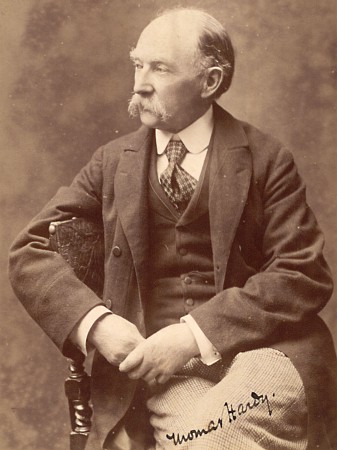
Showing posts with label Hardy. Show all posts

Friday, March 14, 2008

Daddy's on the run

I can give a few reasons why I think the new Stephen Malkmus and the Jicks album, Real Emotional Trash, is the best thing he's done in quite a while. (Here and elsewhere in this post, you will have to excuse obvious evidence of raging fandom.) One is pretty straightforward: Janet Weiss. Malkmus has simply never had a drummer as good as this, and she stiffens up the sinews of his famously loose music in a way it didn't know it needed. And her backup singing (I think it's her; could also be Joanna Bolme) is great too.

The backing isn't the only unusually strong aspect of Trash, though it's likely to get the most attention; in a perfect public sphere the album ought to direct some fresh attention to Malkmus as lyricist, and particularly as metrist, as well. I mean, it's no secret that the man is good with words, but at this point it's become a critical cliché to call his lyrics "casually brilliant" or "stream-of-consciousness" or "surrealist," and while these adjectives might have legitimately applied to the writer of Perfect Sound Forever or even Slanted and Enchanted, I think they tend to underplay what a craftsman Malkmus is capable of being. He gets compared to Ashbery and Wallace Stevens sometimes when critics reach for literary reference points, and fair enough, but one could make an equally strong case for Malkmus as the Thomas Hardy of rock: composer of unprecedentedly weird, sometimes fussy stanza shapes, into which he squeezes the sentiments and occasional observations of a wry, resigned Everyman. The problem is, he often shoots himself in the foot by not filling all of his schemes in all the way; such are the occupational hazards of specializing in crossword puzzle rock. Either that, or he gets bored with the patterns so quickly that he's on to some recondite variation thereof by the second verse, or second recording.

All of which obscures the fact that Malkmus is, or can be, a great lyricist, in some very traditional ways. I'm talking about the basics: singability; colloquial ease; rhyme and meter; unexpected emotional impact. His previous high water mark, to my mind, is Brighten the Corners, which is not at all the best Pavement album (it's dragged down by thin production, indifferent playing, and a little something called "Passat Dream") but may be the best collection of Pavement songs, which is to say melodies wedded to lyrics. Real Emotional Trash is his best since then (again, speaking of lyrics only). I think critics have been deceived by the proggy surface and average running time of its ten songs into believing that this is another Wowee Zowee or Pig Lib: i.e., Malkmus in his meandering surrealist guitar-hero role. In fact, length creep has been a fact of Malkmus' oeuvre since Terror Twilight, a trend which extends to guitar solos, but the notable thing about Trash is its compositional polish: each song sounds finished to a degree that Malkmus sometimes doesn't bother to achieve. Far from being one of the weirder of Malkmus' efforts, from where I'm standing it looks like one of the most generically pigeonholeable: a good old-fashioned marriage-in-trouble record. (I have a few biographical reasons for thinking this, entirely circumstantial of course, and of course I hope untrue.) It's often noted that Malkmus is a husband and father now, but surprising that more people haven't picked up on the strange emotional overtones this gives his work, which on the surface has changed very little but which, I would argue, is beginning to deepen. Part of this is that Malkmus hasn't made the John Lennon move and given up his irony and whimsy for sincerity or sentimentality. If anything, his newfound sense of responsibility makes him sound even more distanced than ever (which may be a question of relative scale, since now we understand better what he's at a distance from). "Cold Son" and "Out of Reaches" (which really ought to be called "Out of Reaches Out") are two statements of this familial anomie; the title track (his first ever!) is another. At the risk of coming off like John Crowe Ransom writing for Spin magazine, I'd like to "read" that one carefully. (I've embedded the song at the bottom of this post. For maximum critical experience, I suggest listening along as you read.)

"Real Emotional Trash" begins in a manner similar to Pig Lib's "Water and a Seat," with a relatively simple, folky guitar riff (almost a scale) that manages to unsettle through slight variations in syncopation rather than through melodic development. Instead of veering into a spastic prog song as "Water" does, however, "Trash" stays restrained, presenting itself initially as a gentle midtempo piano ballad. (Geeky gear note: Malkmus apparently used one of Jeff Tweedy's Fender Telecasters on this song, and the wiry vulnerability of the guitar tone, as opposed to his usual fuzzy crunch, definitely lends it a special something.) The first two verses seem to be taken up with low-key worries about settling down into domestic anonymity: anxieties about becoming an abstract citizen — the kind of person who calls his wife "the wife" — beneath the abstract city sun. The words are a little mundane for Malkmus ("It's that kind of night," he sings, sounding like Billy Joel or someone) but also laced with dread: "Everybody talk, everybody listen, nobody breathe," the first of a few call backs to Pavement's classic "Stop Breathin"; "The trail has two ruts: one is just a tunnel, the other is a funnel to the tomb." The key line, though, is "Daddy's on the run," a phrase that would have been just so much sloganeering in a Pavement song, but which becomes strangely affecting now that we know the singer is in fact somebody's daddy. This is a good example of the weird games Malkmus plays with meter and their occasional affective payoffs: the original stretched out, plaintive, more or less iambic remark "Daddy's on the run," which sounds as if it were a child's observation — where are you going, Daddy? — is then sped up and run together into "Daddysontheru-uh-un," an adult's crazed blurt of irresponsible, unscannable glee: I'm on the run, bye bye kids, see you when I get back. It's two ways of looking at "Papa Was A Rolling Stone," or the theme to an indie-rock Rabbit, Run.

Then there's some dark riffing in the vein of "The Hexx" for about three minutes, leading into a simple, droning pattern that suggests the outro of, again, "Stop Breathin." At around the six minute mark the band breaks loose into a fast boogie vamp, over which SM, feeling "like a snake with five eggs stuck in my stomach" (I think this is what he's saying — a metaphor for pregnancy?), tells of some illicit-sounding hijinks in Northern California (and Mexico — see this ridiculous blog post for a chart of his progress) involving "painted ladies on house arrest." Here the lyrics get much more picaresque and concrete, full of place names and private references in the manner of Malkmus' legitimate inheritors the Fiery Furnaces, but also oblique in relation to the first two verses: is this escape something the speaker is actually accomplishing? Or just fantasizing about? Is the "you" who "spill[s] Chardonnay on your gypsy skirt" his wife, or his lover, or a member of his touring band, or what? It doesn't really matter, I guess: just the sense of release is what this section is all about. Even the obvious corniness of the choogling rhythm is earned: if making like Canned Heat is what the harried narrator of the previous verses needs to shake off his doldrums, then have at it. And if you can coin a readymade proverb like "it's the old fruit that makes wine" in the process, so much the better.

In the second half of this section the narrator seems to consider his own failure ("You got no reputation, never took a swing / Silent when they handed spines out") in a way that I have to try hard not to hear autobiographically. The repeated cry here ("Policeman!" — although the last iteration sounds more like "placement!") reminds me, and I realize I may be going way off the deep end here, of Malkmus' comments about the uninspiring Police reunion when asked about the possibility of Pavement getting back together. Of course, the "policeman" might also be "the wife," or an actual policeman putting an end to these middle-aged monkeyshines; in a live version I have from January 2007 he sings "Release him!" — which, in the context of the reading proposed above, is pretty interesting in itself.

Finally the excitement winds down, and the song ends with a resigned, piano-backed reprise of the opening figure, carried over from notes to chords now: the trash and the emotion both spent, the gamut run, the fun over, the morning after. The rest of the record (not that it's a concept album; leave that to Sufjan Stevens) suggests ways of coping with the subtle peaks and valleys of married life: here, though, there's nothing to do but run down to exhaustion and limp back home. To me, the last minute of this song is some of the most beautiful and affecting music Stephen Malkmus has recorded.


(Matador Records, if you're out there, and you'd like this MP3 to be taken down, I'm happy to oblige.)

Sunday, September 16, 2007

Remembering the Thirties

By Donald Davie:

I

Hearing one saga, we enact the next.
We please our elders when we sit enthralled;
But then they're puzzled; and at least they've vexed
To have their youth so avidly recalled.

It dawns upon the veterans after all
That what for them were agonies, for us
Are high-brow thrillers, though historical;
And all their feats quite strictly fabulous.

This novel written fifteen years ago,
Set in my boyhood and my boyhood home,
These poems about "abandoned workings," show
Worlds more remote than Ithaca or Rome.

The Anschluss, Guernica — all the names
At which those poets thrilled or were afraid
For me mean schools and schoolmasters and games;
And in the process some-one is betrayed.

Ourselves perhaps. The Devil for a joke
Might carve his own initials on our desk,
And yet we'd miss the point because he spoke
An idiom too dated, Audenesque.

Ralegh's Guiana also killed his son.
A pretty pickle if we came to see
The tallest story really packed a gun,
The Telemachiad an Odyssey.

II

Even to them the tales were not so true
As not to be ridiculous as well;
The ironmaster met his Waterloo,
But Rider Haggard rode along the fell.

"Leave for Cape Wrath tonight!" They lounged away
On Fleming's trek or Isherwood's ascent.
England expected every man that day
To show his motives were ambivalent.

They played the fool, not to appear as fools
In time's long glass. A deprecating air
Disarmed, they thought, the jeers of later schools;
Yet irony itself is doctrinaire,

And curiously, nothing now betrays
Their type to time's derision like this coy
Insistence on the quizzical, their craze
For showing Hector was a mother's boy.

A neutral tone is nowadays preferred.
And yet it may be better, if we must,
To praise a stance impressive and absurd
Than not to see the hero for the dust.

For courage is the vegetable king,
The sprig of all ontologies, the weed
That beards the slag-heap with his hectoring,
Whose green adventure is to run to seed.

(1953)

Friday, September 14, 2007

Takes one to know one

Philip Larkin on Thomas Hardy and the codger question:

"Without doubt Hardy, like others of his century, was forever on the look-out for some sign that humanity was improving, and his failure to perceive one produced many occasional bitter utterances ('After two thousand years of mass / We've got as far as poison gas'), and it is curious to note that both he and Shaw see time as a necessary ingredient of man's spiritual and moral advance. Shaw's view is that we must live longer: Hardy's is rather that we must get old quicker or, like the little boy 'Father Time,' be born old. Both, in their different ways, are asking man to grow up." (Required Writing, 171-172)

Monday, July 9, 2007

Naiveté, Irony, Repetition, Repetition


So I have finally started reading Paul Fussell's The Great War and Modern Memory, and I'm struck, as who wouldn't be, by this sentence at the end of his first chapter: "I am saying that there seems to be one dominating form of modern understanding; that it is essentially ironic; and that it originates largely in the application of mind and memory to the events of the Great War" (35).

Yeah? You and what army? As always with this kind of pronouncement, it depends when, and where, you situate the "modern," and Fussell is situating it in the England of the 1910s, by which point modernity, by most people's lights, had already been going on for some forty years, if not fifty or sixty. (It's a weird experience to read critical texts semi-chronologically and see the date of the beginning of "modernity" recede further and further into the past; I think it's about at 1550 now.) All of this is just semantics, though, and doesn't affect Fussell's basic argument (in his first chapter; not in the whole book) that a form of irony associated primarily with Thomas Hardy became, as a result of the colossal social disillusionment by the events of World War I, the modern literary temperament, preparing the way for Eliot, the later Pound, and all the rest of the Modernist gloomy gusses. This irony, put in the simplest possible way, posits an innocent Before and a terrible After, with the author/speaker situated firmly on the latter side, the After (whether it be of war, modernity, death, classicism, revolution).

While not exactly disagreeing with this analysis, I'm interested in the fact that it so obviously doesn't apply to the two modernist writers I've been reading most intensively lately, namely Gertrude Stein and Guillaume Apollinaire. While Fussell locates the force of Hardy's irony in "a collision between innocence and awareness" (5), it seems to me that both Apollinaire and Stein skirt these categories in favor of a thoroughgoing, incorruptible naïveté which simply cannot be mapped on to the before/after structure Fussell sets up. This naïveté seems, more than anything else, to be what links these two seminal figures, and on Fussell's reading it is utterly opposed to the definition of "modern" sensibility that the Great War puts forward and that, on his reading, is apotheosized in a postwar modernist like Eliot. So, is it only because Stein and Apollinaire came of age well before the War that they are so invested not in knowingness (which is what irony, in Hardy's sense, is all about) but in ignorance, in lack of knowledge? Is it because they are American, and French/Italian/Polish, rather than British? Or what?
I'll start with Stein. I keep thinking of a remark made I think by Tristan Tzara in that amazing Pamphlet Against Gertrude Stein that Jeremy assigned us last semester, to the effect that Stein has a "baby style": not quite right, I don't think (she's more like an extremely excited and confident six-year-old) but close enough to suggest the lack of sophistication that Stein so willfully projects in her writing, a lack of sophistication coupled with a dogged urge to pronounce, to state, to display authority.

Two procedures seem important to Stein in maintaining this tricky balance between naïveté: repetition (yes, that again) and time-framing. I was very interested, Greg, in what you wrote a while back about Yeats "testing" his words through repetition, or, to quote you specifically, "asking his rhythm to test ideas and words til they become old in the way polished stones in creeks are old." It's tempting to apply this description to Stein as well: certainly, The Making of Americans (when it's not reminding me of a vacuum cleaner) has the feel of a verbal laboratory, in which the author tries tiny variations on a limited number of formulae, hoping to produce some long-promised extraordinary effect. But Yeats' testing, one could say, attempts to create a sort of eternal present through the construction of a usable mythic past; whereas Stein is always oddly oriented toward the future, at the expense of the past and present. What's interesting in The Making of Americans is how she continually dispels the incantatory power of her repetitions with little reminders that she's driving at something: "soon there will be a history of the Hersland children," "later it will become clearer the kind of being that each one had in them," etc. (I'm paraphrasing; you know how it is, the book's all the way on the other side of the room). These reiterations aren't allowed to seem old, or familiar, or even properly symbolic, the way Yeats' (or Eliot's or Pound's) repeated words are, because they're so obviously temporary: they're not mantras but coordinates on an enormous map we will soon (but when?) be able to step back and admire.

All this to say, Stein is not a Symbolist: where Mallarmé or Verlaine or Symons or Yeats take aesthetic pleasure in the symbol, the image and the word in and of themselves, Stein is so focused on her version of the novelist's traditional "big picture" that she refrains from putting too much weight on any one detail or image or construction. What's happening in The Making of Americans is happening sentence by sentence, but it's not happening within the sentence; and it is, for that reason, impossible to excerpt. One could say that it's happening in the next sentence, only by the time we get there it no longer is. Again and again, we confront Stein's "sometime," "someday," "soon," and, occasionally, a "now" that projects us into the next sentence or paragraph hopefully only to confront us with another delay, or another restatement. This stops being incredibly frustrating only once (and if) you begin to view Stein's progress as incremental, that is, that she is actually accomplishing what she claims to be putting off until later: viz., narrating the history of a family's progress.
Another kind of modernist naïveté is displayed by Stein's contemporary and friend Guillaume Apollinaire. Even more than poétès maudits like Rimbaud and Verlaine, Apollinaire writes a style of French that is intentionally awkward: polyglot, crude, often obscene, syntactically either overly simple or ridiculously muddled. (It may or may not be necessary to emphasize that he did this on purpose; his critical prose is perfectly literate, even elegant.) The title of his most famous volume is Alcools and I think more than a few times in it he is endeavoring to mimic drunkenness (and in the last poem he turns into the mouth of Paris and drinks the blood of Europe like wine). Like Stein, he uses repetition to an effect that is less authoritative than childlike ("Les anges les anges dans le ciel," e.g.). And he also likes to play with the time-frames of his works, most obviously in his landmark poem "La Chanson du Mal Aimé," which begins:

Et je chantais cette romance
En 1903 sans savoir
Que mon amour à la semblance
Du beau Phénix s'il meurt un soir
Le matin voit sa renaissance

(And I sang this ballad
In 1903 in ignorance
Of love's resemblance
To the Phoenix dead at evening
Resurrected by morning) (Alcools, 14-15)

Apollinaire is effectively beginning his poem with a disclaimer: this poem was written in 1903, when I knew less about the subject; I no longer feel this way. But somehow rather than undermining the lyric intensity of the poem that follows, this bizarre flash-forward heightens it (and the tension builds as Apollinaire goes on to interpolate three further poems, taking place further back in the speaker's past or in his fantasy, all of which complicate the lyrical "now" of his "Chanson"). The reason for this is that the ignorance of the speaker is exactly what conditions his utterance: it is Apollinaire's favored pose to be bewildered, melancholy, and slightly drunk-seeming, just as it is Stein's to be earnest, relentless, and positivistic. The poem works if we are affected by this state of confusion and ignorance, and identify with it. But unlike in traditional dramatic irony, where the speaker's ignorance helps us to attain a position of interpretive power over him (because we know more than he does), here the effect relies on us sharing for the most part in the speaker's ignorance, while still recognizing it as ignorance.

Like Stein, then, Apollinaire makes us feel that we aren't fully in possession of the equipment we need to read his work: that it would not just be a matter of understanding how he feels now, but also who he used to be. And of course this knowledge is not just difficult to acquire, it's impossible, and not just for us, but for the speaker himself. The proper time of understanding the poem is not now and not then, and not a simple mediation between the two (as in Hardy's customary irony). For in Apollinaire's poems, each line is an experience of its own: they float on the page, abutting but not intruding on each other (an effect which is enhanced by Apollinaire's removal of all punctuation from the book at the proof-correcting stage).

What I am (very provisionally) theorizing here is a sort of naïve irony common to Apollinaire and Stein, a chosen naïvete, one which always retains the suggestion of a state of greater knowledge to come but which prefers to write out of ignorance (thus, perhaps, anticipating Beckett and his epochal rejection of Joyce's "omniscience and omnipotence"); and that this stands apart from the essentially ironic, elegiac strain of Modernism that Fussell sees as coming to fruition during the Great War. I can't decide whether this type of irony — if it even is irony — is the opposite of Hardy's, or just a lot more complicated: for Hardy there is only before and after, now and then, while for Apollinaire there is a complex weft of nows and thens, perhaps as many as there are lines in the poem.

Question: does this kind of naïve attitude make irony, as such, impossible?

OK, I am probably sounding like Marjorie Perloff with a couple of drinks in her. Sorry to go on so long.

I haven't even gotten to Apollinaire's war poetry yet, but I think it will make a fascinating comparison with the kind of stuff Fussell writes about in his book (about which also more anon).

Sunday, July 1, 2007

Grumpy Old Modernism


Further conjectures about the premature senescence of Yeats, Eliot, Frost et al:

1. Thomas Hardy's age in 1898, the year his first volume of poetry (Wessex Poems) is published: 58. This unusual late debut makes him to a certain extent the Modernists' contemporary. His subject matter, moreover, is an old man's through and through: poems about friends and lovers dying, not being able to change things about yourself, rain on graves, etc. But in the figure of Hardy, age is not associated with a failing of powers (as it would have been in Tennyson or Swinburne) or even with a development or consolidation of old achievements (as with somebody like maybe Browning), but with a new aesthetic and a fresh start: Hardy, having experienced enormous disappointment and pain, is now finally ready to write and publish poetry. (Slight problem with this theory: Eliot didn't really like Hardy's work, and Yeats started publishing before him, so his example might not have meant much to them. Who did like him? Marianne Moore? But she's got to be one of the sprightliest of the Modernist bunch.)

2. The poets of the 1890s (especially Ernest Dowson and Lionel Johnson) were seen as dissolute, drunken messes who wasted their talent and died unnecessarily early deaths — i.e., as cautionary tales about what the post-romantic/aesthetic embrace of youth could lead to. Cf. Yeats' "The Tragic Generation," and Eliot's remarks on these people in the back of Inventions of the March Hare (quotes t/k?).