I hope she doesn't mind my doing this, but I'm going to go ahead and post the illustrious Sonya Posmentier's long and fascinating reply to my earlier writing on Gwendolyn Brooks (and to Evan's back-in-the-day comments about Claude McKay) as its own post, since I don't want it to get buried in the responses from November. I'll have something to say in reply, to this and to the comments on my original analysis, and I'd like to keep these discussions of race and form on the table. Take it away SP:
"Okay, so I’m going to take Greg’s bait and reply to Evan’s earlier post about Claude McKay. As I understood it, Evan had two questions: one about McKay’s status as “modern” and the other having to do with McKay’s apparent nostalgia for Jamaica, his bitterness toward American racism but not the effects of British colonialism. I’ve been reading Michael North’s The Dialect of Modernism, which offers a certain argument at least in response to the first question, but hopefully I can go beyond that. Greg has also already suggested much of what I want to say… first by pointing (through Goldsby’s reading of Brooks) to modern “uses” of form (important since McKay’s formalism is certainly the characteristic that most often labels him as Romantic or un-modern, and he often gets lumped with Countee Cullen in this regard), and second, by suggesting that if lynching is a modern phenomenon, so too are artistic expressions of/responses to that violence. What I see Greg starting to say is not that the subject of lynching alone would constitute “modern” poetry (more on that in a minute), but that McKay’s formal treatment of it might.
Michael North in The Dialect of Modernism notes that defenders of McKay’s modernism often pointed to his “racial” subject matter, as if the “racial” is inherently modern, regardless of style/formal strategy. North demonstrates how McKay must resist “the indiscriminate association of race and modernism,” because of the bind that modernist primitivism puts black writers in. According to North, “there is no real conflict between the defiant subject matter and the conventional form of McKay’s American poems , as is so often supposed” because the form itself is defiant (toward modernism’s “naturalizing” of blacks as “primitive”) (115). This would seem to underscore Evan’s sense that McKay is not so modern—it would seem to suggest that, in fact he can’t be. But North argues, quite convincingly, that in the course of McKay’s career he challenges the various dichotomies that place him in this trap in the first place. North’s focus is onMcKay’s history with dialect—from his first two books, written in Jamaican dialect with the encouragement of his English mentor Walter Jekyll, through the “American poems” written in standard English traditional forms, through the expatriate novels. Because white writers (including Eliot and Pound) use black dialect simultaneously to claim a rebellious aesthetic freedom, and to reinscribe dehumanizing cultural stereotypes of “the black”--that is, to delineate their own propriety—dialect and standard English are already implicated in one another. The tools that make white writers modern (including dialect, free verse), McKay fears, would make him “primitive.” However, having begun his poetic career writing in Jamaican dialect (more on this later), McKay is always in dialogue with dialect. Thus, to North what makes McKay modern is his thematization of this very problem, his bringing “to the surface the subterranean connections between dialect and the standard.” McKay is like Eliot and Pound and other expatriate modernists in his “realization of the malleability of language in general, and of the arbitrariness and relativity of particular languages” (123).
I’m pretty much convinced by North’s argument (although I’m not sure I’ve done it justice here), but he achieves it, finally, by recourse to the novels, which raises my hackles. North ultimately depicts poetry as a dead end for McKay, the bind I’ve tried to describe above, inescapable. While it’s true that McKay more or less stops writing poetry once he leaves America, I think North gives the sonnets short shrift. First of all, while I see the importance of challenging the equation between “racial” subject matter and modernity, the “racial” quality of McKay’s American lyrics takes many forms—not only the nostalgia of “Tropics in New York” (the one “American” poem North discusses in depth) but also, as Greg has already begun to suggest, the rage of the radical protest poems—“If We Must Die,” “The White House,” “The Lynching,” etc. A critic I read a long, long time ago (and thus, embarrassingly, can’t remember who it is), describes McKay’s couplets as enacting the “lynching.”
And little lads, lynchers that were to be,
Danced round the dreadful thing in fiendish glee.
McKay forces together the suspended existence (of lynchers and lynched alike.) and “glee” in these two lines. The description of the corpse as a “dreadful thing” underscores the dehumanizing, indeed deadening, effects of this coupling (an end formally charged with the eros of the “thronging” women). The sonnet form—to me at least—starts to seem complicit in the dance (at least partially the effect of the circularity of the rhyme scheme in the quatrains). I could say a lot more about this, but this post is too long, so…. If McKay is using the sonnet to resist the reductive primitivism of white modernism, I think he’s also using the sonnet to resist the sonnet.
Which brings me, finally, to Evan’s second question, about McKay’s attitude toward Jamaica. Evan, I think you’re right that a lot of the poems in Harlem Shadows seem purely nostalgic toward Jamaica. One simple response re: McKay’s attitude toward colonialism is that there’s a LOT more bitterness/ambivalence in the Jamaican poems. North does a great reading of “Quashie to Buccra” (the first poem in “Jamaican Songs”) that captures both its potential for resistance and its ultimate capitulation to “nostalgic romanticism” (and herein, perhaps, lies the relationship BETWEEN the question of McKay’s modernism and the question of his relationship to colonialism). But another point I’d make (and I said something like this in my presentation for Jeremy’s class) is that McKay’s use of the sonnet (an English form) in “Harlem Shadows” inevitably defines a triangular relationship between American racism, British colonialism, and the black subject (a triangle further outlined by the treatment of commodity/trade in “Tropics of New York.”) The form “penned” (“If We Must Die”) McKay’s speakers in—at once giving them expression and binding them. Is it possible that to use that form against itself is not only to “fight back” in the context of American racism, but also to engage in an anti-colonial struggle (people like Fanon and Derek Walcott would pick up on this kind of practice later, though many, like Kamau Brathwaite, would suggest that this is a losing battle as long as McKay was writing in pentameter)? I’m not sure what I think about this, but I think at the very least it’s a question we need to consider in the case of a double-expatriate Black Jamaican writer (with a British passport) writing sonnets in the 1920s…."
Showing posts with label McKay. Show all posts
Showing posts with label McKay. Show all posts
Friday, December 14, 2007
Sunday, November 18, 2007
"although the pattern prevailed,/ The breaks were everywhere"
Here is Gwendolyn Brooks's stunning short poem "The Last Quatrain of the Ballad of Emmett Till":
AFTER THE MURDER,
AFTER THE BURIAL
Emmett's mother is a pretty-faced thing;
the tint of pulled taffy.
She sits in a red room,
drinking black coffee.
She kisses her killed boy.
And she is sorry.
Chaos in windy grays
through a red prairie.
For Diana Fuss's class on the elegy, I've (we've) just been reading the final chapter in Jacqueline Goldsby's A Spectacular Secret: Lynching in American Life and Literature, in which Goldsby closes with a deft reading of how Brooks's lyric acts in relation to the "modernization of the black press" around the coverage of Till's murder case in 1955, with the attendant shift from a predominantly literary/journalistic regime of protest to a coverage that gained wider support through visual media. Goldsby writes, "If, for the romantics, the emergence of mass-produced print technologies threatened poetry's hegemony as the arbiter of critical judgment, in Brooks's day visual apparatuses like photography and television (and, particularly, the novel channels of the photo-essay and live broadcast) instituted a comparable change worth worrying about" (299).
"The Last Quatrain", then, aims "to scale [Till's mother, Mamie] Bradley's hypervisibility
as a photographic subject down to a less iconic, more human form," marking "a time zone where there are no cameras, no reporters, no rallies, no trials, no open caskets, no graves" (300-301). Toward the end of her argument, Goldsby writes of Brooks's thick, painterly abstraction: "The haunting force of Emmett Till's absence from a poem meant to memorialize his death leaves its trace on the text in another way as well, referring (as its 'colored' words do) to the history of modernism and the literary movement of imagism. Red, black and gray: William Carlos Williams's 'The Red Wheelbarrow,' Ezra Pound's 'In a Station of the Metro,' and Wallace Stevens's 'The Gray Room' come promptly to mind when reading 'Last Quatrain.' Why?" (305). Goldsby goes on to define the peculiar applicability of imagist practice for a poem on Till's murder, but I don't want to reproduce her entire argument, fine as it is.
I'm wondering about the cost of reading Brooks's poem as one that tropes post-imagist concision, and how this description of her form relates to the formal modernity (or not) of earlier poets like Claude McKay (hi S.P., I'm writing this almost exclusively as bait for your commentary btw). Goldsby's focus, among Brooks's body of work, is exclusively on this often anthologized poem, though she notes that she lacks the space to address the poem that proceeds it in 1960's The Bean Eaters, "A Bronzeville Mother Loiters in Mississippi. Meanwhile a Mississippi Mother Burns Bacon". [You can find the poem here, though in a version that screws up the lineation.] Goldsby admits that the two poems "ought to be analyzed together as the diptych they are meant to be" (note 33, pg 401); so I'd like tentatively to begin to do just that, as well as to speculate why, even in the service of Goldsby's stated goal of describing Brooks's relation to visual culture, the critical isolation of "Last Quatrain" poses some difficulties for her interpretation.
"A Bronzeville Mother Loiters in Mississippi. Meanwhile a Mississippi Mother Burns Bacon" is a longer and a messier poem, and that is partly its point -- beginning with that unwieldy title. As the title displays in miniature, the poem interrogates the possibilities of that "Meanwhile" (the simultaneity that allows us to imagine communication, specifically between mothers, across the crime) as well as what "Meanwhile" holds apart or in parallel (the simultaneity which is the basis for recognizing a common subjection within a larger system defined by the normalization of racial/sexual violence). "A Bronzeville Mother..." also describes the preparation of an inedible, abject meal (burnt bacon, "a sickness heaved within her", etc.) to which "Last Quatrain" is an ironic taffy-and-coffee dessert. "Last Quatrain"'s digestif has, itself, been abjected from the longer narrative of "A Bronzeville Mother...", which ends with an imagination of impossible touch and eros, a cross-cut to the "decapitated" ballad, and perhaps a passing reference (in the word "Bigger", capitalized at the line's start) to Richard Wright's Native Son:
But a hatred for him burst into glorious flower,
And its perfume enclasped them - big,
Bigger than all magnolias.
The last bleak news of the ballad.
The rest of the rugged music.
The last quatrain.
The 'plot' of "A Bronzeville Mother..." follows a woman who (given the poem's placement before the "Last Quatrain") we can presume to be Carolyn Bryant, the white woman who accused Emmett Till of his fatal breach of Southern 'decorum,' though neither she nor Till is named here. In Brooks's poem, this "Mississippi Mother" is consumed by the myths of chivalry which are thrust upon her, the "'maid mild'/of the ballad", and which she herself consumes but increasingly cannot swallow. The poem begins:
From the first it had been like a
Ballad. It had the beat inevitable. It had the blood.
A wildness cut up, and tied in little bunches,
Like the four-line stanzas of the ballads she had never quite
Understood - the ballads they had set her to, in school.
Right at the start, the ballad's form itself becomes a euphemism for the binding, torture, and murder of Till -- a form that simultaneously infantalizes the Mother who is here introduced as unable to 'learn her lesson'. In the heroic terms of the ballad, however, her "dark villian" is too young, too reminiscent of her own tussling children whom she is attempting to feed. "The fun was disturbed, then all but nullified" as her knight in shining armor - an agent of bloody infanticide - reveals himself, in acts of sexual aggression, as the true perpetrator of a terrifying leer (rather than the "sexual threat" supposedly posed by Till). The seven page poem testifies to the Mother's growing wordlessness in the face of her husbands "mouth, wet and red,/ So very, very, very red", a color that obviously seeps into "The Last Quatrain". Her husband morphs from Southern gentleman to male vampire, with a possible allusion in these small words "wet" and "red" to the corpse in Ivor Gurney's WWI elegy, "To His Love" ("hide that red, wet thing/ I must somehow forget"). There is also, of course, a pun on "read" that signals the "meddling headlines" that her husband abhors, and that proliferate the slashing visibility/audibility of his hateful, red perspective (metonymically his mouth) to a mass audience (even as the press, for one of the first times in American history, weighed in favor of the black victim). Nevertheless, while his wife is sickened by her husband and by the "courtroom coca-cola," she retains a trace of desire for such nectar, and while sad that the killing wasn't properly "fun" she thereby admits that it could/should have been (the fun was "all but nullified").
What is most disturbing to me about Brooks's "Last Quatrain" is that the signs of "fun" and sweetness have been amplified rather than muted or thrown up. I think this actually furthers Goldsby's reading of the poem, but it does require us to question, in particular, the intimacy of address that she reads too quickly as the site of the poem's enunciation. "Privy to the primacy of this act [of kissing her killed boy], the speaker claims the right to address Bradley using terms of endearment and the diminutive," writes Goldsby, "The colloquialisms indicate the intensity of their bond, which the content and form of the poem allow. Precisely because they are precious turns of phrase, the references counter the perception that figured Bradley to be knowable only as a picture, an image-object detachable from herself" (301-2). Here the "speaker" is tacitly assumed to be Brooks, or at least an empathetic subject whose proximity poses no threat. I would note, however, the ambiguity of the "intensity" that Goldsby rightly points out.
As I've used the term "abjection" a few times now, it may be clear that I'm taking it straight from Kristeva's Powers of Horror, which begins by establishing the concept in a scene of "loathing an item of food." Nevertheless, disgust is proven to be founded on a subject-violating libidinal "want" and, according to Kristeva, "jouissance alone causes the abject to exist as such." While "Bronzeville Mother" saturates us in nauseous scenes of food rotting, being misprepared, or being thrown around (one white child's face is smeared brown with molasses) (all of which, btw, might recall Langston Hughes's pivotal articulation of race memory in terms of food abjection: the "raisin in the sun"), the "Last Quatrain" is candy-coated and, precisely in its imagist bite-sized-ness, eminently edible. Edible, that is, not just by us as readers, but by us as imaginary readers who have been prefigured by the "Mississippi Mother." To say that Emmett's mother is "sorry" is both to allow a space for her unvarnished, moving statement of private grief (Goldsby's point); and yet -- in a disturbing possibility unavailable without the context of what has come before it -- "sorry" also cannot help but connote an apology for the white woman's self-indictment upon seeing, in the courtroom of a prior verse, the "Decapitated exclamation points in that Other Woman's eyes." As such, one could argue that, far from "counter[ing] the perception that figured Bradley to be knowable only as a picture, an image-object detachable from herself", Brooks heightens and even theorizes Mother Till's powerlessness.
Here I find it useful to turn to an article by Sianne Ngai, published in 2005 in Critical Inquiry, entitled "The Cuteness of the Avant Garde." Briefly: Ngai's current project is to examine "comparatively novel" aesthetic categories (in relation to old chestnuts like "the sublime" or "the beautiful") including "cute, glamorous, whimisical, luscious, cozy, or wacky" which, by dint of "the close link between their emergence and the rise of consumer aesthetics...seem all the more suited for the analysis of art's increasingly complex relation to market society in the twentieth century" (that is, a market society that has multiplied and specialized its vocabulary of taste in order to facilitate the "industrialization of modernist aesthetics") (812). As Ngai traces its definitions and uses, "cuteness" comes to describe "the aestheticization of the small, vulnerable, and helpless" which almost inevitably "find[s] its prominence checked in the culture industry of a nation so invested in images of its own bigness, virility, health, and strength" (819) and which is particularly courted by (and a potential source of embarrassment for) the imagist/objectivist /small-concrete-everyday-things tradition of the 20th century avant-garde.
With cuteness's characteristic exaggeration of features (e.g. huge eyes), its anthropomorphization of the commodity, its suggestion of softness, maleability, and smallness, "'cuteness' names an aesthetic encounter with an exaggerated difference in power that," however, "does something to ordinary or communicative speech" (think of how the baby elicits baby-talk from adults) (Ngai 828). This strikes me as useful in discussing Brooks's short poem, because it allows it to be diminished without depriving it of a capacity for retaliating against the discursive impositions of the long, preceding poem about a white mother. Goldsby needs for "pretty-faced" to equal intimate affection and Jahan Ramazani, in Poetry of Mourning, bizarrely describes "pretty-faced" as "colloquial black speech" (172), i.e. as a marker of authenticity. But there is no getting around the condescension of these words; and indeed there is no need to get around it or to cover-over the power imbalance that Brooks stages in introducing the grieving mother in such a way. As Ngai writes of Gertrude Stein's Tender Buttons, "her interest is in how artworks might be driven by positive affects without necessarily becoming affirmative" (829, her italics). [See note 51 in Goldsby for a query on the relationship between Stein's aesthetics and Brooks's.] "The Last Quatrain" is not meant, or is not able given the historical circumstances, to be a nuanced or intimate portrait of Till, who is rather hyper-simplified and abstracted as we are given "just enough face to enable [her] to return our gaze" (Ngai 833, her italics). The Mississippi Mother in the earlier poem describes Emmett's "mouth too young to have lost every reminder of its infant softness." In "Last Quatrain" that softness returns with a vengeance.
In the actual scene of the awful crime against Emmett Till - which Goldsby reminds us can never be seen, can only form an aporia in the archive - we must recall that there were men who ignored his youth - men who did not allow his "infant softness" to take affective hold. Or, on the other hand, as Ngai implies, since infantilization is itself the "always already" of a racist perspective, it may be that these men were able to see nothing but youth and feel nothing but its affective disordering of their "power." "A Brownsville Mother..." asks, as a extreme limit case, what it would mean for Carolyn Bryant to come to identify with either Till's mother or, more uncomfortably, the murdered boy himself (or even with the institution of slavery in total). She imagines "The fear/ tying her as with iron." "Last Quatrain" asks the same question, but it does so by allowing us to identify with her, or to dis-identify, rather than by narrating the subjectivizing vicissitudes of that identification. To call out a pun as blunt as the primary colors on Brooks's palette: the room and the prairie are "read" by us, and thus potentially (made) "red" by us as well. Adam Gussow, in Seems Like Murder Here: Southern Violence and the Blues Tradition, describes the central paradox of an intraracial encounter with the lynched body: "Lynching haunts black southern blues subjects because they are helpless not to identify with the charred, mutilated horror-producing black body it generates, and yet they are unmade as subjects - because claimed by the abject - the moment they feel such identification" (130). In parallel with this formulation, I wonder if we might say that a poem such as Brooks's "The Last Quatrain of the Ballad of Emmett Till" requires an expression of cuteness, tweeness, etc. in order to critique the "grown-up" blindness at the foundation of the crime, while also recognizing that to inhabit this cuteness is to abandon, to some degree, the very agency necessary to undermine the power imbalances implicit in that perspective.
-----------------------------
Goldsby argues convincingly that lynching constitutes a signal feature of American modernity, and that to call lynching "modern" forces us, as Paul Gilroy notes, to look "more deeply into the relationship of racial terror and subordination to the inner character of modernity" (qtd by Goldsby, 286). At heart, I think I'm asking questions of form here, and how this might help to clarify a question Evan posed way back in the thick of generals about the seemingly un-modern style of Claude McKay's sonnets. I know I'm being most opaque about the connection between this poem and, for instance, McKay's sonnet "The Lynching." But, anyway, maybe I've gone on for long enough.
AFTER THE MURDER,
AFTER THE BURIAL
Emmett's mother is a pretty-faced thing;
the tint of pulled taffy.
She sits in a red room,
drinking black coffee.
She kisses her killed boy.
And she is sorry.
Chaos in windy grays
through a red prairie.
For Diana Fuss's class on the elegy, I've (we've) just been reading the final chapter in Jacqueline Goldsby's A Spectacular Secret: Lynching in American Life and Literature, in which Goldsby closes with a deft reading of how Brooks's lyric acts in relation to the "modernization of the black press" around the coverage of Till's murder case in 1955, with the attendant shift from a predominantly literary/journalistic regime of protest to a coverage that gained wider support through visual media. Goldsby writes, "If, for the romantics, the emergence of mass-produced print technologies threatened poetry's hegemony as the arbiter of critical judgment, in Brooks's day visual apparatuses like photography and television (and, particularly, the novel channels of the photo-essay and live broadcast) instituted a comparable change worth worrying about" (299).
"The Last Quatrain", then, aims "to scale [Till's mother, Mamie] Bradley's hypervisibility
as a photographic subject down to a less iconic, more human form," marking "a time zone where there are no cameras, no reporters, no rallies, no trials, no open caskets, no graves" (300-301). Toward the end of her argument, Goldsby writes of Brooks's thick, painterly abstraction: "The haunting force of Emmett Till's absence from a poem meant to memorialize his death leaves its trace on the text in another way as well, referring (as its 'colored' words do) to the history of modernism and the literary movement of imagism. Red, black and gray: William Carlos Williams's 'The Red Wheelbarrow,' Ezra Pound's 'In a Station of the Metro,' and Wallace Stevens's 'The Gray Room' come promptly to mind when reading 'Last Quatrain.' Why?" (305). Goldsby goes on to define the peculiar applicability of imagist practice for a poem on Till's murder, but I don't want to reproduce her entire argument, fine as it is.
I'm wondering about the cost of reading Brooks's poem as one that tropes post-imagist concision, and how this description of her form relates to the formal modernity (or not) of earlier poets like Claude McKay (hi S.P., I'm writing this almost exclusively as bait for your commentary btw). Goldsby's focus, among Brooks's body of work, is exclusively on this often anthologized poem, though she notes that she lacks the space to address the poem that proceeds it in 1960's The Bean Eaters, "A Bronzeville Mother Loiters in Mississippi. Meanwhile a Mississippi Mother Burns Bacon". [You can find the poem here, though in a version that screws up the lineation.] Goldsby admits that the two poems "ought to be analyzed together as the diptych they are meant to be" (note 33, pg 401); so I'd like tentatively to begin to do just that, as well as to speculate why, even in the service of Goldsby's stated goal of describing Brooks's relation to visual culture, the critical isolation of "Last Quatrain" poses some difficulties for her interpretation.
"A Bronzeville Mother Loiters in Mississippi. Meanwhile a Mississippi Mother Burns Bacon" is a longer and a messier poem, and that is partly its point -- beginning with that unwieldy title. As the title displays in miniature, the poem interrogates the possibilities of that "Meanwhile" (the simultaneity that allows us to imagine communication, specifically between mothers, across the crime) as well as what "Meanwhile" holds apart or in parallel (the simultaneity which is the basis for recognizing a common subjection within a larger system defined by the normalization of racial/sexual violence). "A Bronzeville Mother..." also describes the preparation of an inedible, abject meal (burnt bacon, "a sickness heaved within her", etc.) to which "Last Quatrain" is an ironic taffy-and-coffee dessert. "Last Quatrain"'s digestif has, itself, been abjected from the longer narrative of "A Bronzeville Mother...", which ends with an imagination of impossible touch and eros, a cross-cut to the "decapitated" ballad, and perhaps a passing reference (in the word "Bigger", capitalized at the line's start) to Richard Wright's Native Son:
But a hatred for him burst into glorious flower,
And its perfume enclasped them - big,
Bigger than all magnolias.
The last bleak news of the ballad.
The rest of the rugged music.
The last quatrain.
The 'plot' of "A Bronzeville Mother..." follows a woman who (given the poem's placement before the "Last Quatrain") we can presume to be Carolyn Bryant, the white woman who accused Emmett Till of his fatal breach of Southern 'decorum,' though neither she nor Till is named here. In Brooks's poem, this "Mississippi Mother" is consumed by the myths of chivalry which are thrust upon her, the "'maid mild'/of the ballad", and which she herself consumes but increasingly cannot swallow. The poem begins:
From the first it had been like a
Ballad. It had the beat inevitable. It had the blood.
A wildness cut up, and tied in little bunches,
Like the four-line stanzas of the ballads she had never quite
Understood - the ballads they had set her to, in school.
Right at the start, the ballad's form itself becomes a euphemism for the binding, torture, and murder of Till -- a form that simultaneously infantalizes the Mother who is here introduced as unable to 'learn her lesson'. In the heroic terms of the ballad, however, her "dark villian" is too young, too reminiscent of her own tussling children whom she is attempting to feed. "The fun was disturbed, then all but nullified" as her knight in shining armor - an agent of bloody infanticide - reveals himself, in acts of sexual aggression, as the true perpetrator of a terrifying leer (rather than the "sexual threat" supposedly posed by Till). The seven page poem testifies to the Mother's growing wordlessness in the face of her husbands "mouth, wet and red,/ So very, very, very red", a color that obviously seeps into "The Last Quatrain". Her husband morphs from Southern gentleman to male vampire, with a possible allusion in these small words "wet" and "red" to the corpse in Ivor Gurney's WWI elegy, "To His Love" ("hide that red, wet thing/ I must somehow forget"). There is also, of course, a pun on "read" that signals the "meddling headlines" that her husband abhors, and that proliferate the slashing visibility/audibility of his hateful, red perspective (metonymically his mouth) to a mass audience (even as the press, for one of the first times in American history, weighed in favor of the black victim). Nevertheless, while his wife is sickened by her husband and by the "courtroom coca-cola," she retains a trace of desire for such nectar, and while sad that the killing wasn't properly "fun" she thereby admits that it could/should have been (the fun was "all but nullified").
What is most disturbing to me about Brooks's "Last Quatrain" is that the signs of "fun" and sweetness have been amplified rather than muted or thrown up. I think this actually furthers Goldsby's reading of the poem, but it does require us to question, in particular, the intimacy of address that she reads too quickly as the site of the poem's enunciation. "Privy to the primacy of this act [of kissing her killed boy], the speaker claims the right to address Bradley using terms of endearment and the diminutive," writes Goldsby, "The colloquialisms indicate the intensity of their bond, which the content and form of the poem allow. Precisely because they are precious turns of phrase, the references counter the perception that figured Bradley to be knowable only as a picture, an image-object detachable from herself" (301-2). Here the "speaker" is tacitly assumed to be Brooks, or at least an empathetic subject whose proximity poses no threat. I would note, however, the ambiguity of the "intensity" that Goldsby rightly points out.
As I've used the term "abjection" a few times now, it may be clear that I'm taking it straight from Kristeva's Powers of Horror, which begins by establishing the concept in a scene of "loathing an item of food." Nevertheless, disgust is proven to be founded on a subject-violating libidinal "want" and, according to Kristeva, "jouissance alone causes the abject to exist as such." While "Bronzeville Mother" saturates us in nauseous scenes of food rotting, being misprepared, or being thrown around (one white child's face is smeared brown with molasses) (all of which, btw, might recall Langston Hughes's pivotal articulation of race memory in terms of food abjection: the "raisin in the sun"), the "Last Quatrain" is candy-coated and, precisely in its imagist bite-sized-ness, eminently edible. Edible, that is, not just by us as readers, but by us as imaginary readers who have been prefigured by the "Mississippi Mother." To say that Emmett's mother is "sorry" is both to allow a space for her unvarnished, moving statement of private grief (Goldsby's point); and yet -- in a disturbing possibility unavailable without the context of what has come before it -- "sorry" also cannot help but connote an apology for the white woman's self-indictment upon seeing, in the courtroom of a prior verse, the "Decapitated exclamation points in that Other Woman's eyes." As such, one could argue that, far from "counter[ing] the perception that figured Bradley to be knowable only as a picture, an image-object detachable from herself", Brooks heightens and even theorizes Mother Till's powerlessness.
Here I find it useful to turn to an article by Sianne Ngai, published in 2005 in Critical Inquiry, entitled "The Cuteness of the Avant Garde." Briefly: Ngai's current project is to examine "comparatively novel" aesthetic categories (in relation to old chestnuts like "the sublime" or "the beautiful") including "cute, glamorous, whimisical, luscious, cozy, or wacky" which, by dint of "the close link between their emergence and the rise of consumer aesthetics...seem all the more suited for the analysis of art's increasingly complex relation to market society in the twentieth century" (that is, a market society that has multiplied and specialized its vocabulary of taste in order to facilitate the "industrialization of modernist aesthetics") (812). As Ngai traces its definitions and uses, "cuteness" comes to describe "the aestheticization of the small, vulnerable, and helpless" which almost inevitably "find[s] its prominence checked in the culture industry of a nation so invested in images of its own bigness, virility, health, and strength" (819) and which is particularly courted by (and a potential source of embarrassment for) the imagist/objectivist /small-concrete-everyday-things tradition of the 20th century avant-garde.
With cuteness's characteristic exaggeration of features (e.g. huge eyes), its anthropomorphization of the commodity, its suggestion of softness, maleability, and smallness, "'cuteness' names an aesthetic encounter with an exaggerated difference in power that," however, "does something to ordinary or communicative speech" (think of how the baby elicits baby-talk from adults) (Ngai 828). This strikes me as useful in discussing Brooks's short poem, because it allows it to be diminished without depriving it of a capacity for retaliating against the discursive impositions of the long, preceding poem about a white mother. Goldsby needs for "pretty-faced" to equal intimate affection and Jahan Ramazani, in Poetry of Mourning, bizarrely describes "pretty-faced" as "colloquial black speech" (172), i.e. as a marker of authenticity. But there is no getting around the condescension of these words; and indeed there is no need to get around it or to cover-over the power imbalance that Brooks stages in introducing the grieving mother in such a way. As Ngai writes of Gertrude Stein's Tender Buttons, "her interest is in how artworks might be driven by positive affects without necessarily becoming affirmative" (829, her italics). [See note 51 in Goldsby for a query on the relationship between Stein's aesthetics and Brooks's.] "The Last Quatrain" is not meant, or is not able given the historical circumstances, to be a nuanced or intimate portrait of Till, who is rather hyper-simplified and abstracted as we are given "just enough face to enable [her] to return our gaze" (Ngai 833, her italics). The Mississippi Mother in the earlier poem describes Emmett's "mouth too young to have lost every reminder of its infant softness." In "Last Quatrain" that softness returns with a vengeance.
In the actual scene of the awful crime against Emmett Till - which Goldsby reminds us can never be seen, can only form an aporia in the archive - we must recall that there were men who ignored his youth - men who did not allow his "infant softness" to take affective hold. Or, on the other hand, as Ngai implies, since infantilization is itself the "always already" of a racist perspective, it may be that these men were able to see nothing but youth and feel nothing but its affective disordering of their "power." "A Brownsville Mother..." asks, as a extreme limit case, what it would mean for Carolyn Bryant to come to identify with either Till's mother or, more uncomfortably, the murdered boy himself (or even with the institution of slavery in total). She imagines "The fear/ tying her as with iron." "Last Quatrain" asks the same question, but it does so by allowing us to identify with her, or to dis-identify, rather than by narrating the subjectivizing vicissitudes of that identification. To call out a pun as blunt as the primary colors on Brooks's palette: the room and the prairie are "read" by us, and thus potentially (made) "red" by us as well. Adam Gussow, in Seems Like Murder Here: Southern Violence and the Blues Tradition, describes the central paradox of an intraracial encounter with the lynched body: "Lynching haunts black southern blues subjects because they are helpless not to identify with the charred, mutilated horror-producing black body it generates, and yet they are unmade as subjects - because claimed by the abject - the moment they feel such identification" (130). In parallel with this formulation, I wonder if we might say that a poem such as Brooks's "The Last Quatrain of the Ballad of Emmett Till" requires an expression of cuteness, tweeness, etc. in order to critique the "grown-up" blindness at the foundation of the crime, while also recognizing that to inhabit this cuteness is to abandon, to some degree, the very agency necessary to undermine the power imbalances implicit in that perspective.
-----------------------------
Goldsby argues convincingly that lynching constitutes a signal feature of American modernity, and that to call lynching "modern" forces us, as Paul Gilroy notes, to look "more deeply into the relationship of racial terror and subordination to the inner character of modernity" (qtd by Goldsby, 286). At heart, I think I'm asking questions of form here, and how this might help to clarify a question Evan posed way back in the thick of generals about the seemingly un-modern style of Claude McKay's sonnets. I know I'm being most opaque about the connection between this poem and, for instance, McKay's sonnet "The Lynching." But, anyway, maybe I've gone on for long enough.

Wednesday, August 22, 2007
McKay doesn't like Stein
In Paris, everyone kept telling Claude McKay to "go meet Gertrude Stein" if he really meant to be a "modern Negro writer." He didn't like that. He called Stein one of the "eternal faddists who exist like vampires on new phenomena."
No analysis today. brain hurts.
No analysis today. brain hurts.
Friday, July 20, 2007
1920s Cage Matches!
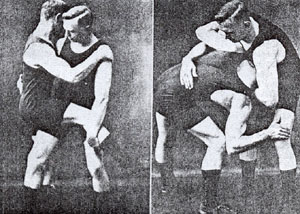 This week I surveyed the first half of the 1920s. I was originally planning on cramming the whole decade, at least in its Anglophone manifestations, into one week and then doing French Surrealism next week for contrast, but I ended up feeling that the 20s are so important for Modernism that I might as well give them an extra week at the expense of something later on (the 40s or 50s, probably). I read two poets per day, which resulted in some interesting unexpected juxtapositions. And because I can't think of any overarching conceptual rubric in which to fit everything I read this week, I will do it in the form of completely subjective value judgments on arbitrarily paired authors. Enjoy!
Tuesday: T.S. Eliot vs. Ezra Pound

 (I tried to pick the pictures where they look most like wrestlers.) This is a fairly obvious match-up, and I should state up front that I am basically an Eliot guy. But I think Pound actually won this round. It may have helped that I read a little less of him (basically just Hugh Selwyn Mauberley; I'll do A Draft of XVI Cantos next week), and that this is the third time I've been made to read The Waste Land in a calendar year. I still love Prufrock and Other Observations above all, but on this reading I've decided that Eliot's 1920 Poems (published as Ara Vos Prec in England) is, for me, one of the most thoroughgoingly unpleasant books of poetry ever written, what with its triple discovery of off-putting obscurantism, brittle quatrains, and off-hand, virulent anti-Semitism. I think this is the Eliot people hate when they hate Eliot (well, one of them). Pound's Mauberley's got the quatrains and the obscurantism (not the anti-Semitism yet; he was saving that up, apparently) but also a more accomplished technical sense and a goofier sense of humor (always Pound's trump card, to my mind), and it benefits greatly from even the limited background I now have in 1890s aestheticism (as Mauberley is essentially somebody like Ernest Dowson, if he had lived). It also marks the last (and, arguably, first) time Pound had a theme that wasn't objectionable and/or completely insane.
Winner: Pound … but this is far from over.
Wednesday: Claude McKay vs. Edith Sitwell

 I must say that McKay, while interesting and talented and obviously hugely important, doesn't strike me as all that modern of a poet; he shares a lot more with the English Great War poets, still working through Keats and Shelley rather than wrestling with even the late nineteenth century, let alone the roaring twentieth. (A comparison with Langston Hughes, who I'm reading next week, is instructive.) One thing about this interests me: I note McKay's deep debt to British Romanticism, and his surprising silence (in his poetry, at least) on British colonial racism, as versus his outspoken condemnations of the American variety. Whenever Jamaica appears in his poetry it's always a pastoral paradise, set against the awfulness of New York City, and moreover it seems populated by nothing but black people. Anybody who knows more about McKay have any comment on this?
Anyway, McKay's stylistic tameness, which might have bored me on another day, was a welcome relief from wading through the once-fashionable train-wreck that is Edith Sitwell's Façade. Talk about imperialism: here we have an indiscriminate display of verbal and cultural wealth, swiped mostly from the French Symbolists (particularly Laforgue — lots of clowns — and Mallarmé — lots of jewels and negresses) and contemporaries who were more legitimately "on to something" like Eliot, Stein and Stravinsky. The poems are controlled by nothing but self-amused alliteration and allusion, toss around foreign phrases (often musical terms) ostentatiously and completely nonsensically, and are so indescribably annoying that I think I just have to quote from one of them and have done:
"The wind's bastinado
Whipt on the calico
Skin of the Macaroon
And the black Picaroon
Beneath the galloon
Of the midnight sky.
Came the great Soldan
In his sedan
Floating his fan —
Saw what the sly
Shadow's cocoon
In the baracoon
Held. Out they fly.
'This melon,
Sir Mammon,
Comes out of Babylon:
Buy for a patacoon —
Sir, you must buy!'
Said Il Magnifico
Pulling a fico —
With a stoccado
And a gambado,
Making a wry
Face: 'This corraceous
Round orchidaceous
Laceous porraceous
Fruit is a lie!' "
That's about enough of that.
Winner: McKay.
Thursday: Mina Loy vs. D.H. Lawrence
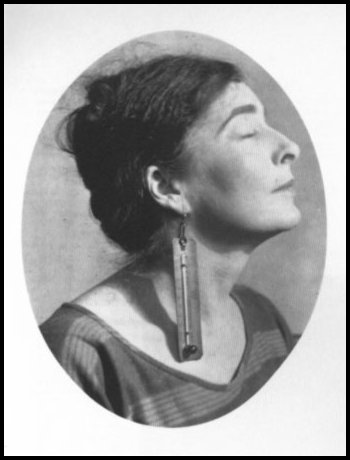
 Probably the most provocative juxtaposition, Loy being most ardent feminist among the Modernists, Lawrence the most chauvinist. This was my first experience with both, and basically I think Loy was right on the verge of being incredible before something went confusingly wrong; Lunar Baedeker, to me, gets steadily less compelling as it goes along. The early satires of Italian Futurism, co-opting the Futurists' (and Apollinaire's) own language in order to impale their pretensions and misogyny, are pretty extraordinary; and the fragmented, profane micro-lyrics of "Songs to Joannes" (which scandalized everybody when they appeared in 1915 in Others) are intriguing as well. She also has a great sense of the colloquial, combined with perhaps the weirdest vocabulary of any Modernist writer (she uses words like "infructuous" and "sialagogues"). But by the end of the 1920s she is doing terrible jazz/dialect poetry ("The Widow's Jazz," "Lady Laura in Bohemia") and "portraits" of the likes of Joyce, Stein and Nancy Cunard, which just makes you want to be reading them instead (well, maybe not Cunard). It's hard not to feel as if Loy lost her direction, which is a shame, because she could've been among the best of the Modernists, probably.
Contrast this with Lawrence's Birds, Beasts & Flowers, which is nothing if not single-minded: basically, in Lawrence's conception all God's creatures are tough, beautiful little bastards, who are more fun to hang out with than people, but end up reminding us anyway of human genitalia. I've got to say that I found this book convincing, and disturbing, in a way I've never felt of any of Lawrence's fiction (of which, admittedly, I've read very little): the way he lovingly renders naturalistic detail is often worthy of John Clare, and the gradual but determined way he pushes his observations into significance is something he legitimately got from Whitman. Granted the poems are completely ridiculous much (most?) of the time, but I don't think it's too perverse to say that's part of their charm.
Winner: As much as I want to like Loy better, I have to give it to D.H.L. Having said that, if I had to read much more of his poetry, I might revoke his title.
Friday: Wallace Stevens vs. William Carlos Williams

 Apples and oranges.
Winner: ???
Monday, July 2, 2007
Mo' Modernism
I am loving Michael North's book 1922. It's like a sane version of Ann Douglas's very insane book on the Terrible Mongerelcy of the Jazz Age. Anyway, North talks a little bit about when Charlie Chaplin met Claude McKay (Documented in Chaplin's biography "My Trip Abroad") Apparently, "The Tropics of New York" was first published in C.K. Ogden's journal, Cambridge Magazine (Which was also one of the early publishes of Wittgenstein). Anyway, apparently Chaplin either starts or renews acquaintance with McKay and talks about how "Tropics" offered him a moment of escape from the pressures of celebrity and civilization.
North's style of scholarship really appeals to me. I guess it's because its the style of scholarship that is in right now, the kind that Jeremy and the critics we read for that class are engaged with--understanding how Modernism became "modernism" and reading against this master narrative...or at least understanding how complicated the networks of Modernism really were.
A taste. North is trying to understand the academic idea of Modernism and how it got there and why it's so valuable. North is making the argument that postmodernism, which relies on a notion of eclecticism, required the constructed foil of a modernism that was as exclusive as possible:
I'm not very far into the book yet, so who knows where it will go, but I'm thoroughly impressed so far. Also, anyone rush out and buy Rabate's 1913 book yet?
North's style of scholarship really appeals to me. I guess it's because its the style of scholarship that is in right now, the kind that Jeremy and the critics we read for that class are engaged with--understanding how Modernism became "modernism" and reading against this master narrative...or at least understanding how complicated the networks of Modernism really were.
A taste. North is trying to understand the academic idea of Modernism and how it got there and why it's so valuable. North is making the argument that postmodernism, which relies on a notion of eclecticism, required the constructed foil of a modernism that was as exclusive as possible:
"Thus, the rivalry between postmodernism and modernism was read back into history, quite openly, as an antipathy between modernism and mass culture, one whose existence has always seemed more a matter of theoretical necessity than of empirical fact. The most widely influential formulation of this view, that of Andreas Huyssen, offers no specific discussion of conditions in the united States or Great Britain, and yet its conclusions are routinely repeated as if they were as applicable to Eliot as to Wagner. Thus, modernism has been transformed in the general estimation from Hugh Kenner's brilliant young technocrat into a doddering old paranoiac possessed by an 'anxiety of contamination by its other: an increasingly consuming and engulfing mass culture,' a life history that seems to match that of Howard Hughes better than that of Eliot of Joyce.
"In short, most of the scholarship that has challenged Kenner's formulation of modernism as the Pound Era has not tried to change his view but rather has begun from it. The result has been the preservation of something called 'modernism' in intellectual amber, something whose purported insulation from the cultural world into which it has introduced is now retrospectively accomplished by critical consensus. Modernism has so thoroughly come to mean that which rejects everything progressive and challenging in the early twentieth century that another term is needed, such as 'avant-garde' or even 'postmodern,' for those writers and artists friendly to change. This simply locks the modern in a tautological box, where it is what it is by definition and not by demonstration."
I'm not very far into the book yet, so who knows where it will go, but I'm thoroughly impressed so far. Also, anyone rush out and buy Rabate's 1913 book yet?
Subscribe to:
Posts (Atom)


