Showing posts with label Stevens. Show all posts

Sunday, October 4, 2009

Steady Job

Some intriguing remarks on literary professionalism from "The Art of Poetry: Marianne Moore," the 1960 Paris Review interview with Donald Hall:

“Interviewer: I was intrigued when you wrote that ‘America has in Wallace Stevens at least one artist whom professionalism will not demolish.’ What sort of literary professionalism did you have in mind? And do you find this a feature of America still?

"Moore: Yes. I think that writers sometimes lose their verve and their pugnacity, and he never would.

“That question I am so often asked: ‘What work can I find that will enable me to spend my whole time writing?’ Charles Ives, the composer, says, ‘You cannot set art off in a corner and hope for it to have vitality, reality and substance. The fabric weaves itself whole. My work in music helped my business and my work in business helped my music.’ I am like Charles Ives. Lawrence Durrell and Henry Miller would not agree with me.

“Interviewer: But how does professionalism make a writer lose his nerve and pugnacity?

“Moore: I suppose money has something to do with it and being regarded as a pundit. Wallace Stevens was really very much annoyed at being catalogued, categorized, and compelled to be scientific about what he was doing — to give satisfaction, to answer the teachers. He wouldn’t do that. He was independent.

“I think the same of William Carlos Williams. I think he wouldn’t make so much of the great American language if he were judicious about everything. And that is the beauty of it — he is willing to be reckless, and if you can’t be that, what’s the point of the whole thing?”

— Reprinted in Marianne Moore: A Collection of Critical Essays, ed. Charles Tomlinson, 44-45

Tuesday, March 25, 2008

"He gets compared to Ashbery and Wallace Stevens sometimes when critics reach for literary reference points, and fair enough, but one could make an equally strong case for Malkmus as the Thomas Hardy of rock…" (me)


You know who really is like Ashbery, though, is Dan Bejar. Neither of them are afraid of the gaudiness of the purely ornamental style, though neither of them give into it completely (key difference from Stevens (Wallace and/or Sufjan)): they always make sure to keep a line open to the demotic. And neither of them go in for rhyme and meter (with occasional, significant exceptions) but both have a very sure and characteristic sense of rhythm, albeit one which dances blithely between music, speech and prose. They're natural (I know, I know). They don't pretend to be craftsmen, but don't pretend to be spontaneous either: what they do is exemplify the mind of the highly aesthetically cultured individual, stuffed with bits of finery it's not sure it needs.

The more I think about this the more it seems like an apt comparison, especially w/r/t the new Destroyer album. Trouble in Dreams could be an Ashbery title; doing an eight-minute track called "Shooting Rockets (From the Desk of Night's Ape)" shares his sense of outrageousness.

Friday, October 5, 2007

This is a facile exercise

To exult with its great throat

Not to be too "all work and no play..." about this, but why can't I memorize things? All I want is to hold onto one little phrase from "Notes Toward a Supreme Fiction."

To exult with its great throat

...even if it's a possibility of populist rhetoric that Stevens offers, only to snatch it back in a cuttingly brusque manner. "This is a facile exercise." The jeremiad, in Stevens, is a false basis of consensus. And yet

To exult with its great throat

Whatever. "These are not things transformed./ Yet we are shaken by them as if they were./ We reason about them with a later reason." Sometimes you just need to type the words.

Monday, September 10, 2007

The indifference formal

In part due to Greg's high recommendation, I reinstated Gwendolyn Brooks' Annie Allen on my list and read it today. And … wow, I'm super-glad I did. Not only is it a truly incredible book of poetry, it clarifies many things (for me) about the trajectory of certain Modernist influences in the 40s/50s. For one thing, the whole book, and especially its long centerpiece "The Anniad" which bears a clear resemblance to "The Comedian is the Letter C," seems like a giant receptacle for the influence of Wallace Stevens, a place where that influence could metastasize and develop in the fuzzy period between his early 20s vogue and his dramatic "rediscovery" by Harold Bloom and company in the late 60s and early 70s. I don't know for sure whether Brooks read Stevens, and I may be overstating the connection a bit: Brooks reminds me of all kinds of modern poets at various times in Annie Allen, including Cummings, Eliot, Hughes, Williams, Pound, etc. But Stevens is, for me, the most consistent and noticeable influence.

And yet she's not just a Stevens clone: she's Stevens with a subject (quite a few of them, in fact: childhood, sex, war, motherhood, and of course race); Stevens with opinions about other people, and experiences of pain and injustice from which to draw; even Stevens with an interest in switching her technique up, and often (in fact, the only other 20th century poet I can think of with comparable stylistic versatility is Auden); in short, Stevens with an emotional ambition and range — just a fearlessness — to match the obvious technical facility. And she's also (hoping I don't sound too reactionary here) the first poet to figure out how to use the Modernist idiom as a truly effective narrative/communicative tool: that is, she writes highly wrought, subtle, varied and ambiguous verse with an awareness of the previous 50 years of poetic history which is nonetheless not the least bit obscure, or only when she really wants it to be. (Robert Lowell, on the other hand, the most praised young American poet of the 40s, tends to lack the verbal rigor of the Modernists while keeping their obscurity — an unprofitable development.)

I read Brooks' book fast and delightedly, with the aid of some caffeine stimulants (as the tone of this post may make clear) but I know I will be returning to it in the future for a more careful analysis. I also don't know too much about its critical reception (I understand it won the Pulitzer), although this page looks like an intriguing place to start. And I may still be hung up on this Stevens Era question, and thus embroiling Brooks in a thought-process-in-progress when she really deserves her own. But right now, in the heat of the blog, I'd go so far as to say that critics like Bloom, who cream all over the Emersonian philosophical posturing in Stevens' late poetry while ignoring the enormous technical and thematic potential his early work opens up, a potential fully realized only in a poet like Brooks, are just missing the point of Stevens entirely. They are, ironically, falling for his authorial persona (albeit a highly impersonal persona) rather than responding to what Stevens, surely, would have considered his key contribution: to expand the possibilities of modern poetry.

In fact, reading the heartbreaking untitled final poem in Annie Allen, which describes the understated racism of Brooks' reception in the academic world of the 1940s, it's hard not to think of Bloom and his like, carefully expatiating on the way of the world, the weight of poetic history, and the sanctity of "the line":

Men of careful turns, hater of forks in the road,
The strain at the eye, that puzzlement, that awe —
Grant me that I am human, that I hurt,
That I can cry.

Not that I now ask alms, in shame gone hollow,
Nor cringe outside the loud and sumptuous gate.
Admit me to our mutual estate.

Open my rooms, let in the light and air.
Reserve my service at the human feast.
And let the joy continue.

…

Next, the indifference formal, deep and slow.

Comes in your graceful glider and benign,
To smile upon me bigly; now desires
Me easy, easy; claims the days are softer
Than they were; murmurs reflectively, "Remember
When cruelty, metal, public, uncomplex,
Trampled you obviously and every hour…"
(Now cruelty flaunts diplomas, is elite,
Deliberate, has polish, knows how to be discreet):
Requests my patience, wills me to be calm,
Brings me a chair, but the one with broken straw,
Whispers, 'My friend, no thing is without flaw.
If prejudice is native — and it is — you
Will find it ineradicable — not to
Be juggled, not to be altered at all,
But left unvexed at its place in the properness
Of things, even to be given (with grudging) honor. What
We are to hope is that intelligence
Can sugar up our prejudice with politeness.
Politeness will take care of what needs caring.
For the line is there.
And has a meaning. So our fathers said —
And they were wise — we think — At any rate,
They were older than ourselves. And the report is
What's old is wise. At any rate, the line is
Long and electric. Lean beyond and nod.
Be sprightly. Wave. Extend your hand and teeth.
But never forget it stretches there beneath." (Blacks, 139-140)

Saturday, September 8, 2007

Can I Just say

That I love William Carlos Williams? I realized today that I hadn't ACTUALLY read any poems by him (though I thought I had...WRONG. Just Wheelbarrow. Can you believe that?!?!?). Anyway, because of time and whatnot, i'm only reading the small lil book edited by Pinsky. And I'm only up to some of the poems roughly around 1918, but i'm sold. Sign me up. Get me a t-shirt. Got the collected poems coming in the mail for some magical time when I have time to read more (along with Hughes, who I also feel deserves so much more time than I gave him). Honestly, I thought Wallace Stevens was a bit of a drag, so I was prepared for WCW to be draggish as well (guilty by national association). Well, that was wrong. Reading his poems makes me want to throw myself on a lawn and roll around in some daisies. And then get in a car and drive past people and make wonderful observations.

Also, read "The Man Who Lived Underground"--a short story by Richard Wright that in many ways functions as a kind of Ur-Text for Invisible Man. It's Great!!! Greg, you might be interested. It's only 60 pages or so and its trippy and out of this world and good, if you're still on the short fiction tip. It's in a book called "Eight Men".

And, finally, to wrap up this whirlwind, just finished The Color Purple. Which I always forget that i like a lot. I remember being really biased when I read it the first time as an undergraduate in a women's southern fiction class. (Where we also read Gone With the Wind and a bunch of O'Connor and Katherine Anne Porter (who by the way, needs to make her way back into the cannon). Anyway, I was prepared to write it off as sentimental, too full of feeling and womany stuff. WRONG. Perhaps its a woman in English dept. thing, but as an undergrad, i felt tremendous pressure that if I wanted to be a serious academic I had to be in the Harold Bloom camp of closed-mindedness. Alice Walker helped snap me out of that. Could Color Purple be...gasp...better than Beloved? It just might. In that way that Vonnegut just might be better than Faulkner sometimes. Who knows.

anyways, the color purple is grabbing every time. The way it is intentionally re-writing so many parts of canonical fiction. I also read Slaughterhouse Five recently and am finding all kinds of strange connections. Both Walker and Vonnegut in these books have interesting ideas on how shame and ethics work together. It's all tied up with personal responsibility, what it means to be a 'good person' in a fucked up world, how there can be room for aesthetics even if we are in an anti-aesthetic moment/era. And both need a touch (or more) of humor to make this all work out right.

Jumbled post, I know. Jumbled brain.

Friday, September 7, 2007

Era-Prone

Let me take this opportunity to recommend to both of you Marjorie Perloff's "Pound/Stevens: Whose Era?," the first piece in her 1985 collection The Dance of the Intellect: Studies in the Poetry of the Pound Tradition (the subtitle of which sort of gives away her answer to the essay's question, but never mind). Among other things, it's a very helpful recapitulation of where things stood Modernism-wise in the academic critical establishment of the early 80s. Basically, the findings can be summarized as follows: Pound stands for anti-Symbolism, form as content, acknowledgment of other minds, making it new, and "constatation of fact"; Stevens stands for the Romantic tradition, matter over manner (!), withdrawal from reality, "desperately triumphant humanism," and having a paraphrasable meaning. You cannot like both, or at least can't consider them both truly Modern.

Funny, this critical obsession with "eras," and with dominant figures to embody those eras; I guess this is what those New Modernist Studies people with their emphasis on "modernisms" rather than "modernism" are trying to sweep away, and good for them (us?). What seems particularly "80s" about this question to me is the assumption that canonical considerations like quality, cultural exemplarity and historical importance can be neatly subsumed under the heading of metaphysical correctness: the poet with the best theory of poetry is therefore the greatest of the era, and ergo is the only one we should read. One only needs to step back from this idea a little way to see that it's just as unsatisfactory as the idea that it's only the writers with the best political views (the closest to "ours") that we should read, which I guess was very "70s." And speaking of politics: Perloff, interestingly, ends her essay by proposing and then quickly dismissing Eliot as an alternative poster-boy to Pound and Stevens: "no one today, whether we look to critics like Bloom or Kenner or Vendler or poets like John Ashbery or James Merrill or Adrienne Rich or Allen Ginsberg, seems eager to call the first half of the twentieth century the Eliot Era." Perloff goes on to speculate that this is "because Eliot's poetry does not fully pose the problem that came to obsess Modernism: whether poetry should be lyric or collage, meditation or encyclopedia, the still moment or the jagged fragment" (23). But would it be too contrarian or anti-formalist to claim instead that this reluctance to enshrine Eliot is because his poetic and philosophical world view, objectionable and conservative as it is, actually makes sense and was well-developed and thus difficult to either answer or caricature, making him a less attractive representative for combatants in a vicious culture war than the more eccentric and reactionary Pound and Stevens? Just asking.

I want to note one other thing which really stood out, to me, in Perloff's essay: the unlikely temporary alliance between what Perloff calls "Romantic visionary humanism" (Frank Kermode, Helen Vendler) and the first wave of American deconstruction (J. Hillis Miller, Geoffrey Hartman) in the late 70s and early 80s, with Harold Bloom bridging the gap between these camps. A key part of the appeal of deconstruction to US English departments is that it let the recently discredited texts and tenets of Romanticism back into the game, under the cover of a concept to be, you know, problematized. I think in part this is a case of smuggling the poetry in with the philosophy: it's a short hop from Derrida's interest in Rousseau to Hartman's reappraisal of Wordsworth, for instance. Thus a "return of the repressed" could look like radical forward-thinking, and questions of canon formation could be shoved aside to make room for new methodological approaches to previously established texts. This is philosophically one of the meagerest, but structurally one of the most important, elements of the legacy of deconstruction in America.

On a related note, has there been any major, sustained criticism of Modernism from a deconstructionist perspective? (This is not totally a rhetorical question; there really might be some stuff I'm not thinking of.) I guess Derrida himself comes closest, having written on Kafka, Joyce, Ponge and Mallarmé, and Jonathan Culler has that book on Flaubert. Largely, though, it's remarkable how many of the big names connected with deconstruction past and present are Romanticists, or nineteenth-centuryists anyway (Miller, Hartman, de Man, Ronell, our buddy Eduardo). And given that deconstruction — it might be better just to say "Derrida" — emerged at roughly the historical point at which Modernism was shaped as a coherent canon of texts and concepts, it's particularly surprising that there hasn't been more overlap. (Marxism, on the other hand, which predates Modernism as an intellectual tradition, has had quite a lot to say about it over the years: Lukács, Benjamin, Adorno, Williams, Jameson, etc.) I guess part of the problem is that so much of the Modernists' philosophy was, as Kenner kindly puts it, "homemade": it's hard to deconstruct "no ideas but in things" because it's, um, not an idea. And so much of the scholarly work involved with Modernism, and especially with figures like Pound and Williams, has been to bring their ideas up to a certain minimal level of intelligibility, or constructedness, without which deconstruction could not begin to take place.

Hmm, this is getting pretty rambly. Maybe I'd better cut it off here. Hi, guys! Looking forward to seeing you soon!

(Final observation: we could never have "the Ashbery Era," because it's too hard to say.)

Friday, August 24, 2007

What, I Say What, Is The Big Idea


The philosophy in Stevens' poems is cartoon philosophy. If philosophy can sometimes seem invulnerable to facts, his poetry is invulnerable to theory. If he decides to hit one of his concepts on the head with an anvil, it gets right back up again, unhurt.

Wednesday, August 22, 2007

Die, Modernism, Die

Yep, it was literary critics killed Modernism, not poets (though many of them poet-critics: not exactly sure what to make of that). And it was accomplished not through any sort of polemical attack, but through a simultaneous collective lowering of expectations, and a willingness to rest on laurels. We know everything we need to know, the argument ran, to write great poetry now: and if you don't know, you haven't been paying attention. In that case, God help you.

Exhibit A: R.P. Blackmur's "Lord Tennyson's Scissors: 1912-1950," an overview of the Modernist period published in 1951 as the epilogue to his collection Language as Gesture. "Forty years of poetry took their rise in Eliot, Yeats, and Pound," Blackmur says, condensing a half century's worth of complex aesthetic and political wrangling into three Big Names to set alongside Shakespeare-Marlowe-Jonson, Wordsworth-Coleridge-Southey and Shelley-Keats-Blake. I'm just going to quote some (OK, a lot of) stuff from this essay, because some of it is helpful, a lot of it is funny (and unfair), and all of it gives a good index of how even the most pro-Modernist critics wanted to wrap things up and move on to the next thing by the beginning of the 50s:

On Yeats: "neither his vices nor his poetry ever quitted him" (424)

On 1922: "1922 seems the great year of our time — especially if you let the months run a little both ways — for it holds a good many of Yeats' Tower poems, Pound's first eight Cantos, and Eliot's The Waste Land, not to mention Ulysses, the finishing of The Magic Mountain, and the beginning of The Counterfeiters. The year 1922 is almost inexhaustible in all the arts" (426)

On Pound and prosody: "The general prosody of the 'teens and 'twenties had equally little to do with the practice of Yeats, Pound, and Eliot … and with the practice of the old conservatives. The general prosody was perhaps the weakest and least conscious in English since the dead poetry of the mid-sixteenth century. It ran, under various guises and doctrines, toward a combination of absolute doggerel and absolute expressionism. Ezra Pound was as responsible as anyone for this condition, not by the progress of his own work but by the procession of manifestoes which he promulgated by letter and print. His doctrine, however it may have promoted the incentive of writing, only got in the way of full work and when it got stronger, deeply damaged, though it never destroyed, his expressive powers" (427)

On "the ideographic method" and expressionism: "The procedure is very tempting, always, to get rid of what is behind one and what is ahead of one, neither by capitulation nor by mastery, but by declaring an arbitrary substitute. Then expression becomes immediate, which is good, and spontaneous, which is not; for spontaneity is the curse of poetry to at least the same degree that neologism is the curse of language. But the temptation is very deep; Art, as Maritain says, Art bitten by poetry longs to be freed from reason, but so long as nothing is substituted for reason the longing is not fatal and may indeed promote a fresh and rejoicing sense of disorder, as The Waste Land did, or a new underground for reason, as the work of Valéry and Mallarmé did" (428)

On Basic English: "What, should we get rid of our ignorance, of the very substance of our lives, merely in order to understand one another?" (428)

On the "heroization of the sensibility": "What [the modern poets] did was to make just enough of a prosody to heroize the sensibility and not quite enough to make a heroic statement. Just enough meter to make a patter, just enough rhyme to make a noise, just enough reason to make an argument; never enough of anything to bind together what came out of the reservoir of their extraordinary sensibility into possible poetry … This bad poetry is not worth reference in itself; it is here only to represent the condition of the language and the state of ambition in which an unusually large amount of good — or partly good — poetry got written" (428-429)

On flatness/prosiness: "Verse should be written, said Pound, not to the metronome but in the sequence of the musical phrase. The prose tradition alone produces flatness, inhibits song, and excludes behavior; and I see no sense in welcoming these disorders, as Eliot has done in parts of the Quartets and as Schwartz has done in all but his earliest work, as other and desirable forms of order. I do not refer to careless writing but to deliberate flatness; which is only the contemporary form of Georgian deliquescence" (429)
[this opinion will become particularly interesting in the context of Ashbery, I think]

On solipsism and "the real world": "…it seems to have been an age when the sensibility took over much of the task of poetry. That is why we have created so many private worlds each claiming ascendancy over the real world about which nothing, or nearly nothing got said. That is why, too, Yeats and Eliot (though not Pound, except rarely) were almost alone able to express a version — an actual form — of the real world. In each the sensibility had other grounds than itself; the ground of beseeching, history, faith or momentum and the other ground, no less important to poetry, of prosody." (430)


Then there's a long section where RPB runs down all the various "schools" of Modernism (what Graves and Riding call "dead movements"), those not entirely assimilable to the traditions created by Yeats, Eliot or Pound. This is the fun part:

1. "the parallel Old-Timers' school, what we might call the school of Chaucer and the Ballad; think of Hardy, Housman, Robinson, and Frost … Reading them, we see why Pound does not occupy a first position, but a position on one side. The superlative metric of Pound may be a clue to their weakness but it would never furnish an understanding of their imperfect strength. Their work stands ready to infect the work of young men who have not yet found a form for their ambition and who can no longer, since they apprehend what has happened to it, heroize their sensibility. At least I should suppose there might be a coming race of poets who would want to reverse Maritain's phrase and say Art, bitten by reason, longs to be freed from poetry: from the spontaneous and the private and the calculated public worlds. There might be a race of poets, that is, who would woo the excited miracles of absolute statement, not as a refuge, but to get their work done" (432)
[to me, this seems to presage a lot of the most accepted poetry today, in both America and Britain; what Ron Silliman calls the School of Quietude. More on this some other day, maybe.]

2. "the Apocalyptic or Violent school … Here is where we find the remains of Vachel Lindsay, the evangel of enthusiastic rebirth; Robinson Jeffers, the classical Freudian; Roy Campbell the animal, authoritarian evangel of anti-culture; Carl Sandburg, the bard of demagogic anti-culture; and of course others … All these stem poetically and emotionally from Whitman-Vates: and all are marked by ignorance, good will, solipsism, and evangelism … nor should we think of them even so briefly as more than false alarms if it were not for the two extraordinary talents that must be grouped with them … D.H. Lawrence and Hart Crane … Each is a blow in the face but neither can hit you twice" (433)

3. "another school of anti-intelligence … They got rid of too much of their reason, and as a result they effervesced rather than expressed, and what is left is flat. Nameless they shall be here; they belonged only to their principal journal transition. What was wrong with them is clear when you see how weak is their imitation of Apollinaire, Aragon, Cocteau, Soupault [!], and how great their misunderstanding of Mallarmé, Rilke, Joyce, Kafka, and Pirandello: all men who longing to be freed from reason had a kind of bottom supply of it. Neither the English nor the Americans have ever been very good at this sort of thing. Let us say that we have not so much of reason that we can afford to lose any of it; we need it to make our nonsense real as well as genuine; and one would say that in this respect prosody was a form of reason" (433-434)
[obviously, this will have renewed significance in the 60s with New York School et al.]

4. "the school of Donne into which the largest number of individual writers of good verse fall when shaken up and let settle … they are difficult in style, violent in their constructed emotions, private with actual secrecy in meaning. There is in their work a wrestling struggle toward statement, a struggle through paradox and irony … and the detritus of convictions. The statements are therefore impossible to make, but the effort to make them is exciting because genuine …" [here he includes John Crowe Ransom, Allen Tate, John Wheelwright, William Empson and Hugh MacDiarmid]
"The general poetry at the center of our time takes the compact and studiable conceit of Donne with the direct eccentricity, vision, and private symbolism of Blake; takes from Hopkins the incalculable and unreliable freedom … of sprung rhythm, and the concentration camp of the single word; and from Emily Dickinson takes spontaneous snatched idiom and wooed accidental inductableness. It is a Court poetry, learned at its fingertips and full of a decorous willfulness called ambiguity. It is, in a mass society, a court poetry without a court" (434-435)

5. William Carlos Williams: "To him beauty is absolute and falls like the rain, like the dream of rain in a dry year. He is, if you like, the imagism of 1912 self-transcended. He is contact without tact; he is objectivism without objective … The neo-classicist and the neo-barbarian are alike in this: their vitality is without choice or purpose" (435)

6. Stevens/Moore/Cummings
"
Each, so to speak, is full of syllables where [Yeats, Eliot and Pound] are full of words. Each is a kind of dandy, or connoisseur, a true mountebank of behavior made song … let us say they make an equilateral triangle of three styles hung like a pendant from the three major styles" (436)

a. Wallace Stevens
is a dandy and a Platonist … You need an old dictionary and an old ear to get his beauty: as if he had to find an unfamiliar name before the beauty of his perception could emerge; and it is along these lines that you have to think of the French symbolists' influence upon him. They taught Eliot the anti-poetic and the conversational style; Stevens they taught the archaic and the rhetorical; that is, Eliot and Stevens saw the one prosody running in opposite directions. But Stevens is in essence of a very old tradition, French and Platonic, working on a modern substance … He should have lived in the age of Pope; with his sensibility and his syllables he could have made rational statements with more beauty than that age was capable of. But as he is, he is 'the tranquil jewel in this confusion'" (436)

b. Marianne Moore
"has written the most complex syllabic verse of our time: as if she brought French numbers to English rhythms with no principle of equivalence. But she is not the syllabist as dandy but as connoisseur; she is the syllabist of the actual, the metrist of the immediate marvel… There is a correspondence here to the coerced heightened perception (the forced close observation) in the painting of still-life. Poetry is to her, as she says, an imaginary garden with real toads in it. She knows all about the toads because she has imagined the garden; as you look suddenly everywhere there is the disengaged leap of a green or a brown toad, all warts, all soft, all leaping, all real. If there is not much other reality there, and there seldom is in a connoisseur's garden, you bring her, or ignore, the life she hasn't got just because what she has got is do real: you bring or ignore as with a shut-in whom you love" (436-437)
[this is, incidentally, both one of the most eloquent and the most spectacularly condescending statements about MM ever made]

c. E.E. Cummings "is the child turned poet, the child with that terrifying and incomplete dimension. Otherwise put, Cummings is the traditionalist who insists on the literal content of his tradition without re-understanding its sources: this is, of course, the easiest form of eccentricity and the most human form of fanaticism … He has too little a developed self ever to escape from it except waywardly, when you want either to console him or beat him … He was educated by Edmund Spenser, the English sonneteers, Keats, Swinburne, the funny-papers, and John Bunyan; but perhaps he was most educated by the things that were left out that would have gone to make a structured mind. All he knows is by enthusiasm, habit, and aversion. He refuses the job of the full intelligence, preferring intimacy with what he loves and contempt for what he hates; and he accepts what love and hatred give as if they made all the music of a full mind … if he were not part of a going concern larger than he, he would be nothing. Here again is a case where prosody is an instrument of reason. Like the wilder currencies in the age of Veluta (or like the serried marks of Hitler [!!!]) Cummings' experimental typography depends on the constant presence of the standard it departs from and would be worthless if not measured against it" (437-438)
[seems like some of these ideas — or prejudices, if you like — could be usefully applied to Kenneth Koch]


Blackmur finishes up by assessing "the further development and release, still inchoate to these observations, of the doomed school of Auden about 1930" with its "deliberate approach to doggerel through Skelton, the Ballads, the immediate situation, and the multi-valenced distrust of self combined to produce the new flat style" (438-439): again, this suspicion of "flatness," and an interesting offhand use of the rhetoric of "doomedness" so often applied to the poets of 1890s (which, as RPB must be thinking of, produced Yeats). He also looks toward "the generation born between 1913 and 1918: Shapiro, Barker, Schwartz, Thomas, Berryman, Manifold, Lowell, Betjeman, Meredith, and Reed" (I must admit I have no idea who half these people are). Solemnly passing the torch to these promising whippersnappers, Blackmur delivers the New Critic's version of "you kids today don't know how good you've got it": "they have the enormous advantage over their predecessors that there is an idiom ready for them to develop according to their own needs" (439). So this is what it has come to, Modernism is "an idiom," and no longer anything like a movement, or even a set of loosely concatenatable authors and texts. "We might have a great age out of them yet," he reckons, but if they do succeed it will be because they keep ploughing the same furrow as the Big Three (or at least their equilateral pendant): "[t]hey have more than a chance — it is half done for them — to develop out of personality the most objective of all creations, the least arbitrary and spontaneous, a style."

Countdown to "arbitrary and spontaneous" begins now.

Sunday, August 19, 2007

Come to think of it…


Pwned!


Watchers of this space will remember that, about a month ago, I declined to say who "won" in the contest between William Carlos Williams and Wallace Stevens — a pair who are always linked in my mind, somehow, maybe as the two "outsider Modernists" whose reputations actually improved after mid-century rather than declining. (Pound sort of belongs in this category, but only sort of.) And of course they were mutual admirers, as well, perhaps realizing that each were doing something for which the other had absolutely no talent. In a 1927 letter to Marianne Moore responding to a request to review WCW for The Dial, Stevens wrote that "[w]hat Columbus discovered is nothing to what Williams is looking for."

Well, without reservations, I'll say that in the 30s Williams beats Stevens hands down. This is largely because the field of American culture in that decade more closely resembled Williams' pre-formed vision of it than it did Stevens', I think. At the risk of generalizing wildly (you know you love it), I'll say that it's sort of a situation where Williams' long-imagined "America," the one the pure products of which go crazy, suddenly has direct reference to something — where the field his poetry has been gesturing toward suddenly fills up with content. (One could say, too, that a similar thing happened with Communism in the 30s: theories of Marx's that had seemed purely intellectual — to Americans, anyway — now seemed to directly address and describe current conditions, in a way that made them all but irresistible.)

In any case, WCW is on fire in the 1930s: the poems in An Early Martyr, Adam and Eve in the City and The Complete Collected Poems are, ironically, invigorated by the symptoms of material devastation that Williams records in them, from the old woman "munching a plum on / the street" (casting back to his own "This is Just to Say," the private domestic moment replaced by a public scene of degradation) to the pitch-perfect dramatic monologue concerning "The Raper from Passenack" to his at-once-Marianne-Moore-ish-and-militant (tough combination!) "The Yachts" to the "rumpled sheet / of brown paper / about the length // and apparent bulk / of a man" that is just symbolic enough to be moving in "The Term" (take that, American Beauty!). Best of all, maybe, is "The Crimson Cyclamen," an eight-page description of a blooming flower that also manages to be a meditation on Williams' own career, the process of poetic thought, the development of American culture in the Depression era, and an elegy for its dedicatee Charles Demuth, all without sacrificing the teensiest bit of grace or specificity. "It's the anarchy of poverty / delights me," Williams admits in "The Poor," but what impresses me most is his intuitive understanding of the structure underlying the anarchy, the distinctly American values and self-understanding that are not lacking in the poor (as Stevens seems to often imagine) but which display themselves more obviously in them, in both their positive and negative aspects, because they are unprotected, naked, left out in the sun. This compassionate humanism — not humanitarianism — is what impresses about Williams, as well as the sophisticated simplicity he invents and masters in order to express it. This attitude is to be preferred to Pound's bullying or Eliot's despair or Stevens' appalled detachment, but it's also better than the earnest but ultimately unconvincing work of other socially commited poets like Muriel Rukeyser (cp. 1938's The Book of the Dead): for her the poor are heroes, martyrs, victims. For Williams they're Americans, and so is he.

Stevens, on the other hand, runs into a twofold problem in the 30s. First, the constant flow of material and cultural amusements which supplied his 1920s poetry ebbs somewhat; thus the astounding catalogue of improbable nouns that filled Harmonium regularizes itself into a stock repertory of suns, moons, birds, books, masks, rabbits and guitars. (It's possible too that this represents a deliberate paring-down of his materials, in order to develop them into a somewhat coherent symbolic system in the manner of Yeats or Blake.) In that sense, then, the area that his poetry seems to be pointing to becomes less crowded, not more, as with Williams. More disastrously, though, the reigning assumption of Stevens' earlier poetry — that of the poet as a detached aesthete negotiating his relationship with the larger, essentially sympathetic culture carefully and almost disinterestedly — starts to fall apart around him. The evidence is rather that Stevens began to feel more and more alien in American culture, and interpreted events such as the Great Depression and the rise of Fascism in Europe as evidence that his early vision was unshared and unshareable. If he had remained happy to play around in his own imagination this would be fine, and if he had meaningfully synthesized his skepticism into his personal artificial vision (as did Eliot) it would be even better; but unfortunately (in my opinion) he makes the disconnect between his sensibility and the state of American political and poetic culture the theme of his poems in Ideas of Order and The Man with the Blue Guitar, rendering them, as a mass, colossally redundant. How many statements of the idea, "The kind of art I make and like seems useless today; I may be a bad person for making and liking this kind of art; but maybe if I just keep making the kind of art I make and like it will seem useful some day again" do we need from one poet? (This is a major component of at least 14 of Stevens' published poems from this period: "A Fading of the Sun," "Evening Without Angels," "The Reader," many sections of "Like Decorations in a Nigger Cemetery," "The American Sublime," "Mozart, 1935," "Sad Strains of a Gay Waltz," "Dance of the Macabre Mice," "Anglais Mort à Florence," "Mr. Burnshaw and the Statue," "Farewell to Florida," "The Men That Are Falling," "A Thought Revolved," and "The Man with the Blue Guitar" — in other words, a little less than half of them.) As a moral, poetic or philosophical stance, this is defensible; but as subject matter for poetry it's tame and dull and, after the dozenth revolution of Stevens' elaborate self-pity mechanism, starts to seem rather hypocritical as well. Over and over, Stevens fashions a gorgeous mental image, compares it to what he sees around him, despairs at the non-homology, and ends by drawing conclusions about the beautiful and/or impossible relationship of non-relationship between the Mind/the Self and the World. I'm not attacking the philosophical validity of such a view (though I could, I could) I'm just saying it's a boring basis for poetry. And Stevens, with some unerring self-sabotaging instinct, makes it more and more important to his work, as if forcing himself not to find a subject. (Well, we'll see if he turns it all around in the 40s.)

Other random notes I couldn't work in above: Stevens' style gets more epigrammatic in the 30s, more "French" in a classical sense, writing poems that often verge on being nothing more than strings of elegant pensées (and some which more than verge); also easier, a little more willing to telegraph the significance of his private ruminations. It's not a good look for a poet whose virtue is in being "fascinating."

God, I love value judgments.

Friday, July 20, 2007

1920s Cage Matches!

This week I surveyed the first half of the 1920s. I was originally planning on cramming the whole decade, at least in its Anglophone manifestations, into one week and then doing French Surrealism next week for contrast, but I ended up feeling that the 20s are so important for Modernism that I might as well give them an extra week at the expense of something later on (the 40s or 50s, probably). I read two poets per day, which resulted in some interesting unexpected juxtapositions. And because I can't think of any overarching conceptual rubric in which to fit everything I read this week, I will do it in the form of completely subjective value judgments on arbitrarily paired authors. Enjoy!

Tuesday: T.S. Eliot vs. Ezra Pound
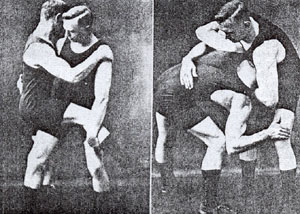
(I tried to pick the pictures where they look most like wrestlers.) This is a fairly obvious match-up, and I should state up front that I am basically an Eliot guy. But I think Pound actually won this round. It may have helped that I read a little less of him (basically just Hugh Selwyn Mauberley; I'll do A Draft of XVI Cantos next week), and that this is the third time I've been made to read The Waste Land in a calendar year. I still love Prufrock and Other Observations above all, but on this reading I've decided that Eliot's 1920 Poems (published as Ara Vos Prec in England) is, for me, one of the most thoroughgoingly unpleasant books of poetry ever written, what with its triple discovery of off-putting obscurantism, brittle quatrains, and off-hand, virulent anti-Semitism. I think this is the Eliot people hate when they hate Eliot (well, one of them). Pound's Mauberley's got the quatrains and the obscurantism (not the anti-Semitism yet; he was saving that up, apparently) but also a more accomplished technical sense and a goofier sense of humor (always Pound's trump card, to my mind), and it benefits greatly from even the limited background I now have in 1890s aestheticism (as Mauberley is essentially somebody like Ernest Dowson, if he had lived). It also marks the last (and, arguably, first) time Pound had a theme that wasn't objectionable and/or completely insane.

Winner: Pound … but this is far from over.

Wednesday: Claude McKay vs. Edith Sitwell
I must say that McKay, while interesting and talented and obviously hugely important, doesn't strike me as all that modern of a poet; he shares a lot more with the English Great War poets, still working through Keats and Shelley rather than wrestling with even the late nineteenth century, let alone the roaring twentieth. (A comparison with Langston Hughes, who I'm reading next week, is instructive.) One thing about this interests me: I note McKay's deep debt to British Romanticism, and his surprising silence (in his poetry, at least) on British colonial racism, as versus his outspoken condemnations of the American variety. Whenever Jamaica appears in his poetry it's always a pastoral paradise, set against the awfulness of New York City, and moreover it seems populated by nothing but black people. Anybody who knows more about McKay have any comment on this?

Anyway, McKay's stylistic tameness, which might have bored me on another day, was a welcome relief from wading through the once-fashionable train-wreck that is Edith Sitwell's Façade. Talk about imperialism: here we have an indiscriminate display of verbal and cultural wealth, swiped mostly from the French Symbolists (particularly Laforgue — lots of clowns — and Mallarmé — lots of jewels and negresses) and contemporaries who were more legitimately "on to something" like Eliot, Stein and Stravinsky. The poems are controlled by nothing but self-amused alliteration and allusion, toss around foreign phrases (often musical terms) ostentatiously and completely nonsensically, and are so indescribably annoying that I think I just have to quote from one of them and have done:

"The wind's bastinado
Whipt on the calico
Skin of the Macaroon
And the black Picaroon
Beneath the galloon
Of the midnight sky.
Came the great Soldan
In his sedan
Floating his fan —
Saw what the sly
Shadow's cocoon
In the baracoon
Held. Out they fly.
'This melon,
Sir Mammon,
Comes out of Babylon:
Buy for a patacoon —
Sir, you must buy!'
Said Il Magnifico
Pulling a fico —
With a stoccado
And a gambado,
Making a wry
Face: 'This corraceous
Round orchidaceous
Laceous porraceous
Fruit is a lie!' "

That's about enough of that.

Winner:
McKay.

Thursday: Mina Loy vs. D.H. Lawrence
Probably the most provocative juxtaposition, Loy being most ardent feminist among the Modernists, Lawrence the most chauvinist. This was my first experience with both, and basically I think Loy was right on the verge of being incredible before something went confusingly wrong; Lunar Baedeker, to me, gets steadily less compelling as it goes along. The early satires of Italian Futurism, co-opting the Futurists' (and Apollinaire's) own language in order to impale their pretensions and misogyny, are pretty extraordinary; and the fragmented, profane micro-lyrics of "Songs to Joannes" (which scandalized everybody when they appeared in 1915 in Others) are intriguing as well. She also has a great sense of the colloquial, combined with perhaps the weirdest vocabulary of any Modernist writer (she uses words like "infructuous" and "sialagogues"). But by the end of the 1920s she is doing terrible jazz/dialect poetry ("The Widow's Jazz," "Lady Laura in Bohemia") and "portraits" of the likes of Joyce, Stein and Nancy Cunard, which just makes you want to be reading them instead (well, maybe not Cunard). It's hard not to feel as if Loy lost her direction, which is a shame, because she could've been among the best of the Modernists, probably.

Contrast this with Lawrence's Birds, Beasts & Flowers, which is nothing if not single-minded: basically, in Lawrence's conception all God's creatures are tough, beautiful little bastards, who are more fun to hang out with than people, but end up reminding us anyway of human genitalia. I've got to say that I found this book convincing, and disturbing, in a way I've never felt of any of Lawrence's fiction (of which, admittedly, I've read very little): the way he lovingly renders naturalistic detail is often worthy of John Clare, and the gradual but determined way he pushes his observations into significance is something he legitimately got from Whitman. Granted the poems are completely ridiculous much (most?) of the time, but I don't think it's too perverse to say that's part of their charm.

Winner: As much as I want to like Loy better, I have to give it to D.H.L. Having said that, if I had to read much more of his poetry, I might revoke his title.

Friday: Wallace Stevens vs. William Carlos Williams
Apples and oranges.

Winner:
???