Showing posts with label Spender. Show all posts
Showing posts with label Spender. Show all posts
Thursday, July 3, 2008
Runner-Up
Stephen Spender on T.S. Eliot: "His conversation could be dry and factual, and if early on one got on to some unpropitious subject — the weather or the sales of poetry — he might pursue it remorselessly, like a tram going through a slum." (T.S. Eliot: The Man and His Work, 50)

Saturday, August 18, 2007
"I would tot up my factors"
Goddamn is post-partition Ireland ever a depressing place! In the most pessimistic view, the nation's cultural and global life after the Civil War is a flatline punctuated by occasional distant crises which only serve to consolidate a feeling of introspective disengagement and torpor. When people talk about the Irish modernists of the 30s, with the exception of Beckett, it's almost always prefaced by a kind of awe at wild-flowers growing in stony soil, asking that their parochial context be a bit of an excuse for their critical neglect. A lot of authors writing in the grim 30s-50s find weird homes in the 60s: Austin Clarke starts using his inwoven English approximations of Gaelic sound patterning to describe his gnarled consciousness when he had been stuck in mental hospitals, which makes for an Irish Mode confessionalism (akin especially to Snodgrass's Heart's Needle) in 1966's Mnemosyne Lay in Dust. Denis Devlin, long championed by Beckett (and a translator of Breton, Mallarme, Apollinaire and others into Gaelic!), is taken up by the Fugitives/New Critics and Allen Tate and R.P. Warren edit and introduce his 1963 Selected Poems. Couple these career turns with MacNeice's new haunted-carnival-ride lyric direction in 1963's The Burning Perch and Patrick Kavanagh's early 60s attempts to toggle the lyric with the epic, and you have a really solid post-Yeats/Joyce foundation for the barrage of amazing poets who form the "Ulster Renaissance" (Montague, Heaney, Mahon, Longley, Muldoon, etc.). Intensified civil rights efforts and political strife give this next generation's verse new urgency, but with tools honed by more than just "Easter 1916".

But I'm getting ahead of myself: 1966 was also the 50th anniversary of the Easter Rising, which - along with the resulting War of Independence, Partition and Civil War (fought, essentially, to exhaustion) - shaped Irish poetry of the 20s and 30s in a way particularly divergent from English High Modernism as it can be said to have risen from the trenches. We've looked at the enabling disillusionment of WWI as it ramifies in all that experimental good stuff. For Ireland, both WWI and the 1916 Easter Rising, particularly to a certain middle and upper-class audience, could be seen as poetic reifications that were affronts to common sense: one of a magnitude to quash Edwardian national pieties and the other, conversely, a revolutionary proof of romantic conceptions of the nation - born in books and shown, all too quickly, to be a bourgeois revolution at its heart.

MacNeice writes as a part of a committed lefty poetic community in England, who comes from a country that had its revolution and is now sticky with its afterbirth. Unlike English retrenchment in the 30s in the face of a crumbling empire (the "Shrinking Island" described by Jed Esty), Ireland's localism was paradoxically what made it "big" enough to be divided against itself: both fringe and cause of the empire's dissolution. As MacNeice writes in The Poetry of W.B. Yeats (1941), Ireland's "characteristic smallnesses [by which he means population, income and even meals], while uniting the country against England which is regarded as essentially big, divide it against itself." Thus, for MacNeice it's both easy and not easy being green: easy because "the Irishman can trade on the glamour of minorities" but tough cause the modern world makes the "traditional Irish aim" of spiritual self-support (think the last chapter of Portrait) as impracticable in the small country as is material self-support.
As Esty writes, "the end of British hegemony was a fait accompli to the Auden-Greene generation...they inherited the cultural detritus and political guilt of empire without the corresponding advantages of metropolitan perception" (8). MacNeice partakes of this guilt, and it's weird that he does because he also (to borrow something he says of the later Yeats) can and does "parade his sensuality like a released prisoner conscious of his freedom" [for "sensuality" here read literally: some accumulation of sense data, all those newspaper details]. Esty describes the Auden generation's characteristic desire to eulogize English culture as one result of growing up at the start of shift toward England being home to a "minor literature"; and it might be worthwhile to compare this generational trend to MacNeice's relentless need to eulogize puritanical Ireland in the days of its history-fraught infancy (or, furthermore, interesting to put his eulogistic 'farewell...in perpetuum' alongside the Irish gothic tradition - still being well represented at this point by Elizabeth Bowen, among others - which could imply a need for constant eulogizing in traumatized response to the nation figured as constantly dying, being reborn, dying, etc.).
So, with these historical conditions perhaps too determinately in mind, check out all the images of fire freezing in MacNeice's early books. In fact, check out all of "Snow" from Jan. 1935:
The room was suddenly rich and the great bay-window was
Spawning snow and pink roses against it
Soundlessly collateral and incompatible:
World is suddener than we fancy it.
World is crazier and more of it than we think,
Incorrigibly plural. I peel and portion
A tangerine and spit the pips and feel
The drunkenness of things being various.
And the fire flames with a bubbling sound for world
Is more spiteful and gay than one supposes -
On the tongue on the eyes on the ears in the palms of one's hands -
There is more than glass between the snow and the huge roses.
A poem about portioning and about partition, with a little or a big "p", describing how borders create the things they separate. It is a view of snow falling past a window, as at the end of "The Dead," that conversely describes profusion, confusion, incompatibility rather than generality over Ireland. At the center is the lyric I as the familiar Joycean God, sitting back and paring his fingernails - here peeling a tangerine (i.e. specifically not an orange, to point the more obliquely at the Protestant majority in the North). His "spit" seems to grow without clear provocation to "spite" when reflected in the fire's mirror. MacNeice's omission of articles and pieces of sentences convey the sense that by imposing form the speaker is finding ways to deal with surplus and where to "leave" it, though this vague, spreading "more"-ness cannot be named and is "incorrigible" or incapable of reform/re-form.

As in the "Last Will and Testament" to which Evan pointed us yesterday, MacNeice's "Train to Dublin" (Sep-Oct 1934) ends with a list of gifts, including "I give you the disproportion between labour spent/ And joy at random". The last stanza is basically "Snow" in reverse ("suddenly rich" to "more than glass between" vs. "give you more" to "they are rich"):
I would like to give you more but I cannot hold
This stuff within my hands and the train goes on;
I know that there are further syntheses to which,
As you have perhaps, people at last attain
And find that they are rich and breathing gold.
The knowledge in the poem's closing "I know" is that of "half-thought thoughts divid[ing]" (line 1), or further portioning and division. Notice that the inability to maintain the surplus - "I cannot hold/ this stuff" - recalls Yeats's vision in "The Second Coming," where "the centre cannot hold". Yeats's vatic assurance that a new golden age is "at hand" comes down to stuff, falling apart, and an "I" put boldly but hazardously at the centre.
David Lloyd has argued persuasively that "A major literature is established as such precisely by virtue of its claims to representative status, or its claims to realize the autonomy of the individual subject to such a degree that this individual subject becomes universally valid and archetypal." MacNeice's best poems puzzle along on the fault line between the ability to assume that universality, especially as it would be an ordering principle, and the sense that systems of archetypes must be, if not rejected, at least revealed as systems. Yeats gave one particularly polarized model of Anglo-Irish claims to universality, as is stated in 1940 by a skeptical T.S. Eliot in a talk he delivered as the first annual Yeats lecture at the Abbey Theater (with Patrick Kavanagh in attendance), where T.S.E. notes "that in becoming more Irish, not in subject-matter but in expression, [Yeats] became at the same time universal." By the time of Autumn Journal, Yeats's "rough beast slouching" may as well be the diaspora, "Who slouch around the world with a gesture and a brogue/ And a faggot of useless memories" (section XVI, my italics). Much of MacNeice's book on Yeats is written with a flat objectivity that registers Yeats's fabrications about and of Ireland as strategic, rather than malicious or misinformed; and it is thus the next generation's task to try to be less strategic in the use of national history - more quotidian, less vatic reportage.
He writes, "Poets like Auden and Spender abandoned this feminine conception of poetry and returned to the old, arrogant principle - which was Yeats's too - that it is the poet's job to make sense of the world, to simplify it, to put shape on it" (223). Could it be said that in this sense MacNeice is both of and to the side of the Auden generation? To put a shape on the world is to begin portioning up the world, and will result, he knows, in an uncountable pile of spit pips.

But I'm getting ahead of myself: 1966 was also the 50th anniversary of the Easter Rising, which - along with the resulting War of Independence, Partition and Civil War (fought, essentially, to exhaustion) - shaped Irish poetry of the 20s and 30s in a way particularly divergent from English High Modernism as it can be said to have risen from the trenches. We've looked at the enabling disillusionment of WWI as it ramifies in all that experimental good stuff. For Ireland, both WWI and the 1916 Easter Rising, particularly to a certain middle and upper-class audience, could be seen as poetic reifications that were affronts to common sense: one of a magnitude to quash Edwardian national pieties and the other, conversely, a revolutionary proof of romantic conceptions of the nation - born in books and shown, all too quickly, to be a bourgeois revolution at its heart.
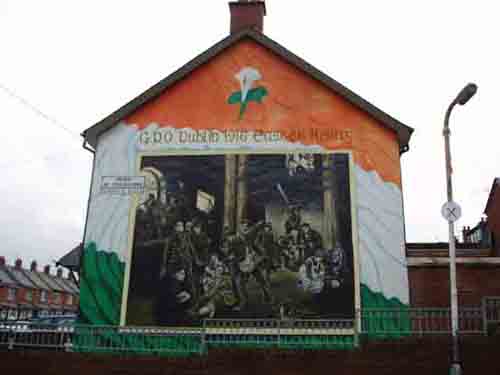
MacNeice writes as a part of a committed lefty poetic community in England, who comes from a country that had its revolution and is now sticky with its afterbirth. Unlike English retrenchment in the 30s in the face of a crumbling empire (the "Shrinking Island" described by Jed Esty), Ireland's localism was paradoxically what made it "big" enough to be divided against itself: both fringe and cause of the empire's dissolution. As MacNeice writes in The Poetry of W.B. Yeats (1941), Ireland's "characteristic smallnesses [by which he means population, income and even meals], while uniting the country against England which is regarded as essentially big, divide it against itself." Thus, for MacNeice it's both easy and not easy being green: easy because "the Irishman can trade on the glamour of minorities" but tough cause the modern world makes the "traditional Irish aim" of spiritual self-support (think the last chapter of Portrait) as impracticable in the small country as is material self-support.
As Esty writes, "the end of British hegemony was a fait accompli to the Auden-Greene generation...they inherited the cultural detritus and political guilt of empire without the corresponding advantages of metropolitan perception" (8). MacNeice partakes of this guilt, and it's weird that he does because he also (to borrow something he says of the later Yeats) can and does "parade his sensuality like a released prisoner conscious of his freedom" [for "sensuality" here read literally: some accumulation of sense data, all those newspaper details]. Esty describes the Auden generation's characteristic desire to eulogize English culture as one result of growing up at the start of shift toward England being home to a "minor literature"; and it might be worthwhile to compare this generational trend to MacNeice's relentless need to eulogize puritanical Ireland in the days of its history-fraught infancy (or, furthermore, interesting to put his eulogistic 'farewell...in perpetuum' alongside the Irish gothic tradition - still being well represented at this point by Elizabeth Bowen, among others - which could imply a need for constant eulogizing in traumatized response to the nation figured as constantly dying, being reborn, dying, etc.).
So, with these historical conditions perhaps too determinately in mind, check out all the images of fire freezing in MacNeice's early books. In fact, check out all of "Snow" from Jan. 1935:
The room was suddenly rich and the great bay-window was
Spawning snow and pink roses against it
Soundlessly collateral and incompatible:
World is suddener than we fancy it.
World is crazier and more of it than we think,
Incorrigibly plural. I peel and portion
A tangerine and spit the pips and feel
The drunkenness of things being various.
And the fire flames with a bubbling sound for world
Is more spiteful and gay than one supposes -
On the tongue on the eyes on the ears in the palms of one's hands -
There is more than glass between the snow and the huge roses.
A poem about portioning and about partition, with a little or a big "p", describing how borders create the things they separate. It is a view of snow falling past a window, as at the end of "The Dead," that conversely describes profusion, confusion, incompatibility rather than generality over Ireland. At the center is the lyric I as the familiar Joycean God, sitting back and paring his fingernails - here peeling a tangerine (i.e. specifically not an orange, to point the more obliquely at the Protestant majority in the North). His "spit" seems to grow without clear provocation to "spite" when reflected in the fire's mirror. MacNeice's omission of articles and pieces of sentences convey the sense that by imposing form the speaker is finding ways to deal with surplus and where to "leave" it, though this vague, spreading "more"-ness cannot be named and is "incorrigible" or incapable of reform/re-form.

As in the "Last Will and Testament" to which Evan pointed us yesterday, MacNeice's "Train to Dublin" (Sep-Oct 1934) ends with a list of gifts, including "I give you the disproportion between labour spent/ And joy at random". The last stanza is basically "Snow" in reverse ("suddenly rich" to "more than glass between" vs. "give you more" to "they are rich"):
I would like to give you more but I cannot hold
This stuff within my hands and the train goes on;
I know that there are further syntheses to which,
As you have perhaps, people at last attain
And find that they are rich and breathing gold.
The knowledge in the poem's closing "I know" is that of "half-thought thoughts divid[ing]" (line 1), or further portioning and division. Notice that the inability to maintain the surplus - "I cannot hold/ this stuff" - recalls Yeats's vision in "The Second Coming," where "the centre cannot hold". Yeats's vatic assurance that a new golden age is "at hand" comes down to stuff, falling apart, and an "I" put boldly but hazardously at the centre.
David Lloyd has argued persuasively that "A major literature is established as such precisely by virtue of its claims to representative status, or its claims to realize the autonomy of the individual subject to such a degree that this individual subject becomes universally valid and archetypal." MacNeice's best poems puzzle along on the fault line between the ability to assume that universality, especially as it would be an ordering principle, and the sense that systems of archetypes must be, if not rejected, at least revealed as systems. Yeats gave one particularly polarized model of Anglo-Irish claims to universality, as is stated in 1940 by a skeptical T.S. Eliot in a talk he delivered as the first annual Yeats lecture at the Abbey Theater (with Patrick Kavanagh in attendance), where T.S.E. notes "that in becoming more Irish, not in subject-matter but in expression, [Yeats] became at the same time universal." By the time of Autumn Journal, Yeats's "rough beast slouching" may as well be the diaspora, "Who slouch around the world with a gesture and a brogue/ And a faggot of useless memories" (section XVI, my italics). Much of MacNeice's book on Yeats is written with a flat objectivity that registers Yeats's fabrications about and of Ireland as strategic, rather than malicious or misinformed; and it is thus the next generation's task to try to be less strategic in the use of national history - more quotidian, less vatic reportage.
He writes, "Poets like Auden and Spender abandoned this feminine conception of poetry and returned to the old, arrogant principle - which was Yeats's too - that it is the poet's job to make sense of the world, to simplify it, to put shape on it" (223). Could it be said that in this sense MacNeice is both of and to the side of the Auden generation? To put a shape on the world is to begin portioning up the world, and will result, he knows, in an uncountable pile of spit pips.
Friday, August 17, 2007
Highlights from the Last Will and Testament of W.H. Auden and Louis MacNeice
 As put down in 1937's Letters from Iceland. It's an amazing poem, a crazy mixture of undergraduate in-jokeyness, sincere political concern, and a sort of passionate desperation to bid farewell to the "low dishonest decade" of the 30s three years early. You get the feeling that Auden and MacNeice really believed they were going to die soon, or that the world would end. These were some of the choicer bits that I copied out in the New York Public Library; I really need to get a copy of this for myself:
"First to our ancestors…
We leave the values of their periods,
The things which seemed to them the things that mattered"
"all the lives by France gently stopped
We leave to Rome"
"Item, to Wittgenstein who writes such hits
As the Tractatus Logico-Philosophicus
We leave all readers who can spare the wits"
"…the Surrealists shall have
J.A. Smith as an Objet Trouvé in disguise."
"To our fellow writers, to the whole literary race
The Interest itself in all its circumstances
That each may see his vision face to face."
"To our two distinguished colleagues in confidence,
To Stephen Spender and Cecil Day-Lewis, we assign
Our minor talents to assist in the defence
Of the European Tradition and to carry on
The Human Heritage."
[W.H.A.] "For my friend Benjamin Britten, composer, I beg
That fortune send him a passionate affair."
"…to Alfred Hitchcock, with sincerest praise of Sabotage"
[L.M.] "a copy of Marx and £1000 a year
And the picture of Love Locked Out by Holman Hunt"
[both] "To Dylan Thomas a leek on a gold plate"
"A terrible double entendre in metre or in prose
To William Empson"
"We leave with our best compliments the Isle of Wight
To Robert Graves and Laura Riding, because
An Italian island is no good place to write."
"The twin towers of the Crystal Palace we would leave
To Leonard and Virginia Woolf"
"our pudenda we leave or rather fling
Our biographers and The Thames Conservancy Board"
"Our humour, all we think is funny,
To Dr. Leavis and almost every psychoanalyst"
[W.H.A.] "hope that Erika, my wife, may have her wish
To see the just end of Hitler and his unjust rule"
[both] "We leave their marvelous native tongue
To Englishmen, and for our intelligent island pray
That to her virtuous beauties by all poets sung
She add at last an honest foreign policy."
Sunday, August 12, 2007
$$$ ₤₤₤ ₣₣₣ ℳℳℳ
 H0w much of the particular character of Modernism can be accounted for by major transformations in the world economy in the first 30 years of the century: e.g., the Panic of 1907 and subsequent bail-out by J.P. Morgan (see Williams' poem on this subject in Spring and All); the slow collapse of Germany's national economy under the mountain of national debts incurred after the First World War; and, climactically, the stock market crash of 1929? Think of some of the individual modernist authors who experienced drastic changes in their financial positions during this period, for these and a variety of other reasons: Proust; Eliot; Yeats; Woolf; Stephen Spender; George Oppen; Nabokov. (You'll have to help me out with the Americans, Adrienne. Didn't Faulkner's family lose a bunch of money? Or was that during Reconstruction?) For these writers, all of whom were raised in an atmosphere of affluence that was later significantly reduced or threatened, how could the expression of despair and cynicism one normally associates with the Modernist moment not also be, in some way, a panic fear about a change in their personal situations? (Others, of course, improved their situations in this period, notably Pound and Joyce — mostly because they were both relatively poor to start with. And how significant is it that, despite living until almost the end of WWII, Joyce never wrote any fiction set later than 1904, when all of these catastrophes were still on the horizon?)
Thus those who become writers during the time of Modernism often give the impression not of entering a new, higher rentier class (which would be the typical role of the author in the eighteenth and nineteenth centuries) but of giving expression to a certain loss of value, a certain fall from grace. (In contrast, the postmodernists — the Americans, anyway — are largely back in the upwardly mobile position, though at this point they are competing for smaller slices of the cultural capital pie, and those usually attached to positions at major American universities. In this context, Nabokov, who grew up as the child of liberal aristocrats, becomes an impoverished European émigré, moves to the U.S. and gets on the academic-job treadmill, and finally finds himself accidentally a Great American Author and rich and famous culture hero, cuts a particularly interesting figure.)
With these circumstances in mind, I can see why Anglo-American Modernism displays such a cautiously exploratory attitude toward the radical positions of Continental Modernism (Surrealism in particular), which by 1920 had largely accepted that important literature was now the province of either the radical Bohemian fringes or the future Marxist state.
So I think we need (if it doesn't exist already) a financial history of these and other relevant figures: an audit of Modernism, as it were. Who got poorer, who got richer, who was in danger and who was not, and how do these various positions affect their writing?
Yes, this has got me thinking.
Subscribe to:
Posts (Atom)


