Showing posts with label William Carlos Williams. Show all posts

Sunday, October 4, 2009

Steady Job

Some intriguing remarks on literary professionalism from "The Art of Poetry: Marianne Moore," the 1960 Paris Review interview with Donald Hall:

“Interviewer: I was intrigued when you wrote that ‘America has in Wallace Stevens at least one artist whom professionalism will not demolish.’ What sort of literary professionalism did you have in mind? And do you find this a feature of America still?

"Moore: Yes. I think that writers sometimes lose their verve and their pugnacity, and he never would.

“That question I am so often asked: ‘What work can I find that will enable me to spend my whole time writing?’ Charles Ives, the composer, says, ‘You cannot set art off in a corner and hope for it to have vitality, reality and substance. The fabric weaves itself whole. My work in music helped my business and my work in business helped my music.’ I am like Charles Ives. Lawrence Durrell and Henry Miller would not agree with me.

“Interviewer: But how does professionalism make a writer lose his nerve and pugnacity?

“Moore: I suppose money has something to do with it and being regarded as a pundit. Wallace Stevens was really very much annoyed at being catalogued, categorized, and compelled to be scientific about what he was doing — to give satisfaction, to answer the teachers. He wouldn’t do that. He was independent.

“I think the same of William Carlos Williams. I think he wouldn’t make so much of the great American language if he were judicious about everything. And that is the beauty of it — he is willing to be reckless, and if you can’t be that, what’s the point of the whole thing?”

— Reprinted in Marianne Moore: A Collection of Critical Essays, ed. Charles Tomlinson, 44-45

Wednesday, October 29, 2008

Linh Dinh

If you're looking for a simultaneously perverse, hilarious, depressing, experimental and formally elegant contemporary poet — and I don't know why you would be, because I don't know why you'd think you'd ever find one — let me recommend Linh Dinh to you. I just finished his 2007 collection Jam Alerts, which I've had for a while but just got around to reading. He has a bit of that Language poetry/flarf compulsion to hit you with the grodiest possible diction ("barf," "fizzin'," "jizz," "hump") without abandoning the high ground of academic mastery (sonnets, quatrains, iambic pentameter, fancy enjambments). But he has a much sharper controlling critical intelligence: his poems are pointed and disturbing in a way that nothing I've read by Bernstein et al. have been. Actually the poet he reminds me of most (not so much formally, but in spirit) is mid-period William Carlos Williams, the observational Williams of An Early Martyr, "the anarchy of poverty / delights me" and so forth. They have a similar transgressive sweetness, an unsentimental attraction to human grossness, coupled with a strong radical streak. In Linh's case, the anarchy that delights him is Internet porn, Iraq war statistics, text message syntax, sex tourism come-ons, broken English, plain narcissistic loneliness. It's often not clear whether his use of this stuff is satirical or lyrical: sometimes he's mocking or despairing about American culture or politics or language, but much of the time he's just swimming around in it. Plus his verse really moves; he can really pull off the traditional meters and stanza forms, without being too showy about it.

I'll hold off on more substantial criticism, because this has nothing to do with anything I'm supposed to be doing, but here are two fairly representative poems:


Instant Replays — Bolus or Eternal Returns?

162 bullshit happenings a year. First thing each morning,
I must check out the bullshit reckonings, even before I had
A chance to shoot, shower and shave. I can't start my day
Without knowing what happened last night, what went down.
I'm a team player, don't you understand? It's not about me.
If my bullshit logo won, then I'm vindicated — I'm half alive,
Sort of, for a minute or two, tops. If it lost, I'm nothing.


Nature Freaks

Sometimes I forget that this world came
From fresh herring, that these people came
From solid herring stock. Lovely Bianca Black

Will soon be wedded to one Chien Meow, I see
Very clearly now how herring has brought us all
Together, under the lych gate, waiting, as always

For the damn priest to tuck away his sin, before
He lowers us, one by one, into the bog, minus
Our blameless nuts and titties.

Friday, September 12, 2008

Left, justified.


R.I.P. Martin K. Tytell

"This is the alphabet q w e r t y u i o p a s d f g h j k l z x c v b n m. The one extraordinary thing is that no one has yet taken the trouble to write it out fully." -- WCW, "The Simplicity of Disorder" (Selected Essays, p. 97)

Wednesday, April 16, 2008

Director's Cut

So I'm preparing my conference paper for the 26th, which is largely composed of quotations from letters by famous poets writing about little magazines, followed by tiny little commentaries from me. However, there a few choice quotes I'm not able to fit into the paper proper. Once again, legitimate academia's loss is the blogosphere's gain! Behold:

Randall Jarrell on the Partisan Review coterie:

“Although its politics are doctrinaire and academic in that funny New York professional-left way, they haven’t prevented it from printing other groups, Stalinists excepted. It’s an awfully shrewd, professional, competent magazine, so far as the editing is concerned. The worst things about it are its extraordinary limitations and lack of imagination: everything is looked at from the point of view of someone who’s semi-Marxist, fairly avant-garde, reasonably Bohemian, anti-bourgeois, cosmopolitan, anti-Stalinist, lives in New York, likes Mondrian, etc., etc., etc. It assumes that New York is the Paris of America, that the United States is Europe all over again, a backward Europe: in fact, it’s barely an American magazine, and always sinks with a sigh of joy into the friendly harbor of Sartre, Camus, [unreadable], the great European writers. (This Sartre-Camus isn’t my joke: I heard two of the editors said to me saying that American writers would be as good as Camus and Sartre if they had a movement like existentialism to organize and inspire them.)”


William Carlos Williams on Poetry:

“I have come to distrust the magazine Poetry. We are not fostering kindergartens and there’s no use paying good money for the sake of sentimentalizing over some new writer prodigy unless he produces. And if he does produce and is a prodigy there us [sic: is] no room for him in a mag like that because of ‘previous commitments’ with the young. It’s a rotten policy and produces unreadable drivel. The general criticism offered is litte [sic: little] better. Once in a while something does happen, of course, but that isn’t the point. The critical standards involved are woefully sophomoric. I don’t see any sense in paying good money for that. Perhaps such a first step should be retained because of its undoubtedly important history, perhaps there is no other way to serve the newcomer - keep the door open and all that. A hell of a lot of cheap stuff wanders in though. Certainly it’s unattractive to me.”


Edmund Wilson on The Kenyon Review:

“The Kenyon Review is indescribably awful.”

And on The Sewanee Review:

“Allen Tate, before he left the Sewanee, never succeeded in lifting the shadow of the influence of J.C. Ransom or being able to refuse filling its space with the writings of his cousins and aunts.”


Similarly, Kenneth Burke on Kenyon:

“I can’t discuss the matter at any length. For, honest to God, I just don’t know. Ransom gets all the farm boys to wiping the mud off their shoes in the name of ‘nice’ thinking – and the choice seems to be between that and muddy thinking.”


And, finally, Williams on better days:

“The vistas are limitless. But had damn well better be limited if any good is to be done.
“I think I’d vote for Whitman, in his time."

Tuesday, April 8, 2008

WTF WCW? (Part Deux)

“For this very reason I detest Eliot (personally) and fear his verse. He is as contagious in his measures as jazz, in fact to me, he is a kind of jazz. I think he realizes that himself and so has gone over into the Parsifal music of his present phase. He doesn’t know how to write any more since he is so badly based in his conception of what verse is. He simply doesn’t know and Aiken is not much different. They are thinking of something very dead and likely to be smelly very soon — one of the first things that is done at an autopsy is to measure and weigh the corpse."

— letter to R.P. Blackmur, November 11, 1940

Tuesday, March 18, 2008

WTF WCW?

"You know, I just came across a medical article, which I know will interest you. It seems that men are not of course all male, as women are not all women. Well, the proof that men are not all male goes something like this: remove the ovaries of a female mouse. Let the gal recover. Then take a pint of male piss. Extract it with alcohol or acetone or ether or what not — I've forgotten. Do this again. Then again. Finally evaporate the stuff down until it is a thin jelly. Of this jelly take a tenth of a cubic centimeter and inject it into the muscle of said mouse. The mouse starts to menstruate!

"Now this is due to the fact that men excrete female hormones in their urine. Ain't that something. So always take a piss before or after you jerk off or you might end some day by finding yourself pregnant — with a castrated mouse perhaps.

"Anyhow this is all true."

(letter to Kenneth Burke, July 29, 1931, quoted in East, The Humane Particulars: The Collected Letters of William Carlos Williams and Kenneth Burke, 53)

Monday, October 1, 2007

bring down the maps again

Seriously last thing I need to be doing as I enter my last week of generals, but I've added Muriel Rukeyser's "Book of the Dead" (1938) to my list. A few notes that wont add up to anything major: A long pastiche poem that she wrote starting in 1936, when at the age of 22 she went to West Virginia to investigate and document the scads of miners dying of silicosis, a lung disease brought on by inhalation of silicon-dioxide. It's the true formal middle step between Reznikoff's Testimony, which carves its sources in order to crystalize historical violences in the present, and Paterson, which seeks to give the inhabitants of the town full control over their fates (WCW's argument against "accident" in Book I, even as spatial coincidence is the work's formal point of origin).

Here we are moved along the road,

"Past your tall central city's influence,
outside its body: traffic, penumbral crowds,
are centers removed and strong, fighting for good reason.

These roads will take you into your own country."

A clear relocation of both proletarian struggle and modernist representation outside the city. But "outside its body" begins to get troubled by the subject of poisoning, as the body politic succumbs to the same blockages (failed pleas on the floor of the House are included and dismissed) as the men's lungs. The purity of the raw materials becomes a threat to the poem's construction -- seeking to include testimonies unpurged -- as it is a threat to the miners, who were told to expand production once the bosses learned how the richest deposits could be "used...without refining". Documentation, as in the Oppen of Discrete Series, cannot stand apart from directly stated advocacy. Thus, the camera eye view of the city is blurred by movement, seems unable to survey properly (X-rays become the dominant and necessary form of photography in the poem, acting as truer "maps" throughout), and becomes another glass frame or prohibition, like the ones that house the manager who is "keeping his books behind the public glass".

"What do you want - a cliff over a city?
A foreland, sloped to sea and overgrown with roses?
These people live here."

ends the section "Gauley Bridge." Can't write a natural poem about the scene. Can't just show the city -- the bridge goes over the river, which is dammed, which is "a scene of power", which allows the mining, the highways, the road you took to get here.

Monday, September 24, 2007

"Dare not decline" - costs of going local


"Poet appointed dare not decline
to walk among the bogus"

So begins the second section of Basil Bunting's Briggflatts, and it sets an injunction the poet cannot keep precisely because "who appointed him?" is the next question. "Decline" - which by the poem's 1966 publication is a deeply troubled term for national devolution in post-War, post-imperial English national topology - can mean two things here: "don't refuse to walk among the bogus" or "don't descend down among the bogus". Either a self-harming injunction to wallow or a self-deceiving presumption of authenticity in a world dirtily without.

This strikes me as paradigmatic of the poet's choices who would attempt epic, even the modernist/Poundian "poem including history", when he (or she) is confronted with a national history that has both shrunk to rocky Saxon particularity and exploded to a global dialogue of plural histories. The rich and gorgeous language of the first section of Briggflatts uncovers a deep and local continuity that could be the epic poet's material (and has Pound's version of and use in the Cantos of "The Seafarer" as a predecessor): "By such rocks/ men killed Bloodaxe." It can be carved in stone and, as in section V's echo of Four Quartets, "Then is diffused in Now" (echo of the Quartets, but diminished -- not about presence and chronological fusion so much as "diffusion", dispersal, weakening).


The poem, called an "autobiography," includes in the second section a reference to Bunting's time as a spy for the British, who "decodes/ thunder, scans/ porridge bubbling, pipes clanking". Eliot, secretive but no spy, could once simply hear what the thunder said. Left the porridge alone. Bunting, in this role among the bogus, must detail the impoverished surround, laying "sick, self-maimed, self-hating,/ obstinate, mating/ beauty with squalor to beget lines still-born." The local, which is the ground of the poem and its primary linguistic audience, forms a substrate of filth rather than a solid ground in which to grow a regional epic. The poem begins to clog with fecal matter, which composts any number of rotting decapitated heads (as the poem's opening describes, "Decay thrusts the blade,/ wheat stands in excrement/ trembling"). As Bunting writes in section IV, "Today's posts are piles to drive into the quaggy past/ on which impermanent palaces balance."

The figure of the still-born, or as another possibility of this "mating", the monstrous is the abiding concern of the poem, itself then a half-product of a region (with the potential for epic) and of the deaths that register that region's deep history (with their potential for elegy). The tomb carved in section one is for the deceased child of the young couple who ride with the mason across Rawthey, and the poem gives gory details about the bestiality that brought us the Minotaur.

I'd like to explore the poem's conjoined topoi of monstrosity and hybridity in the formation of subjective declension. But I'll leave that for now and make a note about the "still-born" as a description of both poem and nation. Though the "sun rises on an acknowledged land" the poem ends with a coda that brings this diurnal recognition into the symbolic sweep of a completed elegiac movement, initiated in such an extended fashion as to make it hard to perceive until *blammo* he's playing off the end of "Lycidas". In the Coda,

A strong song tows
us, long earsick.
Blind, we follow
rain slant, spray flick
to fields we do not know.

Lycidas has its own coda -- its last eight lines zoom out to the third person to describe how "thus sang the uncouth swain" all that had come before. The gesture toward "fresh woods, and pastures new" complete the consolatory purpose of the elegy and declare closed the literary apprenticeship of the lyric speaker, who thereby promises and indeed begins to perform the consummation of his voice in writing the great work (the last 8 lines = one ottava rima stanza of italian epic). In Bunting, the coda works in the opposite direction, marshalling community in blind servile following of the song, and ends with a reworking of the "pastures new" from promise to disillusionment:

Where we are who knows
of kings who sup
while day fails? Who,
swinging his axe
to fell kings, guesses
where we go?

It's Lycidas rewritten with a proleptic view of the heads that would roll in the coming years, both the need for protestant revolution and an acknowledgment of its costs (esp. in post-industrial -- notice how these poems of local epic or thwarted epic have so much interest in work, in craft).

Oh, i'm getting tired of writing this. Something something. The political economy of the commonweal (see the etymology of "bogus" in the OED, as it emerges as a major point of reactionary possibility in English late-mod. epics in this period (see also Hill's Mercian Hymns, lots of Hughes's poems I think) and as a grounding moment in the portraits of community and region that are all over the place in America at this point (Paterson, Howl, Brooks's sketches of Bronzeville, Hughes's "Portrait of a Dream Deferred").

Sorry to cop out but I got other work to do. May come back and edit this eventually. Could continue in the comments, since i'm sure i haven't made myself very clear.

Howl, New Jersey, Holla

Have either of you looked at a little book called The Poem that Changed America: "Howl" Fifty Years Later? Silly title, I know, but it's actually pretty useful. The collection is edited by Jason Shinder, Ginsberg's personal assistant from the late 70s on, and his introduction is kind of embarrassingly idolatrous and not very well-written. But the volume does bring together a number of interesting reactions to "Howl" (by, among others, Amiri Baraka, Marjorie Perloff (who argues that Ginsberg is a direct inheritor of Modernism [OK, fine, whatever] and that "Howl" is really about WWII [more interesting]), Billy Collins (!), John Cage, and Rick Moody) as well as including a facsimile of the original mimeographed edition, which "costed [sic] $10.00 typed by poet Robert Creely [sic] dittoed by Martha Rexroth transported by me to the hands of Robert Lavigne [sic] in exchange for several drawings," according to Ginsberg's inscription. (Doesn't $10 seem like kind of a lot of money for 1956? Seems like one could do a Lawrence Rainey-esque analysis of the economics of this first presentation.)

A couple of remarks about the poem itself: has anyone written on the possible influence of W.H. Auden on Ginsberg? Auden is mentioned in Shinder's preface as one of Ginsberg's "'enemies'," but also an "eternal presence": I don't know much about their personal relationship. But on this reading I notice quite a few touches which seem Audenesque; for one, the unexpected dropping and adding of definite articles (examples include "the drear light of Zoo" and "the last fantastic book thrown out of the tenement window"). This is something Auden does a lot, and I think the effect in his poems is usually to either particularize or universalize the rhetorical situation of any given poem: kind of a Zoom-In/Zoom-Out effect. In "Howl," Ginsberg utilizes this to keep the reader involved on a macrosociological level ("this is an important poem: it's about a generation, it's about a nation, it's about history") and on a more micro-, affective/emotional level ("this is about the author, his friends, his mother, or me"). It's a technique Whitman uses too, of course, but Ginsberg's interest in including shabby, sordid or ironic details which temporarily undercut the grandeur of the macro-phrases (e.g. "in beards and shorts with big pacifist eyes sexy in their dark skin passing out incomprehensible leaflets"; compare "Spain 1937") is closer to (early) Auden, I think.

Second idea: Ginsberg's insistent return to New Jersey place names ("Paterson," "Newark," "the filthy Passaic," etc.), among, admittedly, a lot of other place names, has to be understood, in its historical context, as a very complicated rhetorical move. Because New Jersey was not just where Ginsberg was from, and thus a signifier of the "real" or the "autobiographical," but also, by the mid-1950s, a landscape that was newly literary, thanks to the ecstatic critical reception of William Carlos Williams' still-in-progress Paterson. As Perloff points out her chapter on him in The Poetics of Indeterminacy, the publication of Paterson had finally secured a major reputation for Williams, long considered a marginal figure of the Modernist movement. Thus Paterson, which ten years earlier would have been fairly meaningless as a literary signifier, now evokes a whole complex of ideas about Modernism and American poetry that Ginsberg slyly insists upon. (And WCW also wrote the introduction to Howl's first commercial edition, as Adrienne pointed out months ago.)

Anyway, it's interesting to think of the symbolic capital that New Jersey acquires in this period, as the breeding ground of the only ideologically correct,* homegrown version of High Modernism (Williams') as well as the most incendiary updating/challenging of the academic version of Modernism: significantly a humble state, in proximity to a great metropolis but not containing it, a place synonymous with the simple, homely and plain, which also just happens to be the site of some of the worst industrial exploitation and ecological spoilage in the entire country. This is quite a different pole to orient us than London or New York, and the attitude of its writers to it is also significantly different: sure, it's a waste land, they tell us, but it's our waste land, and we like it that way. And this in turn might have something to do with the remarks by Leslie Fiedler that Adrienne just posted, about the American mediation (some would say adulteration) of Modernism through regionalism. But I'm getting hungry, so I'd better stop here and drag myself through some Brooklyn streets to go looking for a sandwich fix.

* If you ignore the Communism.

Wednesday, September 12, 2007

The big one-two-five

If either of you Williamsites wants to think about swinging by this, I could be convinced.

Saturday, September 8, 2007

Can I Just say

That I love William Carlos Williams? I realized today that I hadn't ACTUALLY read any poems by him (though I thought I had...WRONG. Just Wheelbarrow. Can you believe that?!?!?). Anyway, because of time and whatnot, i'm only reading the small lil book edited by Pinsky. And I'm only up to some of the poems roughly around 1918, but i'm sold. Sign me up. Get me a t-shirt. Got the collected poems coming in the mail for some magical time when I have time to read more (along with Hughes, who I also feel deserves so much more time than I gave him). Honestly, I thought Wallace Stevens was a bit of a drag, so I was prepared for WCW to be draggish as well (guilty by national association). Well, that was wrong. Reading his poems makes me want to throw myself on a lawn and roll around in some daisies. And then get in a car and drive past people and make wonderful observations.

Also, read "The Man Who Lived Underground"--a short story by Richard Wright that in many ways functions as a kind of Ur-Text for Invisible Man. It's Great!!! Greg, you might be interested. It's only 60 pages or so and its trippy and out of this world and good, if you're still on the short fiction tip. It's in a book called "Eight Men".

And, finally, to wrap up this whirlwind, just finished The Color Purple. Which I always forget that i like a lot. I remember being really biased when I read it the first time as an undergraduate in a women's southern fiction class. (Where we also read Gone With the Wind and a bunch of O'Connor and Katherine Anne Porter (who by the way, needs to make her way back into the cannon). Anyway, I was prepared to write it off as sentimental, too full of feeling and womany stuff. WRONG. Perhaps its a woman in English dept. thing, but as an undergrad, i felt tremendous pressure that if I wanted to be a serious academic I had to be in the Harold Bloom camp of closed-mindedness. Alice Walker helped snap me out of that. Could Color Purple be...gasp...better than Beloved? It just might. In that way that Vonnegut just might be better than Faulkner sometimes. Who knows.

anyways, the color purple is grabbing every time. The way it is intentionally re-writing so many parts of canonical fiction. I also read Slaughterhouse Five recently and am finding all kinds of strange connections. Both Walker and Vonnegut in these books have interesting ideas on how shame and ethics work together. It's all tied up with personal responsibility, what it means to be a 'good person' in a fucked up world, how there can be room for aesthetics even if we are in an anti-aesthetic moment/era. And both need a touch (or more) of humor to make this all work out right.

Jumbled post, I know. Jumbled brain.

Thursday, September 6, 2007

So mulch depends...


Now kids, do you want to hear Kora in Hell or "The Raper from Passenack"?
According to this, William Carlos Williams is perhaps the poorest reader of himself and others of the 20th century. Is this true? Discuss. And yes, I use Answers.com for biographical information. Solid.

Thursday, August 30, 2007

Hugh and Ray

OK, so: two ways out of Modernist criticism: Raymond Williams and Hugh Kenner. Both start publishing in the early 50s, in England and America (via Canada) respectively, and can be seen as a sort of transition between the rapidly aging New Critical establishment and the theory-soaked generation that would emerge from the ruins of Existentialism. They both brought new intellectual leanings to the examination of familiar texts and problems and they both engaged, significantly and influentially, with Modernism — Kenner for the whole of his career, Williams at the very end of it.

Hugh first. Kenner liked the Modernists because they were geniuses, and he liked geniuses because he was one. The Marjorie Perloff quote that Adrienne posted last week noting that Kenner posited "a conjunction of literary innovation with that of the other arts, sciences, and technologies" is totally on the money: and while it's certainly a big part of his achievement and the fantastic connections he's able to make, especially in The Pound Era, it also occasionally borders on becoming a gimmick. He also, problematically, assumes that simply by virtue of living through an era in which such scientific revolutions were transpiring, men as Ludditic as Pound and Joyce must have absorbed their innovations by osmosis.

What makes up for this fast-and-loose historicism is his unquestionable awesomeness at close reading, in which he can run circles around the New Critics he succeeded (and whom he mocks in passing in A Homemade World). His typical critical method was dogged patience before the mysteries of a difficult text, coupled with complete faith that its creator had been, in every respect, on to something. (Incidentally, he has one of the most apt names in literature: over the course of his long and tireless career, more and more technical procedures, factoids and acts of random scholarship swim into his ken.) The results of this attitude are its own justification: Kenner finds and explicates problems in Ulysses and The Cantos that other readers hadn't even realized were there, and probably never would have.

But, here's the problem, as I see it, with Kenner's scientistic Modernism: if the Modernists invented a new kind of poem, then they conveniently forgot to tell us how to build one of our own; or rather, the instructions they left are so colored by the first flush of excitement at the discovery that they're often more or less indecipherable. HK admits at much by quoting at length from Williams's "explanatory" prose writing in Spring and All, which he back-handedly compliments as "homemade philosophy," but justifies thusly: "Yet as on a stage where we see nothing but a good mime leaning on the invisible mantelpiece can persuade us he knows where the fireplace would be, so Williams' gesturings around the Imagination are not random nor self-contradictory but compatible with the existence, located and perceived by him, of a reality he may not succeed in making us see" (66). The writing here is so good that you can forget what an easy time he's giving Williams, just as he does Zukofsky's "Sincerity and Objectification" in a later chapter; and, more broadly, how much he has to supply himself in order to make a coherent Modernist Weltanschauung.

In essence, then, he treated the Modernists not like scientists but like scientific phenomena, ineffably but exactly "behaving" the way molecules behave — and not like like people with ideas which could sometimes be drastically wrong. For all his emphasis on science, Kenner lacks any account of how scientific ideas are transmitted from one mind to another: it's all "Eureka" with him, all homemade breakthrough, with almost no interest in that other important aspect of science in the 20th century, the process by which radical new ideas are tested and contested in a public arena. Thomas Kuhn he ain't.

Williams, on the other hand, is all about the communication of ideas. He's considered important for, among other things, finding a synthesis of Leavisism and Marxism to combat the reactionary political climate of Britain in the 50s, which in practice meant rehabilitating the problematic ideas of "culture" and "tradition" for a progressive democratic agenda. In the late 50s and early 60s Williams became a sort of academic celebrity and spokesman for the British New Left, called by Edward Thompson "our best man" (a designation that recalls Auden's position in the mid-30s — there's something very English about this sort of left-wing hero worship, evidently). His 1958 essay "The Masses" (excerpted from the conclusion of Culture and Society), though specifically arguing against "mass-communication" and the conservative fear of a lowering of cultural standards due to the influence of film and television, can also be read as an insistence on communication over aesthetics, intelligent discourse about standards replacing — or rather, constituting — standards themselves. This is a version of Modernism, if it is Modernism, with a politics quite removed from the meritocratic bias of the Pound tradition championed by Kenner. Williams writes that "much of what we call communication is, necessarily, no more in itself than transmisson: that is to say, a one-way sending. Reception and response, which complete communication, depend on other factors than the techniques" (50). Ideas, or poetic styles, in other words, aren't just right or wrong, good or bad, or even qualitatively "of their time"; there are no self-evident "discoveries" in the realm of culture; they take hold only if they are presented and defended in such a way that the people receiving them realize their benefit. (This is close to sounding like John Dewey, but I can't tell if that's me or Williams.) Contra his Canadian contemporary's faith in "a reality [someone else] may not succeed in making us see," Williams would seem to say that there is no reality (in the realm of culture, anyway, which by any definition is where literature belongs) that is not communicated, and communicated well: not, at any rate, for other people.

Well, I hope I'm communicating some kind of reality, at least to myself (hello there, self) in the future. Bottom line: I see Kenner and Williams as engaged in two markedly different attempts to keep Modernism going, Kenner by ensuring that its texts remain influential (and readable), and Williams by keeping the communication channels it opened within the academy free and clear. Kenner makes his name by digging indefatigably into the texts of Pound, Eliot, Joyce, &c, revealing unsuspected depths in them; while, at approximately the same time, Williams takes up the philosophical concepts associated with Modernism, and particularly with Eliot — the volume's editor John Higgins notes that RW's 1958 manifesto "Culture is Ordinary" was a kind of late response to Eliot's 1948 Notes Towards the Definition of Culture — in an attempt to revise and broaden them so they can be applied to new texts and new fields of study (notably politics, sociology and film).

(And now this is really just a suggestion for further study, but it might be interesting to compare Williams and Kenner in the light of the rise of communication theory; Kenner's early association with Marshall McLuhan would be particularly important in such a narrative. And lookee here: that ever-reliable conduit of communication Wikipedia informs me that McLuhan's "interest in the critical study of popular culture was influenced by the 1933 book Culture and Environment by F.R. Leavis and Denys Thompson." It all goes back to Leavis, it appears. Gotta read Leavis now, I guess.)

Wednesday, August 22, 2007

Forget the melting pot, its a brew

Waldo Frank on American language:
"Our brew of Nigger-strut, of wailing Jew, of cantankerous Celt, of nostalgic Anglo-Saxon, is a brew of Dada"

Edmund Wilson on contemporary literature in 1926:
"polyglot, parvenu, hysterical and often only semi-literate"

The black William Carlos Williams, as quoted from Van Wyck Brooks:
"Dr Williams's father and mother had grown up with the colored people in their West Indian islands, and he himself had, ingrained in his very bones, a love of the negroes, 'furnaces of emotional power'.

Die, Modernism, Die

Yep, it was literary critics killed Modernism, not poets (though many of them poet-critics: not exactly sure what to make of that). And it was accomplished not through any sort of polemical attack, but through a simultaneous collective lowering of expectations, and a willingness to rest on laurels. We know everything we need to know, the argument ran, to write great poetry now: and if you don't know, you haven't been paying attention. In that case, God help you.

Exhibit A: R.P. Blackmur's "Lord Tennyson's Scissors: 1912-1950," an overview of the Modernist period published in 1951 as the epilogue to his collection Language as Gesture. "Forty years of poetry took their rise in Eliot, Yeats, and Pound," Blackmur says, condensing a half century's worth of complex aesthetic and political wrangling into three Big Names to set alongside Shakespeare-Marlowe-Jonson, Wordsworth-Coleridge-Southey and Shelley-Keats-Blake. I'm just going to quote some (OK, a lot of) stuff from this essay, because some of it is helpful, a lot of it is funny (and unfair), and all of it gives a good index of how even the most pro-Modernist critics wanted to wrap things up and move on to the next thing by the beginning of the 50s:

On Yeats: "neither his vices nor his poetry ever quitted him" (424)

On 1922: "1922 seems the great year of our time — especially if you let the months run a little both ways — for it holds a good many of Yeats' Tower poems, Pound's first eight Cantos, and Eliot's The Waste Land, not to mention Ulysses, the finishing of The Magic Mountain, and the beginning of The Counterfeiters. The year 1922 is almost inexhaustible in all the arts" (426)

On Pound and prosody: "The general prosody of the 'teens and 'twenties had equally little to do with the practice of Yeats, Pound, and Eliot … and with the practice of the old conservatives. The general prosody was perhaps the weakest and least conscious in English since the dead poetry of the mid-sixteenth century. It ran, under various guises and doctrines, toward a combination of absolute doggerel and absolute expressionism. Ezra Pound was as responsible as anyone for this condition, not by the progress of his own work but by the procession of manifestoes which he promulgated by letter and print. His doctrine, however it may have promoted the incentive of writing, only got in the way of full work and when it got stronger, deeply damaged, though it never destroyed, his expressive powers" (427)

On "the ideographic method" and expressionism: "The procedure is very tempting, always, to get rid of what is behind one and what is ahead of one, neither by capitulation nor by mastery, but by declaring an arbitrary substitute. Then expression becomes immediate, which is good, and spontaneous, which is not; for spontaneity is the curse of poetry to at least the same degree that neologism is the curse of language. But the temptation is very deep; Art, as Maritain says, Art bitten by poetry longs to be freed from reason, but so long as nothing is substituted for reason the longing is not fatal and may indeed promote a fresh and rejoicing sense of disorder, as The Waste Land did, or a new underground for reason, as the work of Valéry and Mallarmé did" (428)

On Basic English: "What, should we get rid of our ignorance, of the very substance of our lives, merely in order to understand one another?" (428)

On the "heroization of the sensibility": "What [the modern poets] did was to make just enough of a prosody to heroize the sensibility and not quite enough to make a heroic statement. Just enough meter to make a patter, just enough rhyme to make a noise, just enough reason to make an argument; never enough of anything to bind together what came out of the reservoir of their extraordinary sensibility into possible poetry … This bad poetry is not worth reference in itself; it is here only to represent the condition of the language and the state of ambition in which an unusually large amount of good — or partly good — poetry got written" (428-429)

On flatness/prosiness: "Verse should be written, said Pound, not to the metronome but in the sequence of the musical phrase. The prose tradition alone produces flatness, inhibits song, and excludes behavior; and I see no sense in welcoming these disorders, as Eliot has done in parts of the Quartets and as Schwartz has done in all but his earliest work, as other and desirable forms of order. I do not refer to careless writing but to deliberate flatness; which is only the contemporary form of Georgian deliquescence" (429)
[this opinion will become particularly interesting in the context of Ashbery, I think]

On solipsism and "the real world": "…it seems to have been an age when the sensibility took over much of the task of poetry. That is why we have created so many private worlds each claiming ascendancy over the real world about which nothing, or nearly nothing got said. That is why, too, Yeats and Eliot (though not Pound, except rarely) were almost alone able to express a version — an actual form — of the real world. In each the sensibility had other grounds than itself; the ground of beseeching, history, faith or momentum and the other ground, no less important to poetry, of prosody." (430)


Then there's a long section where RPB runs down all the various "schools" of Modernism (what Graves and Riding call "dead movements"), those not entirely assimilable to the traditions created by Yeats, Eliot or Pound. This is the fun part:

1. "the parallel Old-Timers' school, what we might call the school of Chaucer and the Ballad; think of Hardy, Housman, Robinson, and Frost … Reading them, we see why Pound does not occupy a first position, but a position on one side. The superlative metric of Pound may be a clue to their weakness but it would never furnish an understanding of their imperfect strength. Their work stands ready to infect the work of young men who have not yet found a form for their ambition and who can no longer, since they apprehend what has happened to it, heroize their sensibility. At least I should suppose there might be a coming race of poets who would want to reverse Maritain's phrase and say Art, bitten by reason, longs to be freed from poetry: from the spontaneous and the private and the calculated public worlds. There might be a race of poets, that is, who would woo the excited miracles of absolute statement, not as a refuge, but to get their work done" (432)
[to me, this seems to presage a lot of the most accepted poetry today, in both America and Britain; what Ron Silliman calls the School of Quietude. More on this some other day, maybe.]

2. "the Apocalyptic or Violent school … Here is where we find the remains of Vachel Lindsay, the evangel of enthusiastic rebirth; Robinson Jeffers, the classical Freudian; Roy Campbell the animal, authoritarian evangel of anti-culture; Carl Sandburg, the bard of demagogic anti-culture; and of course others … All these stem poetically and emotionally from Whitman-Vates: and all are marked by ignorance, good will, solipsism, and evangelism … nor should we think of them even so briefly as more than false alarms if it were not for the two extraordinary talents that must be grouped with them … D.H. Lawrence and Hart Crane … Each is a blow in the face but neither can hit you twice" (433)

3. "another school of anti-intelligence … They got rid of too much of their reason, and as a result they effervesced rather than expressed, and what is left is flat. Nameless they shall be here; they belonged only to their principal journal transition. What was wrong with them is clear when you see how weak is their imitation of Apollinaire, Aragon, Cocteau, Soupault [!], and how great their misunderstanding of Mallarmé, Rilke, Joyce, Kafka, and Pirandello: all men who longing to be freed from reason had a kind of bottom supply of it. Neither the English nor the Americans have ever been very good at this sort of thing. Let us say that we have not so much of reason that we can afford to lose any of it; we need it to make our nonsense real as well as genuine; and one would say that in this respect prosody was a form of reason" (433-434)
[obviously, this will have renewed significance in the 60s with New York School et al.]

4. "the school of Donne into which the largest number of individual writers of good verse fall when shaken up and let settle … they are difficult in style, violent in their constructed emotions, private with actual secrecy in meaning. There is in their work a wrestling struggle toward statement, a struggle through paradox and irony … and the detritus of convictions. The statements are therefore impossible to make, but the effort to make them is exciting because genuine …" [here he includes John Crowe Ransom, Allen Tate, John Wheelwright, William Empson and Hugh MacDiarmid]
"The general poetry at the center of our time takes the compact and studiable conceit of Donne with the direct eccentricity, vision, and private symbolism of Blake; takes from Hopkins the incalculable and unreliable freedom … of sprung rhythm, and the concentration camp of the single word; and from Emily Dickinson takes spontaneous snatched idiom and wooed accidental inductableness. It is a Court poetry, learned at its fingertips and full of a decorous willfulness called ambiguity. It is, in a mass society, a court poetry without a court" (434-435)

5. William Carlos Williams: "To him beauty is absolute and falls like the rain, like the dream of rain in a dry year. He is, if you like, the imagism of 1912 self-transcended. He is contact without tact; he is objectivism without objective … The neo-classicist and the neo-barbarian are alike in this: their vitality is without choice or purpose" (435)

6. Stevens/Moore/Cummings
"
Each, so to speak, is full of syllables where [Yeats, Eliot and Pound] are full of words. Each is a kind of dandy, or connoisseur, a true mountebank of behavior made song … let us say they make an equilateral triangle of three styles hung like a pendant from the three major styles" (436)

a. Wallace Stevens
is a dandy and a Platonist … You need an old dictionary and an old ear to get his beauty: as if he had to find an unfamiliar name before the beauty of his perception could emerge; and it is along these lines that you have to think of the French symbolists' influence upon him. They taught Eliot the anti-poetic and the conversational style; Stevens they taught the archaic and the rhetorical; that is, Eliot and Stevens saw the one prosody running in opposite directions. But Stevens is in essence of a very old tradition, French and Platonic, working on a modern substance … He should have lived in the age of Pope; with his sensibility and his syllables he could have made rational statements with more beauty than that age was capable of. But as he is, he is 'the tranquil jewel in this confusion'" (436)

b. Marianne Moore
"has written the most complex syllabic verse of our time: as if she brought French numbers to English rhythms with no principle of equivalence. But she is not the syllabist as dandy but as connoisseur; she is the syllabist of the actual, the metrist of the immediate marvel… There is a correspondence here to the coerced heightened perception (the forced close observation) in the painting of still-life. Poetry is to her, as she says, an imaginary garden with real toads in it. She knows all about the toads because she has imagined the garden; as you look suddenly everywhere there is the disengaged leap of a green or a brown toad, all warts, all soft, all leaping, all real. If there is not much other reality there, and there seldom is in a connoisseur's garden, you bring her, or ignore, the life she hasn't got just because what she has got is do real: you bring or ignore as with a shut-in whom you love" (436-437)
[this is, incidentally, both one of the most eloquent and the most spectacularly condescending statements about MM ever made]

c. E.E. Cummings "is the child turned poet, the child with that terrifying and incomplete dimension. Otherwise put, Cummings is the traditionalist who insists on the literal content of his tradition without re-understanding its sources: this is, of course, the easiest form of eccentricity and the most human form of fanaticism … He has too little a developed self ever to escape from it except waywardly, when you want either to console him or beat him … He was educated by Edmund Spenser, the English sonneteers, Keats, Swinburne, the funny-papers, and John Bunyan; but perhaps he was most educated by the things that were left out that would have gone to make a structured mind. All he knows is by enthusiasm, habit, and aversion. He refuses the job of the full intelligence, preferring intimacy with what he loves and contempt for what he hates; and he accepts what love and hatred give as if they made all the music of a full mind … if he were not part of a going concern larger than he, he would be nothing. Here again is a case where prosody is an instrument of reason. Like the wilder currencies in the age of Veluta (or like the serried marks of Hitler [!!!]) Cummings' experimental typography depends on the constant presence of the standard it departs from and would be worthless if not measured against it" (437-438)
[seems like some of these ideas — or prejudices, if you like — could be usefully applied to Kenneth Koch]


Blackmur finishes up by assessing "the further development and release, still inchoate to these observations, of the doomed school of Auden about 1930" with its "deliberate approach to doggerel through Skelton, the Ballads, the immediate situation, and the multi-valenced distrust of self combined to produce the new flat style" (438-439): again, this suspicion of "flatness," and an interesting offhand use of the rhetoric of "doomedness" so often applied to the poets of 1890s (which, as RPB must be thinking of, produced Yeats). He also looks toward "the generation born between 1913 and 1918: Shapiro, Barker, Schwartz, Thomas, Berryman, Manifold, Lowell, Betjeman, Meredith, and Reed" (I must admit I have no idea who half these people are). Solemnly passing the torch to these promising whippersnappers, Blackmur delivers the New Critic's version of "you kids today don't know how good you've got it": "they have the enormous advantage over their predecessors that there is an idiom ready for them to develop according to their own needs" (439). So this is what it has come to, Modernism is "an idiom," and no longer anything like a movement, or even a set of loosely concatenatable authors and texts. "We might have a great age out of them yet," he reckons, but if they do succeed it will be because they keep ploughing the same furrow as the Big Three (or at least their equilateral pendant): "[t]hey have more than a chance — it is half done for them — to develop out of personality the most objective of all creations, the least arbitrary and spontaneous, a style."

Countdown to "arbitrary and spontaneous" begins now.

Sunday, August 19, 2007

Pwned!


Watchers of this space will remember that, about a month ago, I declined to say who "won" in the contest between William Carlos Williams and Wallace Stevens — a pair who are always linked in my mind, somehow, maybe as the two "outsider Modernists" whose reputations actually improved after mid-century rather than declining. (Pound sort of belongs in this category, but only sort of.) And of course they were mutual admirers, as well, perhaps realizing that each were doing something for which the other had absolutely no talent. In a 1927 letter to Marianne Moore responding to a request to review WCW for The Dial, Stevens wrote that "[w]hat Columbus discovered is nothing to what Williams is looking for."

Well, without reservations, I'll say that in the 30s Williams beats Stevens hands down. This is largely because the field of American culture in that decade more closely resembled Williams' pre-formed vision of it than it did Stevens', I think. At the risk of generalizing wildly (you know you love it), I'll say that it's sort of a situation where Williams' long-imagined "America," the one the pure products of which go crazy, suddenly has direct reference to something — where the field his poetry has been gesturing toward suddenly fills up with content. (One could say, too, that a similar thing happened with Communism in the 30s: theories of Marx's that had seemed purely intellectual — to Americans, anyway — now seemed to directly address and describe current conditions, in a way that made them all but irresistible.)

In any case, WCW is on fire in the 1930s: the poems in An Early Martyr, Adam and Eve in the City and The Complete Collected Poems are, ironically, invigorated by the symptoms of material devastation that Williams records in them, from the old woman "munching a plum on / the street" (casting back to his own "This is Just to Say," the private domestic moment replaced by a public scene of degradation) to the pitch-perfect dramatic monologue concerning "The Raper from Passenack" to his at-once-Marianne-Moore-ish-and-militant (tough combination!) "The Yachts" to the "rumpled sheet / of brown paper / about the length // and apparent bulk / of a man" that is just symbolic enough to be moving in "The Term" (take that, American Beauty!). Best of all, maybe, is "The Crimson Cyclamen," an eight-page description of a blooming flower that also manages to be a meditation on Williams' own career, the process of poetic thought, the development of American culture in the Depression era, and an elegy for its dedicatee Charles Demuth, all without sacrificing the teensiest bit of grace or specificity. "It's the anarchy of poverty / delights me," Williams admits in "The Poor," but what impresses me most is his intuitive understanding of the structure underlying the anarchy, the distinctly American values and self-understanding that are not lacking in the poor (as Stevens seems to often imagine) but which display themselves more obviously in them, in both their positive and negative aspects, because they are unprotected, naked, left out in the sun. This compassionate humanism — not humanitarianism — is what impresses about Williams, as well as the sophisticated simplicity he invents and masters in order to express it. This attitude is to be preferred to Pound's bullying or Eliot's despair or Stevens' appalled detachment, but it's also better than the earnest but ultimately unconvincing work of other socially commited poets like Muriel Rukeyser (cp. 1938's The Book of the Dead): for her the poor are heroes, martyrs, victims. For Williams they're Americans, and so is he.

Stevens, on the other hand, runs into a twofold problem in the 30s. First, the constant flow of material and cultural amusements which supplied his 1920s poetry ebbs somewhat; thus the astounding catalogue of improbable nouns that filled Harmonium regularizes itself into a stock repertory of suns, moons, birds, books, masks, rabbits and guitars. (It's possible too that this represents a deliberate paring-down of his materials, in order to develop them into a somewhat coherent symbolic system in the manner of Yeats or Blake.) In that sense, then, the area that his poetry seems to be pointing to becomes less crowded, not more, as with Williams. More disastrously, though, the reigning assumption of Stevens' earlier poetry — that of the poet as a detached aesthete negotiating his relationship with the larger, essentially sympathetic culture carefully and almost disinterestedly — starts to fall apart around him. The evidence is rather that Stevens began to feel more and more alien in American culture, and interpreted events such as the Great Depression and the rise of Fascism in Europe as evidence that his early vision was unshared and unshareable. If he had remained happy to play around in his own imagination this would be fine, and if he had meaningfully synthesized his skepticism into his personal artificial vision (as did Eliot) it would be even better; but unfortunately (in my opinion) he makes the disconnect between his sensibility and the state of American political and poetic culture the theme of his poems in Ideas of Order and The Man with the Blue Guitar, rendering them, as a mass, colossally redundant. How many statements of the idea, "The kind of art I make and like seems useless today; I may be a bad person for making and liking this kind of art; but maybe if I just keep making the kind of art I make and like it will seem useful some day again" do we need from one poet? (This is a major component of at least 14 of Stevens' published poems from this period: "A Fading of the Sun," "Evening Without Angels," "The Reader," many sections of "Like Decorations in a Nigger Cemetery," "The American Sublime," "Mozart, 1935," "Sad Strains of a Gay Waltz," "Dance of the Macabre Mice," "Anglais Mort à Florence," "Mr. Burnshaw and the Statue," "Farewell to Florida," "The Men That Are Falling," "A Thought Revolved," and "The Man with the Blue Guitar" — in other words, a little less than half of them.) As a moral, poetic or philosophical stance, this is defensible; but as subject matter for poetry it's tame and dull and, after the dozenth revolution of Stevens' elaborate self-pity mechanism, starts to seem rather hypocritical as well. Over and over, Stevens fashions a gorgeous mental image, compares it to what he sees around him, despairs at the non-homology, and ends by drawing conclusions about the beautiful and/or impossible relationship of non-relationship between the Mind/the Self and the World. I'm not attacking the philosophical validity of such a view (though I could, I could) I'm just saying it's a boring basis for poetry. And Stevens, with some unerring self-sabotaging instinct, makes it more and more important to his work, as if forcing himself not to find a subject. (Well, we'll see if he turns it all around in the 40s.)

Other random notes I couldn't work in above: Stevens' style gets more epigrammatic in the 30s, more "French" in a classical sense, writing poems that often verge on being nothing more than strings of elegant pensées (and some which more than verge); also easier, a little more willing to telegraph the significance of his private ruminations. It's not a good look for a poet whose virtue is in being "fascinating."

God, I love value judgments.

Wednesday, August 1, 2007

Friday, July 27, 2007

Howl! intro


William carlos William's introduction to Howl:

"When he was younger, and I was younger, I used to know Allen Ginsberg, a young poet living in Paterson, New Jersey, where he, son or a well-known poet, had been born and grew up. He was physically slight of build and mentally much disturbed by the life which he had encountered about him during those first years after the First World War as it was exhibited to him in and about New York City. He was always on the point of ‘going away', where it didn't seem to matter: he disturbed me, I never thought he'd live to grow up and write a book of poems. His ability to survive, travel, and go on writing astonishes me. That he has gone on developing and perfecting his art is no less amazing to me.

Now he turns up fifteen or twenty years later with an arresting poem. Literally he has, from all the evidence, been through hell. On the way he met a man named Carl Solomon with whom he shared among the teeth and excrement of this life something that cannot be described but in the words he has used to describe it. It is a howl of defeat. Not defeat at all for he has gone through defeat as if it were an ordinary experience, a trivial experience. Everyone in this life is defeated but a man, if he be a man, is not defeated.

It is the poet, Allen Ginsberg, who has gone, in his own body, through the horrifying experiences described from life in these pages. The wonder or the thing is not that he has survived but that he, from the very depths, has found a fellow whom he can love, a love he celebrates without looking aside in these poems. Say what you will, he proves to us, in spite of the most debasing experiences that life can offer a man, the spirit of love survives to ennoble our lives if we have the wit and the courage and the faith—and the art’ to persist.

It is the belief in the art of poetry that has gone hand in hand with this man into his Golgotha, from that charnel house, similar in every way, to that of the Jews in the past war. But this is in our own country, our own fondest purlieus. we are blind and live our blind lives out in blindness. Poets are damned but they are not blind, they see with the eyes of the angels. This poet sees through and all around the horrors he partakes of in the very intimate details of his poem. He avoids nothing but experiences it to the hilt. He contains it. Claims it as his own—and, we believe, laughs at it and has the time and affrontery to love a fellow of his choice and record that love in a well-made poem. Hold back the edges of your gowns, Ladies, we are going through hell.

William Carlos Williams"


-----------


So for Williams, the poem's all about about love of men for men, love of the male mind and the male body and everything that comes with it, the horribly good and the horribly bad. Men who use their manly 'tools' which allows them to 'plunge' into the world and "experience it to the hilt"--- and yet, the final invocation is to ladies who need to hold up their gowns. Or men who are like ladies in gowns. A jab at the feminine, nonetheless (no matter if its the bourgeois feminine...its the feminine under attack, since bourgeois and feminine can't be unlinked by Williams nor the Beats it seems)


Howl! contains the male flanneur tradition continued, except with more drugs and more shit. The flanneur may be crazy and imprisoned from time to time, but the mobility is always still central. It's interesting to compare this long outrageously-announced constantly-moving madness with Plath's quiet unperformed and unarticulated poems of madness, which happen to be just as image-filled, horrific, and desperate, but without the mobility. Plath's ultra-white poems (the color of her imagery, not completely but also not un-completely racial--especially with all the African lions running around in contrast) versus the dirty grays and blacks of Howl! (with its own black shadows and Negro-fied background figures leaping in and out of the poem) reveal the conflict for me. Ginsberg doesn't seem to really care about color...a few are mentioned in Howl! from time to time, but I think he wants them all to blur, to create a blurish block where its impossible to pick a single color.


Anyway, just wondering if anyone knew about Plath's connections/possible reflections on the beats. Ariel could be read, somewhat perhaps, in response to the utterly masculinized madness of the Beat generation, where their madness is allowed to be celebrated and idolized, making them freer and freer with every public performance of it, people eating up the (faux) spontaneity as part of all the boyish antics. Ten years later, we have Plath's carefully revised and reworked poems, written alone, portraying a slow and static position, a madness unglorified, poems not read aloud or not even allowed to be read. Not allowed to be dirty, the cleaness is what ultimately seems to be what is so dangerous to Plath.

Friday, July 20, 2007

1920s Cage Matches!

This week I surveyed the first half of the 1920s. I was originally planning on cramming the whole decade, at least in its Anglophone manifestations, into one week and then doing French Surrealism next week for contrast, but I ended up feeling that the 20s are so important for Modernism that I might as well give them an extra week at the expense of something later on (the 40s or 50s, probably). I read two poets per day, which resulted in some interesting unexpected juxtapositions. And because I can't think of any overarching conceptual rubric in which to fit everything I read this week, I will do it in the form of completely subjective value judgments on arbitrarily paired authors. Enjoy!

Tuesday: T.S. Eliot vs. Ezra Pound
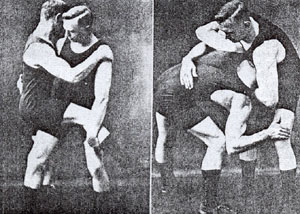
(I tried to pick the pictures where they look most like wrestlers.) This is a fairly obvious match-up, and I should state up front that I am basically an Eliot guy. But I think Pound actually won this round. It may have helped that I read a little less of him (basically just Hugh Selwyn Mauberley; I'll do A Draft of XVI Cantos next week), and that this is the third time I've been made to read The Waste Land in a calendar year. I still love Prufrock and Other Observations above all, but on this reading I've decided that Eliot's 1920 Poems (published as Ara Vos Prec in England) is, for me, one of the most thoroughgoingly unpleasant books of poetry ever written, what with its triple discovery of off-putting obscurantism, brittle quatrains, and off-hand, virulent anti-Semitism. I think this is the Eliot people hate when they hate Eliot (well, one of them). Pound's Mauberley's got the quatrains and the obscurantism (not the anti-Semitism yet; he was saving that up, apparently) but also a more accomplished technical sense and a goofier sense of humor (always Pound's trump card, to my mind), and it benefits greatly from even the limited background I now have in 1890s aestheticism (as Mauberley is essentially somebody like Ernest Dowson, if he had lived). It also marks the last (and, arguably, first) time Pound had a theme that wasn't objectionable and/or completely insane.

Winner: Pound … but this is far from over.

Wednesday: Claude McKay vs. Edith Sitwell
I must say that McKay, while interesting and talented and obviously hugely important, doesn't strike me as all that modern of a poet; he shares a lot more with the English Great War poets, still working through Keats and Shelley rather than wrestling with even the late nineteenth century, let alone the roaring twentieth. (A comparison with Langston Hughes, who I'm reading next week, is instructive.) One thing about this interests me: I note McKay's deep debt to British Romanticism, and his surprising silence (in his poetry, at least) on British colonial racism, as versus his outspoken condemnations of the American variety. Whenever Jamaica appears in his poetry it's always a pastoral paradise, set against the awfulness of New York City, and moreover it seems populated by nothing but black people. Anybody who knows more about McKay have any comment on this?

Anyway, McKay's stylistic tameness, which might have bored me on another day, was a welcome relief from wading through the once-fashionable train-wreck that is Edith Sitwell's Façade. Talk about imperialism: here we have an indiscriminate display of verbal and cultural wealth, swiped mostly from the French Symbolists (particularly Laforgue — lots of clowns — and Mallarmé — lots of jewels and negresses) and contemporaries who were more legitimately "on to something" like Eliot, Stein and Stravinsky. The poems are controlled by nothing but self-amused alliteration and allusion, toss around foreign phrases (often musical terms) ostentatiously and completely nonsensically, and are so indescribably annoying that I think I just have to quote from one of them and have done:

"The wind's bastinado
Whipt on the calico
Skin of the Macaroon
And the black Picaroon
Beneath the galloon
Of the midnight sky.
Came the great Soldan
In his sedan
Floating his fan —
Saw what the sly
Shadow's cocoon
In the baracoon
Held. Out they fly.
'This melon,
Sir Mammon,
Comes out of Babylon:
Buy for a patacoon —
Sir, you must buy!'
Said Il Magnifico
Pulling a fico —
With a stoccado
And a gambado,
Making a wry
Face: 'This corraceous
Round orchidaceous
Laceous porraceous
Fruit is a lie!' "

That's about enough of that.

Winner:
McKay.

Thursday: Mina Loy vs. D.H. Lawrence
Probably the most provocative juxtaposition, Loy being most ardent feminist among the Modernists, Lawrence the most chauvinist. This was my first experience with both, and basically I think Loy was right on the verge of being incredible before something went confusingly wrong; Lunar Baedeker, to me, gets steadily less compelling as it goes along. The early satires of Italian Futurism, co-opting the Futurists' (and Apollinaire's) own language in order to impale their pretensions and misogyny, are pretty extraordinary; and the fragmented, profane micro-lyrics of "Songs to Joannes" (which scandalized everybody when they appeared in 1915 in Others) are intriguing as well. She also has a great sense of the colloquial, combined with perhaps the weirdest vocabulary of any Modernist writer (she uses words like "infructuous" and "sialagogues"). But by the end of the 1920s she is doing terrible jazz/dialect poetry ("The Widow's Jazz," "Lady Laura in Bohemia") and "portraits" of the likes of Joyce, Stein and Nancy Cunard, which just makes you want to be reading them instead (well, maybe not Cunard). It's hard not to feel as if Loy lost her direction, which is a shame, because she could've been among the best of the Modernists, probably.

Contrast this with Lawrence's Birds, Beasts & Flowers, which is nothing if not single-minded: basically, in Lawrence's conception all God's creatures are tough, beautiful little bastards, who are more fun to hang out with than people, but end up reminding us anyway of human genitalia. I've got to say that I found this book convincing, and disturbing, in a way I've never felt of any of Lawrence's fiction (of which, admittedly, I've read very little): the way he lovingly renders naturalistic detail is often worthy of John Clare, and the gradual but determined way he pushes his observations into significance is something he legitimately got from Whitman. Granted the poems are completely ridiculous much (most?) of the time, but I don't think it's too perverse to say that's part of their charm.

Winner: As much as I want to like Loy better, I have to give it to D.H.L. Having said that, if I had to read much more of his poetry, I might revoke his title.

Friday: Wallace Stevens vs. William Carlos Williams
Apples and oranges.

Winner:
???