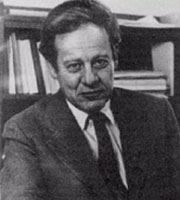
 (Sorry for the post title: I almost literally couldn't resist.)
So……… Blindness and Insight. It's terrific! In particular, for my purposes, it's incredibly useful, since it's largely concerned (in its first two and last two chapters, anyway, which are the ones I read) with a triangulation of international critical discourses: the Anglo-American academic New Criticism (or what was left of it by the late sixties); French structuralism/poststructuralism associated with Barthes, Tel Quel, and Derrida; and, perhaps most importantly, the mainstream tradition of Continental literary history and criticism that De Man reps for (but which he sees as in danger of becoming obsolete).
PDM's initial point, in his first two essays ("Criticism and Crisis" and "Form and Intent in the American New Criticism"), is that the Anglo-American critical establishment has long ignored the work, and refused the theoretical rigor, of the Continental tradition, despite the fact that many of its leading lights ended up living and working in America (he names Erich Auerbach, Leo Spitzer, Georges Poulet and Roman Jakobson, and one could add Adorno, Renato Poggioli and, ahem, De Man himself). Instead it was content to follow out the largely untheorized, and geographically provincial, implications of the New Criticism as it descended from Eliot, Empson, and I.A. Richards (my genealogy, not De Man's) and for this reason was doomed from the start. So far, this is an old story: English and American arrogance and narrow-mindedness, refusing the fruits of the mind of Europe: close-reading as unilateralism. Yet De Man details all of the above only as a prelude to his main point, which addresses the emerging discourse of poststructuralism. As he ominously puts it, "today, it is too late to bring about this kind of encounter" (21). Because now (1967) new developments in France are calling that tradition radically into question, along with the blinkered Anglo-American one. This already complicates any narrative that would see what happens in the 70s as America (and, to a lesser extent, England) "absorbing the Continental literary critical tradition": rather, what we absorb is a response to that tradition, a revolt against it, much as centuries earlier we absorb the ideas and rhetoric of the French Revolution without the specific experience of absolute monarchy that those ideas were developed against. Which is not to say the ideas, once absorbed, are "just ideas," or have no use-value in their new context. As De Man puts it at the end of "Literary History and Literary Modernity": "the bases of historical knowledge are not empirical facts but written texts, even if these texts masquerade in the guises of wars or revolutions" (165). One tradition's revolution is another's foundation.
This is helpful. I'm not entirely convinced by De Man's philosophical attacks on the intentional fallacy in the second essay, "Form and Intent in the American New Criticism," even though I think I'm ultimately on the same side as he is w/r/t intentionality. Furthermore, De Man's rhetoric partakes of a certain "dog-pile on New Criticism" zeitgeist of the late 1960s, allowing him to completely ignore (though probably honestly: he may never have read them) an "other tradition" of American criticism which is perhaps closer to the European model, and where we could include Wilson, Burke, and Trilling. The reduction De Man seems to make — that English and American literary history and criticism is New Criticism, as theorized by Wimsatt and Beardsley — is in many ways just as disastrous as the error he warns against, that of conflating French poststructuralism with European literary criticism tout court.
Moving quickly, aren't we? I skipped Chapters III-VII, on Binswanger, Lukács, Blanchot, Poulet and Derrida, never to return (well, maybe someday). That brings us to "Literary History and Literary Modernity," which is probably De Man's most crucial intervention in the modernism/modernity debates. This one is worth dealing with on more theoretical terms, as it is an essentially an attack on the idea of modernism — that is, on the idea of modernity having useful reference to questions of literature or aesthetics. To put it succinctly, De Man's position is that all literature (all "authentic" literature, that is) is modern, or begs the question of modernity, not just so-called "modernism." This is because, whether or not the aesthetic quality that could be accurately called modernist — a quality of foregrounding the historical moment in which the work of art is produced — is present in the work, even the most minimal act of reading is a dialectic between past and present, now and then. "The ambivalence of writing is such that it can be considered both an act and an interpretative process that follows after an act with which it cannot coincide … The appeal of modernity haunts all literature" (152). Leaving aside the question of how we feel about De Man's seeming jump from structural property to theme in this passage, or whether we need a micro/macro distinction to distinguish historical time from what we might call "reading reaction time," it must be admitted that on its own terms De Man's argument is powerful: and one can easily see how it could be used as an excuse for many academics to stop thinking seriously about the problem of Modernism, and the canon of texts it had produced and continued to produce, for many years.
There's a sociological element here, of course, which De Man is admirably up front about: there is a modernism, an avant-garde, that he cares about, and it is not literary but critical. "Certain forces that could legitimately be called modern and that were at work in lyric poetry, in the novel, and the theater have also now become operative in the field of literary theory and criticism," he writes. "… This development has by itself complicated and changed the texture of our literary modernity a great deal" (143-144). I should say so! This essay itself is just such a radical complication and change. In De Man's penultimate paragraph, he takes issue with practically every form of criticism then operating in the United States. To wit: "A positivistic history that sees literature only as what it is not (as an objective fact, an empirical psyche, or a communication that transcends the literary text as text) is … necessarily inadequate." That takes care of Marxism, psychoanalysis, cultural studies, and traditional progressivist literary history. "The same is true of approaches that take for granted the specificity of literature (what the French structuralists, echoing the Russian formalists, call literarity [littérarité] of literature)," and here lie Northrop Frye and the remnants of the American New Criticism as well. (Note that all of the above movements were articulated in response to the emergence of Modernism and the avant-garde, and that most of them, in their late 60s form at least, tended to privilege that tradition.) "If literature rested at ease within its own self-definition," De Man says, "it could be studied according to methods that are scientific rather than historical," although he implies that such a state of rest is in fact illusory and impossible. "We are obliged to confine ourselves to history when this is no longer the case, when the entity steadily puts its own ontological status into question" — as in the period of Modernism, when the first set of critical methods that De Man now deems "inadequate" were developed. What replaces these failed experiments, which are unable in themselves to come to terms with literature qua literature? Glad you asked: it is, of course, deconstruction (not yet named as such), which as a practice is loftily unconcerned with the petty historical and formal questions that constitute all previous discussions of "modernism" in literature; thus, "the critical method which denies literary modernity would appear — and even, in certain respects, would be — the most modern of critical movements" (164).
This is a clarion call for the big flip-flop of the 1970s: the decade in which academic literary criticism stops lagging behind the avant-garde trying to unravel its mysteries and starts being the avant-garde, in the literal sense of the words, setting the agenda for poets, artists, and (to a lesser extent) novelists and adopting an oppositional and adversarial attitude to the culture at large. It's the necessary fact to explain the rise of the L=A=N=G=U=A=G=E poets as well as, in many ways, our poetic and academic cultures in America today. It's also where I get off, for the time being — hey, look at the time! It's 1970.