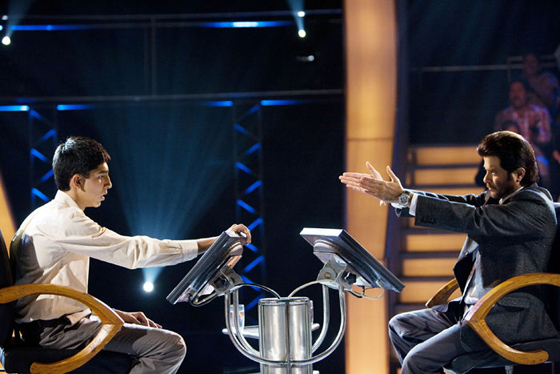
An early scene in Danny Boyle's latest fidgety, feel-good cry of "choose life,"
Slumdog Millionaire, provides a neat allegory for the film as a whole: a boy locked in a toilet must crawl through shit, literally, to get the autograph of a passing movie star. (Viewers may recall the fecal fantasia of Renton pearl-diving into "the worst toilet in Scotland" in Boyle's breakthrough
Trainspotting.) It's hard to think of many unabashedly crowd-pleasing films that start with scenes of police torture and a hand-held dash through urban poverty, but here we are. As the end credits played over a dance number that alternates between lavish and lonely (i.e. we cut between a bollywood crowd in choreographed mass joy, and the film's romantic leads ballroom dancing alone on a deserted train platform), it seemed all but inevitable that the post-Thanksgiving folks with whom I saw the movie would break out cheering. In the exact words of a woman walking out of the theater in front of me: "That movie had everything: romance, violence, action, cute Indian kids."
So it wouldn't be wrong to say that the movie abandons social expose for universalized romantic pabulum. Nevertheless, doing so might occlude the continuity between the two modes, documentary and romantic, and it is this continuity that exists as the film's central point about the global. As with the banal worry that
Trainspotting glorifies poverty and substance abuse, arguments that
Slumdog is "poverty chic" will be just as correct and just as far from seeing what fuels this picaresque climb. The film, like the novel on which it is based (written by moonlighting Indian diplomat Vikas Swarup), barely has a plot of its own. Rather, it exists as a series of extended biographical-cultural footnotes to the knowledge-drama of a single episode of
Who Wants to Be a Millionaire?. We cut between Jamal Malik (Dev Patel), the eponymous slumdog, being interrogated by the slick host of the show's Indian permutation (played here by
Anil Kapoor; in real life currently hosted by
Shahrukh Khan) and by the police who don't believe a poor kid could possess a pile of cultural factoids that would win him 10 million rupee. Why they would doubt him -- in a world of telecom ethnoscapes, service industry chai-wallahs, and sufficient TVs for all of Mumbai to watch his victory -- never becomes convincingly clear.
But that narrative skeleton provided by Who Wants to be a Millionaire? (or even its patronizing title question alone) obviates all questions of predictability and, indeed, is the key to the film's depiction of progress at the personal, national and transnational levels (levels it repeatedly collapses). Boyle's movie will make hundreds of millions, because Boyle's movie can be screened in a minimum of 106 countries without anyone in the crowd needing to be caught up on the rules of the game they are about to watch. We -- a global 'we' -- don't need to be told that our protagonist can, and will, "phone a friend," nor even that this is an option. It waits as a deus-ex-machina in the wings. Nor, then, is it any great bit of hermeneutic sleuthing to point out the way this "lifeline" option echoes Jamal's employment in an outsourced British call-centre, or the way the film as a whole naturalizes and reassures a Western audience that a tech-complaint to a spatially dislocated call-centre is actually a call to a 'friend.' To complain that the plotting of the film is obvious and formulaic would be like complaining that the "Final Jeopardy" round is formulaic. And if, sure, your average paint-by-numbers murder mystery and Wheel of Fortune both end with someone declaring "I'd like to solve the puzzle," this movie owns that homology (or wins the homology, perhaps, as consolation prize). Not only is it ruled by format, it is inextricably written by a genre that is seemingly effortlessly global, intrinsically transnational.
Our friend Prof. Jim English mentioned at MSA that he is currently thinking about the format-based international circulation of reality TV shows such as
Big Brother. These, he points out, are examples of the true global media, even as we stretch to discuss the mobility of the novel or the lyric: here is a genre capable of being implanted into seemingly any country, whereupon producers can apply a bit of local culture, or just cast a nationally recognizable host in a drab and pricey suit, like icing atop the sturdy transnational cake. "
Who Wants to Be a Millionaire?" is a question that, in spite of exchange rates, can be asked
in any language.

In just one respect, Boyle's film reminded me of P.T. Anderson's Magnolia, another movie structured by the rounds of a game show. But the difference between the fictional game What Do Kids Know? and the very real game Who Wants to Be a Millionaire? is that the latter focuses on the suspense of a single, un-timed contestant's knowledge, rather than the speed of competitors attempting to buzz-in their knowledge first. (Note: I'm actually getting this point of comparison from wikipedia. If I were ever interrogated for how I won big on a game show, the resulting film would just cut from me in the police office to me looking shit up online at various points in my life.) In direct contrast to the way in which Magnolia pretends interest in social networks that it actually groups around chance dyadic meetings, Slumdog is a film that pretends to find the individual within a range of structural hustles. The personal "destiny" of the hero is the romance of economic determinism, and Boyle rarely pretends otherwise.
There is a mismatch here. Boyle and his team, headed by the director of photography, Anthony Dod Mantle, clearly believe that a city like Mumbai, with its shifting skyline and a population of more than fifteen million, is as ripe for storytelling as Dickens’s London, and they may be right; hence the need to get their lenses dirty on its clogged streets. At the same time, the story they chose is sheer fantasy, not in its glancing details but in its emotional momentum. How else could Boyle get away with assembling his cast for a Bollywood dance number, at a railroad station, over the closing credits? You can either chide the film, at this point, for relinquishing any claim to realism or you can go with the flow—surely the wiser choice.
Is this really a choice? Did the film ever make a convincing claim to a realism that could be separated from the magic-realism of its flow? I'd argue that the format-based format does not allow us to separate modes at the level of detail and momentum. The addition of "realist detail" is precisely the way in which the global form of "reality TV" becomes simultaneously indigenous and transitive. The game show itself makes easy drama from our perception of the details, the facts, the memorized and excessive knowledge of the historical and the everyday alike. Think back: how much of Slumdog Millionaire was actually concerned with the sordid realities of poverty in India? The torture scene is played for bureaucratic laughs, even if it will be met with resounding silence in American theaters; the shit-crawl has all the squirmy gross-out build-up of a Farrelly Brothers stunt; scenes of child-slavery and disfigurement play out with deliberate and fantastical nods to Fagin and Pinocchio (more the Disney version, even, than the Collodi).
Another recollection or two of
Trainspotting: as Renton's opening voiceover chides, "People think it's all about misery and desperation and death and all that shite, which is not to be ignored. But what they forget is the pleasure of it. Otherwise we wouldn't do it. We're not fucking stupid." Has anything, by the end of that movie, really upset the visual exuberance that gave expression to that pleasure? When Boyle directed
Trainspotting, he took the 1980s setting of Irvine Welsh's novel, with its mired backdrop of blight under Thatcher's cultural-economic regime, and silently updated it to stand as a deeply ambivalent stylistic avatar of Blair's new labour, "Cool Britannia,"
supposed sweeping-away of all those Thatcherite cobwebs. I think there's a comparison here, though I'm not totally certain what it is: The novel
Q & A, on which
Slumdog is based, invents a game-show roughly approximate to
Millionaire in order to hang on it a series of postcards of Indian life; Boyle's film re-plants the structure in our actual entertainment milieu, potentially in order to stand very slightly to the side of the economic moment of his source text. When we start to consider
Slumdog, a flawed postcard to or from Mumbai, we might recall how much Danny Boyle hates a tourist, even though he is frightfully adept at making
tourist videos.
 "The petit bourgeois do not know how to play the game of culture as a game. They take culture too seriously to go in for bluff or imposture or even for the distance and casualness which show true familiarity; too seriously to escape permanent fear of ignorance or blunders, or to sidestep tests by responding with the indifference of those who are not competing or the serene detachment of those who feel entitled to confess or even flaunt their lacunae. Identifying culture with knowledge, they think that the cultivated man is one who possesses an immense fund of knowledge and refuse to believe him when he professes … that, brought down to its simplest and most sublime expression, it amounts to a relation to culture ('Culture is what remains when you've forgotten everything'). Making culture a matter of life and death, truth and falsehood, they cannot suspect the irresponsible self-assurance, the insolent off-handedness and even the hidden dishonesty presupposed by the merest page of an inspired essay on philosophy, art or literature. Self-made men, they cannot have the familiar relation to culture which authorizes the liberties and audacities of those who are linked to it by birth, that is, by nature and essence."


