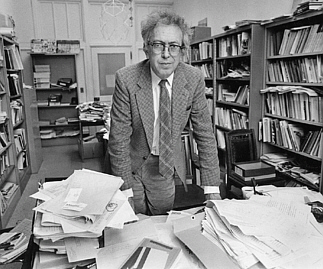
 OK, so: two ways out of Modernist criticism: Raymond Williams and Hugh Kenner. Both start publishing in the early 50s, in England and America (via Canada) respectively, and can be seen as a sort of transition between the rapidly aging New Critical establishment and the theory-soaked generation that would emerge from the ruins of Existentialism. They both brought new intellectual leanings to the examination of familiar texts and problems and they both engaged, significantly and influentially, with Modernism — Kenner for the whole of his career, Williams at the very end of it.
Hugh first. Kenner liked the Modernists because they were geniuses, and he liked geniuses because he was one. The Marjorie Perloff quote that Adrienne posted last week noting that Kenner posited "a conjunction of literary innovation with that of the other arts, sciences, and technologies" is totally on the money: and while it's certainly a big part of his achievement and the fantastic connections he's able to make, especially in The Pound Era, it also occasionally borders on becoming a gimmick. He also, problematically, assumes that simply by virtue of living through an era in which such scientific revolutions were transpiring, men as Ludditic as Pound and Joyce must have absorbed their innovations by osmosis.
What makes up for this fast-and-loose historicism is his unquestionable awesomeness at close reading, in which he can run circles around the New Critics he succeeded (and whom he mocks in passing in A Homemade World). His typical critical method was dogged patience before the mysteries of a difficult text, coupled with complete faith that its creator had been, in every respect, on to something. (Incidentally, he has one of the most apt names in literature: over the course of his long and tireless career, more and more technical procedures, factoids and acts of random scholarship swim into his ken.) The results of this attitude are its own justification: Kenner finds and explicates problems in Ulysses and The Cantos that other readers hadn't even realized were there, and probably never would have.
But, here's the problem, as I see it, with Kenner's scientistic Modernism: if the Modernists invented a new kind of poem, then they conveniently forgot to tell us how to build one of our own; or rather, the instructions they left are so colored by the first flush of excitement at the discovery that they're often more or less indecipherable. HK admits at much by quoting at length from Williams's "explanatory" prose writing in Spring and All, which he back-handedly compliments as "homemade philosophy," but justifies thusly: "Yet as on a stage where we see nothing but a good mime leaning on the invisible mantelpiece can persuade us he knows where the fireplace would be, so Williams' gesturings around the Imagination are not random nor self-contradictory but compatible with the existence, located and perceived by him, of a reality he may not succeed in making us see" (66). The writing here is so good that you can forget what an easy time he's giving Williams, just as he does Zukofsky's "Sincerity and Objectification" in a later chapter; and, more broadly, how much he has to supply himself in order to make a coherent Modernist Weltanschauung.
In essence, then, he treated the Modernists not like scientists but like scientific phenomena, ineffably but exactly "behaving" the way molecules behave — and not like like people with ideas which could sometimes be drastically wrong. For all his emphasis on science, Kenner lacks any account of how scientific ideas are transmitted from one mind to another: it's all "Eureka" with him, all homemade breakthrough, with almost no interest in that other important aspect of science in the 20th century, the process by which radical new ideas are tested and contested in a public arena. Thomas Kuhn he ain't.
Williams, on the other hand, is all about the communication of ideas. He's considered important for, among other things, finding a synthesis of Leavisism and Marxism to combat the reactionary political climate of Britain in the 50s, which in practice meant rehabilitating the problematic ideas of "culture" and "tradition" for a progressive democratic agenda. In the late 50s and early 60s Williams became a sort of academic celebrity and spokesman for the British New Left, called by Edward Thompson "our best man" (a designation that recalls Auden's position in the mid-30s — there's something very English about this sort of left-wing hero worship, evidently). His 1958 essay "The Masses" (excerpted from the conclusion of Culture and Society), though specifically arguing against "mass-communication" and the conservative fear of a lowering of cultural standards due to the influence of film and television, can also be read as an insistence on communication over aesthetics, intelligent discourse about standards replacing — or rather, constituting — standards themselves. This is a version of Modernism, if it is Modernism, with a politics quite removed from the meritocratic bias of the Pound tradition championed by Kenner. Williams writes that "much of what we call communication is, necessarily, no more in itself than transmisson: that is to say, a one-way sending. Reception and response, which complete communication, depend on other factors than the techniques" (50). Ideas, or poetic styles, in other words, aren't just right or wrong, good or bad, or even qualitatively "of their time"; there are no self-evident "discoveries" in the realm of culture; they take hold only if they are presented and defended in such a way that the people receiving them realize their benefit. (This is close to sounding like John Dewey, but I can't tell if that's me or Williams.) Contra his Canadian contemporary's faith in "a reality [someone else] may not succeed in making us see," Williams would seem to say that there is no reality (in the realm of culture, anyway, which by any definition is where literature belongs) that is not communicated, and communicated well: not, at any rate, for other people.
Well, I hope I'm communicating some kind of reality, at least to myself (hello there, self) in the future. Bottom line: I see Kenner and Williams as engaged in two markedly different attempts to keep Modernism going, Kenner by ensuring that its texts remain influential (and readable), and Williams by keeping the communication channels it opened within the academy free and clear. Kenner makes his name by digging indefatigably into the texts of Pound, Eliot, Joyce, &c, revealing unsuspected depths in them; while, at approximately the same time, Williams takes up the philosophical concepts associated with Modernism, and particularly with Eliot — the volume's editor John Higgins notes that RW's 1958 manifesto "Culture is Ordinary" was a kind of late response to Eliot's 1948 Notes Towards the Definition of Culture — in an attempt to revise and broaden them so they can be applied to new texts and new fields of study (notably politics, sociology and film).
(And now this is really just a suggestion for further study, but it might be interesting to compare Williams and Kenner in the light of the rise of communication theory; Kenner's early association with Marshall McLuhan would be particularly important in such a narrative. And lookee here: that ever-reliable conduit of communication Wikipedia informs me that McLuhan's "interest in the critical study of popular culture was influenced by the 1933 book Culture and Environment by F.R. Leavis and Denys Thompson." It all goes back to Leavis, it appears. Gotta read Leavis now, I guess.)


