Showing posts with label O'Neill. Show all posts

Friday, August 31, 2007

I have come to seduce you, Edna St. Vincent Millay


How did I miss so many blog entries from while I was gone? I thought I'd read them all when I got back in town, but looking through the list I noticed Adrienne's great and really helpful long note on Bellow, Evan's work on Pooley-Wah, and so on. I'm a bit slow.

About The Emperor Jones, I think I'm going to go see the Wooster Group's version of it in the Philly Fringe Fest next week and will report back if I do.


There's also a play called Gatz on -- have you all heard of this? Apparently it's 7.5 hours long (you get a meal at intermission) and involves a full reading of The Great Gatsby, with stage actions playing off the text in various ways. I kinda want to do this for the sheer Andy Kaufmanness, and cause it'll save me re-reading Gatsby. Couldn't there be a few more such plays? -- I'd gladly attend a 43 hour Invisible Man performance. Bloomsday people seem to get sloppily through Ulysses every year. I just want to be the audience to the rest of my generals list.

Sunday, August 5, 2007

For you, Greg


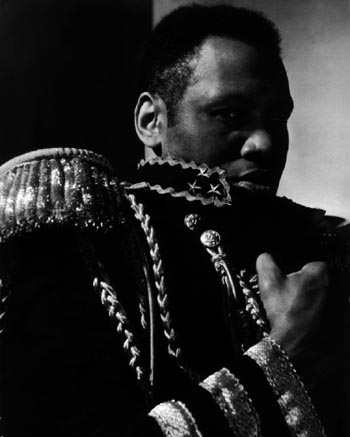
Are you reading Emperor Jones by Eugene O'Neill? It's pretty interesting, and really short as well. The play has got an interesting take on dialect, which you might find interesting (the dialect is really strange and out of place) and also a connection between african-american culture and Irishness. Jones is usually touted as the first play written by whites and performed by white theater troupes to feature a black character which is meant to be played by a black actor (not in blackface). It's got a pretty interesting run history, with Charles Gilpin being replaced by Paul Robeson when the play ran on Broadway. Anyway, this is from an article on Emperor Jones and race:
O'Neill may well have internalized the comparison between African and Irish Americans in a similar manner to the way in which Dyer feels kinship with black men on the basis of his own discrimination. O'Neill's father James certainly identified with black men in his own curious way. In 1874, just before the outburst of black-Irish satire, James O'Neill achieved what he later conceived of as the pinnacle of his career: playing Othello (in the requisite blackface) opposite Edwin Booth's Iago. Later in his life, James would directly compare his own marriage to Mary "Ella" Quinlan to that of Othello and Desdemona. Conceiving of himself as the lowly outsider marrying into beauty, money, and elite (read: white) power, James frequently launched into Othello's defense of his "seduction" of Desdemona when in the later stages of a drinking bout. 40 In his own writings, O'Neill literally cast himself in the role of the tragic mulatto figure: in All God's Chillun Got Wings (1924), the first play with an interracial couple on the Broadway stage, O'Neill named the interracial couple after his parents Jim and Ella.

Move over Greenwich Village


Bet you thought a city like New York, or possibly Chicago was the hub of Modernism in America. Well, WRONG. Apparently, Provincetown, Mass. is where it's at.

Let's start with the obvious. Eugene O'Neill had his big summer theater there and made his name and those of his plays famous. The Provincetown Players were the leaders in experimental theater in the early/mid 20th century. Tennessee Williams also debuted several of his plays with this company.

Moving on. In 1925, Eugene O'Neill rented his house to Edmund Wilson, who came to Provincetown to seduce Edna St. Vincent Millay. When that didn't work out, Wilson had giant alcoholic bashes with E.E. Cummings and John Dos Passos. The house collapsed in 1931 (the ghost of too much partying shook it down)

Kerouac wrote sections of On The Road in Provincetown (not a big deal, right? He wrote that everywhere, but still)

And then, in 1935, Hans Hoffman opened his summer school of art there, which brought in the likes of Rothko and Pollock and Motherwell and Robert DeNiro's Dad. The first American exhibit of Abstract Expressionism was in Provincetown in 1949

AND Bette Davis made her stage debute in Provincetown.

Mailer lives there now, as does Grace Paley