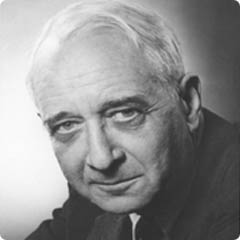
 I have a tremendous critical crush on Lionel Trilling. It's the dangerous kind of crush, one where you're not quite sure you really ought to like the other person, or whether your friends would approve: a certain sense of "What am I getting myself into here?" attends my reading, especially of his more sweeping and impressive moments. After all, Trilling in many ways represents what the radical energies of the 60s and 70s swept away, not without some very good reasons; and his general theoretical bent, though emerging out of Trotskyism and addressing itself to fellow liberal intellectuals of the 1940s, is usually seen as a harbinger of neoconservatism (the most substantial recent article I could find on him is from the Weekly Standard, which gives you some idea).
But as Trilling points out in his preface, "a criticism which has its heart the interests of liberalism might find its most useful work not in conforming liberalism in its general sense of rightness but rather in putting under some degree of pressure the liberal ideas and assumptions of the present time" (x). And putting ideas under pressure is what Trilling does brilliantly. I read just four essays (five including the preface) from his 1950 book The Liberal Imagination — I borrowed my dad's copy; it's apparently, Yaron informs me, out of print — but they were real doozies: "Reality and America," "The Function of the Little Magazine," "The Sense of the Past" and "The Kinsey Report." Each of them is amazing and challenging in its own way, devoting itself to very specific contemporary issues while nonetheless making up part of an expansive, deeply felt and cogently defended view of literature. (Adrienne, you might want to check out the first one; it has some really interesting insights about the realist novel and the liberal preference for Theodore Dreiser over Henry James. And he also has pieces, in the same book, on Sherwood Anderson, Huckleberry Finn, and "Manners, Morals, and the Novel.")
Anyway, all of the essays have a lot to recommend them, not least for their usefulness in summing up late 40s critical and political attitudes (often in the process of critiquing them). "The Sense of the Past," for instance, is an ambivalent meditation on the New Criticism and its methods, which Trilling argues have to be tempered with an awareness of literary works as "historical facts" — pretty much the deconstruction/new historicism debate of the 1980s in embryo. The one on the Kinsey Report, on the other hand, is the most unsettling, in part because Trilling violently resists the report's attempt to destigmatize homosexuality, a stance he takes in part because of his own strong allegiance to Freudianism. This is where you begin to see the pernicious side of Trilling's neoconservative leanings; though one wonders if Trilling were alive today, when homosexuality as a social fact seems so much more evident and has been so much more cogently argued for, if he wouldn't temper his objections so much. Maybe that's wishful thinking. At any rate, its early considerations of the role science can and should play in social discourse are fascinating and valuable.
Anyway, I'm just going to end with a list of quotes I liked. And I'm going to let out a little sigh as I finish typing each of them.
from the preface:
"in the modern situation it is just when a movement despairs of having ideas that it turns to force, which it masks in ideology" (x)
"Charles Péguy said, 'Tout commence en mystique en finit en politique' — everything begins in sentiment and assumption and finds it issue in political action and institutions. The converse is also true: just as sentiments become ideas, ideas eventually establish themselves as sentiments." (xi)
"the literature of the modern period, of the last century and a half, has been characteristically political" (xii) [interestingly contra Edmund Wilson]
"The paradox is that liberalism is concerned with the emotions above all else, as proof of which the word happiness stands at the very center of its thought, but in its effort to establish the emotions, or certain among them, in some sort of freedom, liberalism somehow tends to deny them their full possibility." (xii-xiii)
"literature is that human activity that takes the fullest and most precise account of variousness, possibility, complexity, and difficulty" (xv)
from "Reality and America":
"the culture of a nation is not truly figured in the image of the current. A culture is not a flow, nor even a confluence; the form of its existence is struggle, or at least debate — it is nothing if not dialectic. And in any culture there are likely to be certain artists who contain a large part of the dialectic within themselves …" (9)
"In the American metaphysic, reality is always material reality, hard, resistant, unformed, impenetrable, and unpleasant. And that mind is alone felt to be truly trustworthy which most resembles this reality by most nearly reproducing the sensations it affords." (13)
[Greg, I think this might be usefully applied to Pound and the Objectivists — what do you think?]
"We live, understandably enough, with the sense of urgency; our clock, like Baudelaire's, has had the hands removed and bears the legend, 'It is later than you think.' But with us it is always a little too late for mind, yet never too late for honest stupidity; always a little too late for understanding, never too late for righteous, bewildered wrath; always too late for thought, never too late for naïve moralizing. We seem to like to condemn our finest but not our worst qualities by pitting them against the exigencies of time." (18)
from "The Function of the Little Magazine":
"… [in the nineteenth century] it was the natural expectation that a serious idea would be heard and considered. Baudelaire is the poet from whom our modern disowned poets have taken their characteristic attitudes, yet Baudelaire himself was still able to think of 'success,' to believe in the possibility of being seriously listened to by the very society he flouted, and he even carried his belief to the point of standing for election to the Academy" (96)
"the emotional space of the human mind is large but not infinite, and perhaps it will be pre-empted by the substitutes for literature — the radio, the movies, and certain magazines — which are antagonistic to literature not merely because they are competing genres but because of the political and cultural assumptions that control them. Further, the politics with which we are now [1946] being confronted may be of such kind as to crush the possibility of that interplay between free will and circumstance on which all literature depends. These conditions can scarcely encourage us. On the other hand, they must not be allowed to obsess us so that we cannot work" (96-97)
"It is a striking fact about [the] literature of contemporary liberalism that it is commercially very successful — at the behest of the liberal middle class, that old vice of 'commercialism,' which we all used to scold, is now at a disadvantage before the 'integrity' which it once used to corrupt. Our dominant literature is profitable in the degree that it is earnest, sincere, solemn. At its best it has the charm of a literature of piety. It has neither imagination nor mind." (98)
[Adrienne, you mentioned you guys were talking about WCW's "earnestness" the other day — does this quote have any resonances for that discussion?]
[on the apoliticality of the great Modernists]: "If tolerance is in question, I am inclined rather to suppose that it should go to those writers from whom, whatever their difficulty, we hear the unmistakable note of seriousness — a note which, when we hear it, should suggest to us that those who sound it are not devoting their lives to committing literary suicide." (99)
"to organize a new union between our political ideas and our imagination — in all our cultural purview there is no work more necessary … There are manifest dangers in doing this, but greater dangers in not doing it. Unless we insist that politics is imagination and mind, we will learn that imagination and mind are politics, and of a kind that we will not like." (100)
[could be a gloss on Auden]
"We are dealing again with power. The question of power has not always preoccupied literature … Quality is the first, and perhaps should be the only, consideration. But in our situation today, when we think of quality, we must ask what chance a particular quality has to survive, and how it can be a force to act in its own defense and in the defense of those social circumstances which will permit it to establish and propagate itself in the world. This is not a desirable state of affairs. 'Art is a weapon' and 'ideas are weapons' were phrases that a few years ago had a wide and happy currency; and sometimes, as we look at the necessities of our life, we have the sense that the weapon metaphor all too ruthlessly advances — food is now a weapon, sleep and love will soon be weapons, and our final slogan perhaps will be, 'Life is a weapon.' And yet the question of power is forced upon us." (101)
[and this almost demands to be read vis-à-vis Marianne Moore and her constant concern with metaphorical "weapons" — maybe we can talk about this a little on Tuesday?]
"The word coterie should not frighten us too much. Neither should it charm us too much; writing for a small group does not ensure integrity any more than writing for the many; the coterie can corrupt as surely, and sometimes as quickly, as the big advertisement appropriation. But the smallness of the coterie does not limit the 'human' quality of the work." (102)
"When we try to estimate the power of literature, we must not be misled by the fancy pictures of history. Now and then periods do occur when the best literature overflows its usual narrow bounds and reaches a large mass of the people … It is what we must always hope and work for. But in actual fact the occasions are rare when the best literature becomes, as it were, the folk literature, and generally speaking literature has always been carried on within small limits and under great difficulties … But whenever it becomes a question of measuring the power of literature, Shelley's old comment recurs, and 'it exceeds all imagination to conceive what would have been the moral condition of the world' if literature did not continue in existence with its appeal to limited groups, keeping the road open." (103)
[this is problematic, probably, but so so beautiful]
from "The Sense of the Past":
"All sorts of studies are properly ancillary to the study of literature. For example, the study of the intellectual conditions in which a work of literature was made is not only legitimate but sometimes even necessary to the perception of its power. Yet when Professor Lovejoy in his influential book, The Great Chain of Being, tells us that for the study of the history of ideas a really dead writer is better than one whose works are still enjoyed, we naturally pull up short and wonder if we are not in danger of becoming like the Edinburgh body-snatchers who saw to it that there were enough cadavers for study in the medical school." (182)
"in an age of science prestige is to be gained by approximating the methods of science" (182)
"The faults of [the New Critics] we know. Perhaps their chief fault they share with the scientific-historical scholars themselves — they try too hard. No less than the scholars, the critics fall into the error that [John Jay] Chapman denounced, the great modern illusion 'that anything whatever … can be discovered through hard intellectual work and concentration.' We often feel of them that they make the elucidation of poetic ambiguity or irony a kind of intellectual calisthenic ritual [a little smack at Empson, I think]. Still, we can forgive them their strenuousness, remembering that something has happened to our relation with language which seems to require that we make methodical and explicit what was once immediate and unformulated." (184)
"even in the lyric poem the factor of historicity is part of the aesthetic experience; it is not merely a negative condition of the other elements, such as prosody and diction, which, if they are old enough, are likely to be insufficiently understood — it is itself a positive aesthetic factor with positive and pleasurable relations to the other aesthetic factors. It is part of the given of the work, which we cannot help but respond to. The New Critics imply that this situation should not exist, but it cannot help existing, and we have to take it into account." (185)
"The question is always arising: What is the real poem? Is it the poem we now perceive? Is it the poem the author consciously intended? Is it the poem the author intended and his first readers read? Well, it is all these things, depending on the state of our knowledge. But in addition the poem is the poem as it has existed in history … This makes it a thing we can never wholly understand — other things too, of course, help to make it that — and the mystery, the unreachable part of the poem, is one of its aesthet
"we have … to open our minds to the whole question of what we mean when we speak of causation in culture … 'There is no subject,' [Hume] says, 'in which we must proceed with more caution than in tracing the history of the arts or sciences: lest we assign causes which never existed and reduce what is merely contingent to stable and universal principles.' … But there is one fact, he continues, which gives us the license to speculate — this is the fact that the choice spirits arise from and are related to the mass of the people of their time … This gives us our charter to engage in cultural history and cultural criticism, but we must see that it is a charter to deal with a mystery." (188)
"We have come to believe that some ideas can betray us, others save us. The educated classes are learning to blame ideas for their troubles, rather than blaming what is a very different thing — our own bad thinking. This is the great vice of academicism, that it is concerned with ideas rather than thinking, and nowadays the errors of academicism do not stay in the academy; they make their way into the world, and what begins as a failure of perception among intellectual specialists finds its fulfillment in policy and action." (192)
I could go on and on (I haven't even gotten to the Kinsey essay yet), but if you've cared to read this far you should probably just buy the book. I'll close, though, with a sentence which might serve as Trilling's manifesto, though he attributes its idea not to himself but to Nietzsche: that "culture [should] be studied and judged as life's continuous evaluation of itself, the evaluation being understood as never finding full expression in the 'operating forces' of a culture, but as never finding expression at all without reference to these gross, institutional facts" (197). From my perspective, this is as close as we can get — as close as we need to get, maybe I should say — to a justification of what we should be trying to do.


