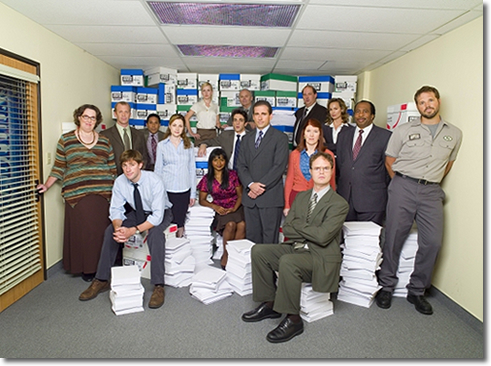
I've been watching
The Office on DVD a lot lately — "binging," as Emily lovingly puts it. (It's occurred to me that, in these amorphous post-generals times, I might be indulging some weird fantasy about having a regular job again. If so, please remember to slap some sense into me the next time you see me.) It took me a long time to get into the American series, because I was so attached to the original British show, but it finally wore me down, and I've come to appreciate it on its own terms.
And as with anything that gives me real pleasure, I feel neurotically compelled to theorize a little bit about it. Here's a trial balloon: The British
Office is to the American
Office as Franz Kafka is to Erving Goffman. That is, the focus shifts from the mindnumbing banality and oppression inflicted on innocent office workers by idiotic superiors (Ricky Gervais' David Brent and Steve Carell's Michael Scott, respectively) to the coping mechanisms that the office workers use to live with that banality: pranks, office romances, small but significant expressions of community. All of which are an important element of the British version, but they're close to being the whole point of the American one.
Also, the characters' attitude toward the cameras is entirely different: in the British show they seem like something everyone (except for David) is subjected to, somewhat unwillingly; in the American one they're playfully acknowledged, even directly involved in the action (as when the camera operator directs Pam's attention to intrigue going on between Dwight and Angela). The impulse in the American
Office is always toward inclusion, socialization, communal ritual (however unwelcome) above personal anomie: closeness at any cost.
To me this says a lot about the American attitude towards work, circa early 21st century: specifically, that it ought to be above all a lifestyle, and a
socius. (This is an idea held by David Brent in the British show too, but there it's obviously a PC fiction, something everybody but him can plainly see; whereas the American show agrees with Michael that an office should be a community, but just thinks he goes about fostering it all wrong.) There are so many American TV shows about work, and about high-pressure jobs in particular (all doctor shows, all lawyer shows,
The West Wing,
3o Rock, etc. etc.), where this vision of job-as-community is even easier to see; in fact, one thing that's refreshing and appealing about
The Office is it's almost unique in being about a
low-pressure job. Everything about the show is low-stakes, modest, unassuming: but rather than being experienced as degraded and humiliating, the mundanity of the office is exactly what gives pleasure, or allows the possibility of it.
(Just for the sake of probity, I am now issuing a
spoiler alert.) The British
Office ends with David Brent becoming a (minor) celebrity, in a literalization of the mock-documentary format of the show as a whole. Though this scarcely works out better for him than being a regional manager, it does read, in context, as a necessary dramaturgical move away from the temporary situation of the office, which Merchant and Gervais evidently considered exhausted after just twelve episodes. It's hard to imagine the American version allowing itself this way out, both because it's in the nature of American television shows to keep their premises humming indefinitely, and because, ultimately, the American office doesn't seem like such a bad place to be. (This difference also, if you think about it, reverses some of the standard commonplaces about American "escapism" and celebrity obsession.)
Not sure what valuation to put on this: Stockholm Syndrome or simple realism? Stanley Cavell said "the fact of television" is an acknowledgment of "the uninhabitability of the world," and one might say that the British
Office works by extending this terrible fact to the workplace, the American
Office by using the workplace to ward it off. But then again we do all have to work, somehow, don't we, and get along with each other in the process? Either way there seems to be something (not uniquely, but distinctively) American about the show's
Weltanschaaung. Probably Elizabeth Bishop — who hardly worked a day in her life — said it best: "All the untidy activity continues, / Awful but cheerful."


 Lately I've been relaxing in the evenings (or, more commonly, waking up in the very early mornings) with episodes of the 1978 BBC TV series Men of Ideas. These are charmingly stilted dialogues between host Bryan Magee and then- (and, mostly, still-) contemporary Anglo-American philosophers (yes, all men, except for Martha Nussbaum and Iris Murdoch) on major philosophers of the past. (Magee seems like a pretty interesting character in his own right: Cockney boy turned Labour MP turned BBC presenter and popularizer of philosophy. Only in England.) They're pitched for a non-specialist audience, and I'm sure there's much in the views presented that have been superseded since the late seventies,* but they're still pretty good general introductions as well as fascinating artifacts of a bygone TV era. My favorites so far: Hubert Dreyfus on Heidegger, Hilary Putnam on the philosophy of science, and Peter Singer on Hegel and Marx. But there are plenty more, mostly skewed toward the analytic tradition: episodes on Kant, Hume, Frege, pragmatism, Wittgenstein, et al. Not to mention a wide variety of amusing late 1970s academic hairstyles. Enjoy!


