Showing posts with label Lawrence. Show all posts

Tuesday, August 7, 2007

Specters of Eliot

This week it's the 30s. A little depressing after all that terrible honesty and sexy Surrealism, but what are you gonna do, we've got to get to the 60s somehow.

Anyway. Anyone remember two weeks ago when I noted that T.S. Eliot seems to have developed a split personality in the mid-1920s? Well, what's interesting me currently is that these two sides of Eliot seem to have borne fruit in two different writers: significantly, one a novelist, one a poet. I'm reading Henry Green's Living at the moment, which I highly recommend to both of you and to anyone else who may be reading this: it's really an extraordinary book, and certainly a neglected Modernist text (it was first published in 1929). I sort of expected Green to be basically a novel-of-manners type, and I suppose in a way he is, but he's much weirder than I expected. He writes a very spare, almost telegraphic kind of prose, not a million miles away from Hemingway or D.H. Lawrence or even at times Gertrude Stein, full of abbreviated syntax and dropped articles (for example, here are the third and fourth sentences: " 'What we want is go, push,' said works manager to son of Mr. Dupret. 'What I say to them is — let's get on with it, let's get the stuff out,' " 207). But Green pushes it further, and to more striking effect, in my opinion, than any of them. At times it anticipates David Mamet! At other times, William Gaddis! As well as more expected people like Green's friend Graham Greene, especially his early stuff like Brighton Rock.

As the above comparisons should indicate, what Green is especially good at, and what his reputation rests on, is dialogue. The range of voices in Living is pretty extraordinary, encompassing upper-class and lower, young and old, male and female, etc. And he's especially interested in his working-class characters, the rhythm of their speech, their slang, their reflection of motifs and phrases from movies, music, and other pop culture. As I wrote before, this was a talent of Eliot's which he largely neglected to develop after Sweeney Agonistes, perhaps deciding that it wasn't really suitable to lyric poetry: at any rate, I think Green must have read Sweeney, and the relevant sections of The Waste Land, before writing his book. John Updike's introduction makes it seem as if Green wasn't all that avant-garde of a guy (for one thing, he was the managing director of an engineering firm, just like "Mr. Dupret's son" in Living) and suggests that his style is modeled on Charles M. Doughty's 1888 Travels in Arabia Deserta (also a big favorite of Marianne Moore's; clearly I need to take a look at this book); but I'm thinking that there just have to be some Modernist skeletons in Green's closet as well: certainly Eliot and Lawrence, if not Stein. He does admit to reading Proust (and refers to him, very amusingly, on page 261; apparently he was a big tipper) but that influence is more or less undetectable, whereas the English writers — who would, of course, have been right under Green's nose — are all over the place.

At the same time, more or less, W.H. Auden is making the first significant advance on Eliot's style and sensibility in English (as opposed to American) letters. And he does it by taking the bleak, blasted landscapes that Eliot's poetry had colonized (in "What the Thunder Said," "The Hollow Men" and "Ash-Wednesday") and making them more specifically English, both in their descriptive particulars and in their metrical expression. But it largely lacks Eliot's irony, or sense of humor (though Auden would soon manifest one of his own); Auden, at this stage anyway, is not really interested in colloquialism, or vulgarity: he's interested in refining Eliot's style (and "refining" seems like an appropriate word here, since one of the things Auden does is put factories into Eliot's waste lands). The sense of sinister atmosphere that Eliot conjures in his poetry of the 20s becomes absolutely oppressive in Auden's early work: and for the Laforguean Symbolist lightness that Eliot always retains, even when seriously bumming us out, Auden substitutes a very English heaviness, experimenting with alliterative verse in imitation of William Langland's Piers Plowman (e.g., "Doom is dark and deeper than any sea-dingle") and other lugubrious effects. (The Doughty influence seems to sneak in in places as well, particularly in the prose sections of The Orators.)

I will probably write about Auden again soon so I'll stop here. But for now, in order to radically oversimplify everything and help me see what's wrong with my own argument (a useful tactic, I've often noted), I'll say that Eliot, in his early years, was equally interested in the way the modern world talked (which both delighted and repelled him) and the way it looked (which just filled him with disgust). Green is only interested in the former, Auden the latter.

Friday, July 20, 2007

1920s Cage Matches!

This week I surveyed the first half of the 1920s. I was originally planning on cramming the whole decade, at least in its Anglophone manifestations, into one week and then doing French Surrealism next week for contrast, but I ended up feeling that the 20s are so important for Modernism that I might as well give them an extra week at the expense of something later on (the 40s or 50s, probably). I read two poets per day, which resulted in some interesting unexpected juxtapositions. And because I can't think of any overarching conceptual rubric in which to fit everything I read this week, I will do it in the form of completely subjective value judgments on arbitrarily paired authors. Enjoy!

Tuesday: T.S. Eliot vs. Ezra Pound
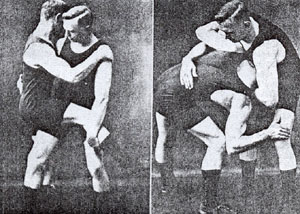
(I tried to pick the pictures where they look most like wrestlers.) This is a fairly obvious match-up, and I should state up front that I am basically an Eliot guy. But I think Pound actually won this round. It may have helped that I read a little less of him (basically just Hugh Selwyn Mauberley; I'll do A Draft of XVI Cantos next week), and that this is the third time I've been made to read The Waste Land in a calendar year. I still love Prufrock and Other Observations above all, but on this reading I've decided that Eliot's 1920 Poems (published as Ara Vos Prec in England) is, for me, one of the most thoroughgoingly unpleasant books of poetry ever written, what with its triple discovery of off-putting obscurantism, brittle quatrains, and off-hand, virulent anti-Semitism. I think this is the Eliot people hate when they hate Eliot (well, one of them). Pound's Mauberley's got the quatrains and the obscurantism (not the anti-Semitism yet; he was saving that up, apparently) but also a more accomplished technical sense and a goofier sense of humor (always Pound's trump card, to my mind), and it benefits greatly from even the limited background I now have in 1890s aestheticism (as Mauberley is essentially somebody like Ernest Dowson, if he had lived). It also marks the last (and, arguably, first) time Pound had a theme that wasn't objectionable and/or completely insane.

Winner: Pound … but this is far from over.

Wednesday: Claude McKay vs. Edith Sitwell
I must say that McKay, while interesting and talented and obviously hugely important, doesn't strike me as all that modern of a poet; he shares a lot more with the English Great War poets, still working through Keats and Shelley rather than wrestling with even the late nineteenth century, let alone the roaring twentieth. (A comparison with Langston Hughes, who I'm reading next week, is instructive.) One thing about this interests me: I note McKay's deep debt to British Romanticism, and his surprising silence (in his poetry, at least) on British colonial racism, as versus his outspoken condemnations of the American variety. Whenever Jamaica appears in his poetry it's always a pastoral paradise, set against the awfulness of New York City, and moreover it seems populated by nothing but black people. Anybody who knows more about McKay have any comment on this?

Anyway, McKay's stylistic tameness, which might have bored me on another day, was a welcome relief from wading through the once-fashionable train-wreck that is Edith Sitwell's Façade. Talk about imperialism: here we have an indiscriminate display of verbal and cultural wealth, swiped mostly from the French Symbolists (particularly Laforgue — lots of clowns — and Mallarmé — lots of jewels and negresses) and contemporaries who were more legitimately "on to something" like Eliot, Stein and Stravinsky. The poems are controlled by nothing but self-amused alliteration and allusion, toss around foreign phrases (often musical terms) ostentatiously and completely nonsensically, and are so indescribably annoying that I think I just have to quote from one of them and have done:

"The wind's bastinado
Whipt on the calico
Skin of the Macaroon
And the black Picaroon
Beneath the galloon
Of the midnight sky.
Came the great Soldan
In his sedan
Floating his fan —
Saw what the sly
Shadow's cocoon
In the baracoon
Held. Out they fly.
'This melon,
Sir Mammon,
Comes out of Babylon:
Buy for a patacoon —
Sir, you must buy!'
Said Il Magnifico
Pulling a fico —
With a stoccado
And a gambado,
Making a wry
Face: 'This corraceous
Round orchidaceous
Laceous porraceous
Fruit is a lie!' "

That's about enough of that.

Winner:
McKay.

Thursday: Mina Loy vs. D.H. Lawrence
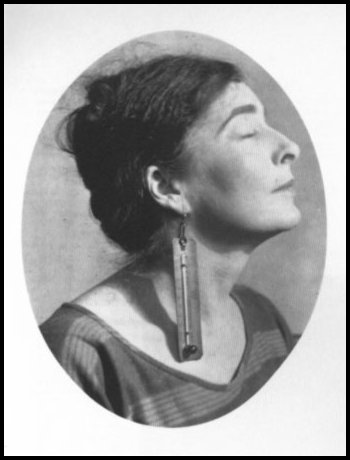
Probably the most provocative juxtaposition, Loy being most ardent feminist among the Modernists, Lawrence the most chauvinist. This was my first experience with both, and basically I think Loy was right on the verge of being incredible before something went confusingly wrong; Lunar Baedeker, to me, gets steadily less compelling as it goes along. The early satires of Italian Futurism, co-opting the Futurists' (and Apollinaire's) own language in order to impale their pretensions and misogyny, are pretty extraordinary; and the fragmented, profane micro-lyrics of "Songs to Joannes" (which scandalized everybody when they appeared in 1915 in Others) are intriguing as well. She also has a great sense of the colloquial, combined with perhaps the weirdest vocabulary of any Modernist writer (she uses words like "infructuous" and "sialagogues"). But by the end of the 1920s she is doing terrible jazz/dialect poetry ("The Widow's Jazz," "Lady Laura in Bohemia") and "portraits" of the likes of Joyce, Stein and Nancy Cunard, which just makes you want to be reading them instead (well, maybe not Cunard). It's hard not to feel as if Loy lost her direction, which is a shame, because she could've been among the best of the Modernists, probably.

Contrast this with Lawrence's Birds, Beasts & Flowers, which is nothing if not single-minded: basically, in Lawrence's conception all God's creatures are tough, beautiful little bastards, who are more fun to hang out with than people, but end up reminding us anyway of human genitalia. I've got to say that I found this book convincing, and disturbing, in a way I've never felt of any of Lawrence's fiction (of which, admittedly, I've read very little): the way he lovingly renders naturalistic detail is often worthy of John Clare, and the gradual but determined way he pushes his observations into significance is something he legitimately got from Whitman. Granted the poems are completely ridiculous much (most?) of the time, but I don't think it's too perverse to say that's part of their charm.

Winner: As much as I want to like Loy better, I have to give it to D.H.L. Having said that, if I had to read much more of his poetry, I might revoke his title.

Friday: Wallace Stevens vs. William Carlos Williams
Apples and oranges.

Winner:
???

D.H. Lawrence is Twee as Fuck

From "Tortoise-Shell":

"It needed Pythagoras to see life playing with counters on the living back
Of the baby tortoise;
Life establishing the first mathematical tablet,
Not in stone, like the Judean Lord, or bronze, but in life-clouded, life-rosy tortoise shell.

The first little mathematical gentleman
Stepping, wee mite, in his loose trousers
Under all the eternal dome of mathematical law." (Birds, Beasts & Flowers, 115)

I won't even get into "Bibbles," where he calls his French bulldog "[y]ou little Walt-Whitmanesque bitch."