Showing posts with label Joyce. Show all posts
Showing posts with label Joyce. Show all posts
Thursday, June 3, 2010
Ruse of Reason
I've put in so many professors that it will keep the enigmas and puzzles busy for centuries meaning things for them to argue over.

Wednesday, October 7, 2009
Harder Better Faster Stronger
 Over at Larval Subjects, Levi Bryant gives an excellent gloss on Latour's notion of "trials of strength." He says, sensibly enough, that a scientific theory is akin to a bridge built over a creek: what gives it reality is its ability to withstand pressure over the course of time, to maintain its structure when other similar objects around it are being destroyed. "Reality, for Latour … consists of gradients of resistance. Some things have a high degree of resistance, some do not and are easily toppled or shattered."
He then concludes the post by extending the claim to literature, which obviously made my ears perk up:
Finally the case is similar in literature. The thesis that the best selling novel is the best novel fails to attend to the manner in which endurance is one of the crucial dimensions of reality or strength. To be sure, most people prefer Dean R. Kuntz [sic] to Joyce… However, the comparative popularity of Dean R. Kuntz compared to Finnegan’s Wake is not what establishes the reality of the object. Kuntz’s novel Intensity, while perhaps enjoyable, has very little staying power and very easily passes out of existence. However, when speaking of works like Homer’s Illiad, Dostoyevsky’s Crime and Punishment, Joyce’s Finnegan’s Wake, we are talking of works that are like a well built bridge, somehow clearly carrying traces of the historical setting out of which they emerged but also having the capacity to transcend that historical setting, to resonate like two strings of a guitar against one another producing differences in other historical settings, never, somehow, becoming cliches in the way that Kuntz’s mustached Scotch drinking heroes seem to immediately embody the cliche of the Reagan era, faux-sophisticate 80s man that loses our interest when this time passes. There is something here about how the language holds together, the thought holds together, the themes hold together, that give these works high gradients of resistance to dissolution. Indeed, it is the resistance we encounter in reading the work, the difficulty of navigating them, the richness of their multi-stratified and resonating diverse meanings that functions as an index of their strength or their ability to resonate in multiple changing historical settings like the cone of Bergson’s memory without losing their originality. They are like the art of pantomime, in a strange way, where the good pantomime manages to extract the pure event of a particular action from its causal context such that it becomes capable of appearing in any context as a singularity. The greatness of these works, their strength, does not lie in the attitudes people have towards it – like coffee one has to learn how to read Joyce and at first it is painful – but rather in the sturdiness of the construction that allows it to endure.
Hmmmmm. While the extension of the analogy is tempting, I'm not sure that Bryant is able to solve the overwhelming question of cultural value so fast. I'll leave aside the usual queries about class and subjectivity and who gets to decide what "resonates," both because they're too easy and also because they're not really in the spirit of Bryant's speculation. Instead I'll just ask: what would a total failure of a trial of strength look like for a literary text? Less like a negative evaluation by posterity, as Bryant imagines, and more like simple illegibility: a text in a dead language, or one of which no copies have been preserved, is the weakest possible text, in Latour's sense. So while in one sense, Bryant is right, Finnegans Wake probably has a much better chance of resonating fifty years from now than Koontz's Intensity, in another sense it is a much weaker, more fragile assemblage, one that, without the Skeleton Key and our biographies of Joyce and an enormous (but finite) amount of other paraphernalia, would be within spitting distance of illegible. Whereas Intensity, I'm guessing, will be roughly readable as long as current vernacular English remains in a recognizable state. So which text is stronger?
But what I like about Bryant's formulation, in spite of everything, is that it makes the social use value of literature the criterion for textual strength without immediately conflating use and exchange value (as materialist approaches to literary sociology, like Franco Moretti's, often risk doing). On this view, a writer like Joyce is not just his fluctuating reputation, or his sales figures: he is also, as the card-carrying New Critic would insist, his texts, which can stand up as well as anybody's to trials of strength. And his texts are stronger than Koontz's, because they are more likely to satisfy examiners in a number of different social contexts, over a longer period of historical time, than Koontz's are, which will some day probably only be read by people who have a thing for late-twentieth-century period horror fiction.
But of course Joyce — any author, but particularly Joyce — is not just his texts either; he's also, as the card-carrying poststructuralist would insist, his paratexts, not only all of those he refers to in his work but also all of those books and articles that have been written on it, and all the other works that have been inspired by it. So it seems to me that Bryant is being unnecessarily formalist when he says that "[t]here is something here about how the language holds together, the thought holds together, the themes hold together, that give these works high gradients of resistance to dissolution." It's taking the metaphor of "construction" too literally: any given Joyce text is indeed a very sturdy construction, or assemblage, but it's one assembled not only by Joyce himself. It's in this sense that Joyce's texts, like any writer's, are social: that is, they require many actors and actants working together to give them their full strength, value, or "meaning."
But still. Doesn't this privilege the particular constructions of literary critics, academic scholars, and "highbrow" readers above the millions who are certainly experiencing some reality when they read a Koontz book (whatever else you say, you can't take that away from them)? Could we say, then, that Koontz may be real to more people, but Joyce is real in more ways?
Wednesday, August 20, 2008
Franco Moretti on Joyce
 "Ulysses is indeed static, and in its world nothing — absolutely nothing — is great. But this is not due to any technical or ideal shortcoming on Joyce's part, but rather to his subjection to English* society; for Joyce, it is certainly the only society imaginable, although he just as certainly condemns it, through a hyperbolic presentation of its worst features, to a future of paralysed mediocrity (a future that Joyce, with a stroke of genius, places in the past, as if to underline his consummate skepticism: one can always hope never to reach the negative utopias of science fiction, but if a negative utopia came into being twenty years ago, and no one realized it, then the die is truly cast…)" (Signs Taken For Wonders, p. 189)
I don't agree with this as an interpretation of Ulysses, but it's brilliantly formulated.
* Weirdly Moretti insists on reading Joyce as an English, rather than an Irish, writer.
Tuesday, March 11, 2008
My new myspace friends:
http://profile.myspace.com/index.cfm?fuseaction=user.viewprofile&friendid=196964734
http://profile.myspace.com/index.cfm?fuseaction=user.viewprofile&friendid=221927129
http://profile.myspace.com/index.cfm?fuseaction=user.viewprofile&friendid=96839414
Dare you enter the hottest salon this side of the virtual Left Bank?
http://profile.myspace.com/index.cfm?fuseaction=user.viewprofile&friendid=196964734
http://profile.myspace.com/index.cfm?fuseaction=user.viewprofile&friendid=221927129
http://profile.myspace.com/index.cfm?fuseaction=user.viewprofile&friendid=96839414
Dare you enter the hottest salon this side of the virtual Left Bank?
Thursday, October 4, 2007
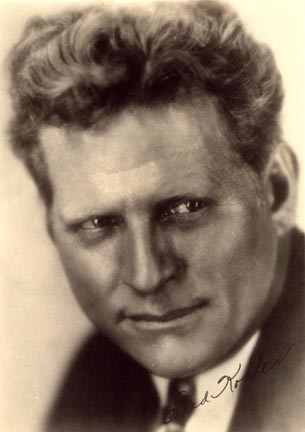 The villain in the movie Underworld (1927; directed by Josef von Sternberg, story by Ben Hecht) is named Buck Mulligan.
Postscript: he's played by the actor Fred Kohler, above.
Tuesday, September 11, 2007
Erving Goffman, the 50s and Literature
 Sociology: what is it good for? For students of literature, that is. I'm pondering this question as generals loom. Still on my list, yet to be cracked, are Pierre Bourdieu's Distinction and Jurgen Habermas' The Structural Transformation of the Public Sphere — both works that have already influenced my thinking via my hazy preconceptions of what they are likely to say, but which I must admit I'm scared to actually confront. And even more scared to have to talk about in front of a committee who might actually know something about them.
One sociology book I have managed to read, however, as previously mentioned, is Erving Goffman's The Presentation of Self in Everyday Life. I have some ideas about how I might eventually be able to work this into a developing thesis idea about the social self-presentation of poets and the genealogy that stretches from Eliot to Auden to Ashbery, but I will leave those aside for another day. In the meantime, I'll just give a sketch of some first impressions of Goffman, in the hope that they might lead to something more fruitful later.
I was turned on to Goffman originally by Jeff Nunokawa, who used a little bit of I think Frame Analysis in his Victorian novel seminar as a conceptual framework to talk about "awayness" and the evasion of the social totality (Jeff, in his own personal conceptual system, plays Goffman off against Foucault). He is (still?) highly regarded as a sociologist who facilitated a paradigm shift within the discipline from the macro- to the micro- level, i.e. studying not broad social trends or "laws" but actual human behavior as collected by experts in the field operating similarly to anthropologists.
Anyway, The Presentation of Self is a weird, crafty, idiosyncratic little book that is equal parts empirical survey, philosophical treatise, etiquette guide and public relations manual. Its basic subject is "the art of impression management": how people strive to make other people feel a certain way about them, or to limit or control the information others have about them. (This theme gets its best literary expression, to my knowledge anyway, in the works of David Foster Wallace.) To this end, Goffman uses "some language of the stage," speaking of performances, backstage areas, rehearsals and improvisations, etc., only to retract this conceit on the second-to-last page in a headspinning rhetorical move: "The claim that all the world's a stage is sufficiently commonplace for readers to be familiar with its limitations and tolerant of its presentation" (254) — that is, this very claim, on which the whole book has been based, was itself an impression-management strategy. It made me slap my forehead when I read it.
Though Goffman focuses on real-time interactions and thus is naturally led to use theatrical terminology, the manipulations he describes could just as well be those of a novelist, or a poet, both of whom also work by carefully controlling the amount of information, both literary and extra-literary, given to the audience of their work. In fact, one thing that distinguishes Goffman from sociologists past (Weber, Durkheim) and future (Bourdieu) is his conscious literariness. Not only is his own prose style economical and attractive, clearly learned from reading short stories and New Yorker profiles, but he often takes his clinching examples from literary sources: some of the authors he quotes from at length include Kenneth Burke (25, 175, 194), Henry Mayhew (41), Kafka (96), Warren Miller (97), Evelyn Waugh (101), Orwell (122), Melville (137), Gore Vidal (193) and Mary McCarthy (219) (as well as stuff like Character, Manner and Customs in the People of India and Ebony magazine). And it must be admitted that he sometimes comes off like a frustrated novelist himself ("So, too, members of the team must not exploit their presence in the front region in order to stage their own show, as do, for example, marriageable stenographers who sometimes encumber their office surroundings with a lush undergrowth of high fashion," 214). There's a lot of that sort of thing, sometimes a little too much: a number of Goffman's categories seem like opportunities for examples rather than helpful distinctions in their own right.
 Goffman is also, noticeably, a creature of the 50s, receptive to the literary and intellectual influences of that time. One of the more interesting features of Goffman's book are its periodic mentions of Jean-Paul Sartre and Simone de Beauvoir. Sartre's Being and Nothingness supplies a description of a waiter in a café who "is playing at being a waiter in a café": "The child plays with his body in order to explore it, to take inventory of it; the waiter in the café plays with his condition in order to realize it" (76). De Beauvoir's The Second Sex is quoted a few times to describe the attitude of women (problematically labelled "woman," a usage not followed by Goffman) to their performances in the presence of men: "Confronting man woman is always play-acting; she lies when she makes believe that she accepts her status as the inessential other … With other women, a woman is behind the scenes; she is polishing her equipment, but not in battle; she is getting her costume together, preparing her make-up, laying out her tactics…" (113).
On the one hand, Goffman's quotations from Sartre and De Beauvoir clearly have something to do with the widespread popularity of Existentialism in America in the 50s; this vogue both explains why the quotes impressed Goffman and why he feels they will bolster his argument with a "lay" "literary" reader. But in another sense Sartre seems an odd choice of hero, given that Goffman (a) doesn't seem to be much interested in metaphysics, or abstract thinking of any kind, and (b) avoids any explicit discussion of politics. And yet Sartre and De Beauvoir were also associated with and influenced by Maurice Merleau-Ponty, author of The Structure of Behavior and The Phenomenology of Perception — both Goffman-ish titles. And while I don't know squat about phenomenology — just that it was also being enthusiastically received in the art critical world at about this time, by Michael Fried for instance, and that it made my eyes glaze over in college — it's clearly this aspect of Existentialism, and not so much its concern with "being" or "commitment," that interested Goffman.
Well, how about this. A vogue for phenomenology suits a sudden awareness of an explosion of phenomena: and that's what the affluence of the American postwar economy, with all its attendant cultural renaissances, produced. And there was apparently also an explosion of sociological research conducted and published in the 1950s (much of it, I think, under Goffman's supervision). Reading The Presentation of Self in Everyday Life you get the feeling that we have so much more data on 1950s America than we do on any previous society. While Goffman occasionally dips back into earlier eras (often Victorian or eighteenth-century England) for his examples, he rarely "historicizes" in the sense of accounting for changes in values or social agreements from one period to another. I would have to think that this close focus on the current day was fairly radical for the field of sociology, which, in its development out of Hegelian philosophy and traditional social history, would have been interested in nothing so much as epochal change. My question is, how much of Goffman's contentment with "now" was tied to a general sense in the America of the 50s that, after centuries of talking around the subject, everyday life itself was finally being discovered, a notion that is connected both to the public events of the time — the Kinsey Report comes up in passim — and the gradual permeation of such intellectual events as Freudianism and phenomenology into American life? It's a notion, at any rate, that prepares the way for Confessionalism, and for the Beat poets.
A final question. Can Goffman meaningfully be called a Modernist, or even placed in respect to the intellectual influence of Modernism? This is tricky. His literary sources (with a few interesting exceptions, like Kafka) are straight-ahead novelistic realism, because that's where the source of the best information lies. He shows little concern with language, and much with physicality and expression, making his work hard to subsume under the heading of "the linguistic turn" that is often seen to be Modernism's theoretical counterpart. (On the other hand, it suggests points of contact with the later Wittgenstein.) In his concern with "everyday life" rather than "culture," with the facts of contemporary social life rather than what it evolved out of or might be tending toward, he is not at all in the semi-metaphysical tradition of Eliot, Leavis and Raymond Williams. But clearly he's in no way a throwback to 19th century intellectual traditions either: he engages with Freud, with Simmel and Durkheim, with literature. He recognizes modernity has taken place, but he prefers to anatomize and catalogue it than to situate it in a larger historical or theoretical framework. For this reason the Modernist he most resembles is probably Joyce, the Balzacian Joyce who bragged about Ulysses being a blueprint from which turn-of-the-century Dublin could be reconstructed.
 Or maybe Beckett: "Performers are aware they foster and ordinarily also possess destructive information about the show," Goffman states on page 144. Waiting for Godot had its American premiere in 1956, Endgame in 1957; a dedicated follower of Existentialism would presumably have been aware of them. This last point raises the question of what I'll risk calling the postmodernity of Goffman's approach, and it's closely connected with one of my biggest problems with his book in general. It seems to me that Goffman's concept of "destructive information" (first used on page 141) is seriously flawed. Putting my objection in short, analytically unrigorous form: just how sensitive are we, anyway? Goffman sometimes talks as though the merest breeze that happens along could destroy the delicate ecosystems of human interaction that he so minutely anatomizes. Social relations are more adaptable and impervious than that, as the early work of Stanley Cavell (in my view a direct inheritor of Goffman: but more on that trajectory another day) shows quite extensively. Goffman, for one thing, is so eagle-eyed himself that he fails to account for the fact of repression, or willful not-noticing, that the more Freudian Cavell so doggedly attends to in essays like "Knowing and Acknowledging." But this emphasis on the ever-present possibility of destruction, far from being a mere weakness on Goffman's part, may point to something bigger, a distinctively postwar epistemic framework that extends inexorably to where we are now: that is, we are getting used to being disillusioned — perhaps Adorno would say "disenchanted" — consistently, and in every aspect of our cultural life. (This is a condition perhaps also anticipated by Wittgenstein, whose Philosophical Investigations was made available and became influential only after the Second World War.)
Hypothesis: in the postmodern period, disillusionment itself becomes the frame in which cultural activity — and not just, but especially, literary activity — is automatically viewed.
Corollary: it's time for a nap.
Monday, August 13, 2007
Writing in a post MFA world


Didn't have time this week to do a full re-reading of Flannery O'Connor this week. Just returned to some old favorites. I hadn't realized how much I remembered her stories, and it was pleasurable to return to them. I find it hard to read writers like O'Connor, usually short story writers, who want you to NOT academicize or intellectualize their stories and just try to spin a good yarn. I feel like they put so many road blocks in their writing to prevent just what I'm trained to do. I always feel like I'm breaking their hearts. Forgive me, Flan. But with her, it was always complicated by the devout Catholic thing anyway, so whatevskis.
O'Connor claims she didn't read people like Faulkner or Joyce until she left Georgia and went to the Iowa's Writers Workshop. She's one of the most epiphantic American short-story writers I know, so its surprising that Dubliners came to her so late (or so she claims...she's a tricky wily one, that O'Connor) And unlike Dubliners' epiphanies, the ones for an O'Connor character are usually completely ahistorical, a dropping away of all past and future for the graceful moment usually connected to some sort of personal death, be in physical or spiritual. Death haunts the edges of Dubliners, but death is wham smack bam in your face in an O'Connor story. She's also so fucking good a dialogue and dialect. Puts Faulkner to shame.
Anyways, my real point is I read half/skimmed a little bit of an article about O'Connor in relation to the rise of the MFA in America in a New Criticism world and how this really affected how she wrote and the fabric of her stories. And I can see this being true. They have kind of that MFA quality, ya know? (I worked for a literary agent and I was trained to distrust the MFA writers submissions we got because "they write the same anyway. too stylized, we don't want it") Any other writers you all are reading that went to MFA programs or something similar? How should we talk about this and does it matter?
Sunday, August 12, 2007
$$$ ₤₤₤ ₣₣₣ ℳℳℳ
 H0w much of the particular character of Modernism can be accounted for by major transformations in the world economy in the first 30 years of the century: e.g., the Panic of 1907 and subsequent bail-out by J.P. Morgan (see Williams' poem on this subject in Spring and All); the slow collapse of Germany's national economy under the mountain of national debts incurred after the First World War; and, climactically, the stock market crash of 1929? Think of some of the individual modernist authors who experienced drastic changes in their financial positions during this period, for these and a variety of other reasons: Proust; Eliot; Yeats; Woolf; Stephen Spender; George Oppen; Nabokov. (You'll have to help me out with the Americans, Adrienne. Didn't Faulkner's family lose a bunch of money? Or was that during Reconstruction?) For these writers, all of whom were raised in an atmosphere of affluence that was later significantly reduced or threatened, how could the expression of despair and cynicism one normally associates with the Modernist moment not also be, in some way, a panic fear about a change in their personal situations? (Others, of course, improved their situations in this period, notably Pound and Joyce — mostly because they were both relatively poor to start with. And how significant is it that, despite living until almost the end of WWII, Joyce never wrote any fiction set later than 1904, when all of these catastrophes were still on the horizon?)
Thus those who become writers during the time of Modernism often give the impression not of entering a new, higher rentier class (which would be the typical role of the author in the eighteenth and nineteenth centuries) but of giving expression to a certain loss of value, a certain fall from grace. (In contrast, the postmodernists — the Americans, anyway — are largely back in the upwardly mobile position, though at this point they are competing for smaller slices of the cultural capital pie, and those usually attached to positions at major American universities. In this context, Nabokov, who grew up as the child of liberal aristocrats, becomes an impoverished European émigré, moves to the U.S. and gets on the academic-job treadmill, and finally finds himself accidentally a Great American Author and rich and famous culture hero, cuts a particularly interesting figure.)
With these circumstances in mind, I can see why Anglo-American Modernism displays such a cautiously exploratory attitude toward the radical positions of Continental Modernism (Surrealism in particular), which by 1920 had largely accepted that important literature was now the province of either the radical Bohemian fringes or the future Marxist state.
So I think we need (if it doesn't exist already) a financial history of these and other relevant figures: an audit of Modernism, as it were. Who got poorer, who got richer, who was in danger and who was not, and how do these various positions affect their writing?
Yes, this has got me thinking.
Friday, August 3, 2007
Surrealism
 So, Surrealism. This was a fun week, and more cohesive and immediately relevant to the rest of my reading than I expected (or feared) it would be. The thing to realize about the Surrealists is that their intellectual background is, despite the language barrier, in many ways much closer to our own than that of many of the English and American Modernists: they are products of the same French tradition of philosophical education that would later produce Derrida, Foucault, Deleuze, and all the other sacred monsters of High Theory that have been forcibly absorbed, for better or worse, by our discipline in the past forty years. So we are part of the same intellectual tradition, at least by proxy; and even if we don't consider ourselves experts on Descartes or Hegel, the odds are we've picked up more of the gist of their systems and ways of thinking than we have of, I don't know, F.H. Bradley or C.H. Douglas or something.
Add to this the French emphasis on rhetoric and you have a pretty good explanation for the high caliber of the Surrealists' programmatic writing (seen primarily in Breton's manifestoes, of course, but this tone tends to infect their more strictly literary output as well). Eliot, Pound, Stevens, Moore, Lawrence, and Williams, despite their various levels of formal schooling, were all sort of (and of necessity) autodidacts, a fact that accounts for much of the continuing strangeness of their work and their ways of justifying it. By contrast, Breton and Aragon are like confident schoolboys: they know they can encase their artistic efforts in a watertight carapace of theory, and for this reason their self-justifications feel natural in a way that the Modernists' rarely do, in fact more natural than some of the writing it justifies. Even Lautréamont — whose work pre-dates Surrealism proper by about forty years and as far as I can tell was absolutely fucking insane — is just flat-out convincing, able to put together a series of declaratory sentences or marshal a quotation or an epigram in a way that puts most full-faculty-possessing American academics of our time to shame. (The one Anglophone Modernist who shares this tendency, of course, is James Joyce, thanks to his Jesuit training I suppose. No wonder he's always been so big in France.)
The ironic implication of this is that, for me at least, Surrealist writing today often says more about the culture that they supposedly hated so much than it does about their individual campaigns of revolt against it. How much of the attraction of Paris Peasant or Nadja, or even The Magnetic Fields or Soluble Fish, has to do with their "pooling" of a communal poetic subconscious (as Breton puts it in the Second Surrealist Manifesto, 179) and how much of it has to do with the particular debris floating around in that pool, and the fact that it was filled in a time and place that now seems so romantically alien (Paris in the 20s… sighs)? Of all of them, Aragon was probably the most aware of this contradiction, which is why he grounds Paris Peasant in the particulars of the group's milieu; and certainly Walter Benjamin, in his fantastic essay on "Surrealism" from 1929, realizes that it's their specific attitude toward Paris itself ("the most dreamed-of of their objects") that constitutes the Surrealists' real originality. (My pet theory is that the New York School, and particularly Ashbery, was also especially attuned to the culturally exemplary aspect of Surrealism, and it's this that accounts for his strange marriage of insurrectionary European absurdity with homely American sentimental pragmatism. Which in turn has significant effects for contemporary American poetry, much of which is running with one or the other half of Ashbery's synthesis.)
The other thing that fascinates me about the Surrealists is their constant propping up each other's proper names, in a way that would seem to belie Breton's repeated insistence that the individual is of no significance, that none of them have any talent in the usually accepted literary sense. One could certainly (someone probably already has) write a very interesting book on homosociality and Surrealism; Exhibit A would have to be Breton's little phantasmagoria in the first Manifesto about an imaginary castle "in a rustic setting, not far from Paris … [where] a few of my friends are living … as permanent guests," surrounded by "gorgeous women," where "[t]he spirit of demoralization has elected domicile," a place which sounds like a cross between Axel's castle and the Playboy Mansion. (Speaking of guys who live together: this reminds me, I decided that the four major Surrealists each correspond to a Beatle. In case you're interested, here's what I came up with:
ANDRE BRETON = PAUL McCARTNEY
Always trying to keep everything together. Talks a lot about love but you just know he's an asshole.
LOUIS ARAGON = JOHN LENNON
Most realistic, most cynical, perhaps most brilliant. Eventually decides he doesn't really like his friends.
PAUL ELUARD = GEORGE HARRISON
Spiritual, and a little remote.
ROBERT DESNOS = RINGO STARR
The silliest one; the one who has the most troubled solo career.
PHILIPPE SOUPAULT = PETE BEST
Kicked out of the band early on.
I'll add that I tend to think of any grouping of four people in Beatles terms. Anyone want to try this with Joyce, Pound, Eliot and Williams?)
A few other random observations:
Surrealists were the first hipsters (and hippies). In the countercultural realm as well as the academic, the Surrealists seem more our contemporaries than the Modernists. Breton shops at flea-markets for "objects that can be found nowhere else: old-fashioned, broken, useless, almost incomprehensible, even perverse" (Nadja, 52); Aragon drolly observes the ravages of gentrification without being interested in doing much about it; Eluard drops a lot of names ("Max Ernst," "Pablo Picasso," "Arp"); and Desnos, and for that matter all the rest of them too, elevate "love" to the state of a ridiculous transcendental abstraction. We (OK, I) may recognize these attitudes as unsavory, hypocritical, or stupid; but they're certainly familiar.
Surrealism often overlaps with pastoral. Subjects for further study: Lautréamont (op cit.), Aragon's "A Feeling for Nature," Desnos' "Of the Flower of Love and the Wandering Horses," and various passages in Breton's first Manifesto and Soluble Fish. Also: of all animals the Surrealists seem to prefer birds (Eluard) and fish (Breton). Both are small, familiar, and difficult to anthropomorphize, one of them identifiably "poetic," the other conventionally "weird." Compared to the Americans, like Moore and Pound, a surprising dearth of dogs and cats: why? Because they're too domesticable?
Breton may have influenced Nabokov. This never occurred to me before, but the style of Breton's Nadja seems in many ways to be a model for Lolita: an anecdotal first-person account of a love affair with an obviously inappropriate partner (insane woman, underage girl) who is very dubiously portrayed as the chief instigator and controller of the situation, which ends with an extended bout of moral and intellectual self-justification on the part of its self-involved narrator. They even have a similar way of mixing aesthetic, emotional, and dramatic registers, all under a slightly detached, man-of-the-world tone; and they also both use fate and coincidence as the basic framing-device for their narratives (maybe more so in other Nabokov novels, like Pale Fire, than Lolita). The crucial difference is that Breton claims to be writing about himself, and offering us random episodes and coincidences taken from his everyday life, trusting that there is some pattern which neither he nor the reader can immediately perceive; whereas Nabokov uses an unreliable narrator, and reverse-engineers the ephemera from a pre-arranged pattern (I wonder if the link to Breton can be tied in with his famous hatred of Freudian analysis somehow.) Still, the similarities are striking. I don't know off-hand if VN ever made any statements on Surrealism (which I would guess he'd have been skeptical about: then again, he loved Queneau), but he lived in Berlin in the 20s and Paris in the late 30s and presumably would have been aware of the Surrealists in some capacity. In any case, it'd be an interesting avenue to explore, and if I'm right it would be another way Surrealism snuck in through the back-door of the American literary establishment.
Subscribe to:
Posts (Atom)


