Tuesday, April 1, 2008
Good catch

Thursday, August 30, 2007
Sick and tired
 I want to throw a passage by Raymond Williams, somewhat haphazardly, at the question of Modernism's Old Man Fetish that we were kicking around way back. This is from "Individuals and Societies," an excerpt from his 1961 book The Long Revolution given in The Raymond Williams Reader, and it clarifies his theoretical distinction between "subjects" and "servants":
"The subject, at whatever violence to himself, has to accept the way of life of his society, and his own indicated place in it, because there is no other way in which he can maintain himself at all … It is not his way of life, in any sense that matters, but he must conform to it to survive. In the case of the servant, the pressure is less severe, though still, to him, irresistible. The subject has no choice; the servant is given the illusion of a choice, and is invited to identify himself with the way of life in which his place is defined. It is an illusion of choice, because again, like the subject, he has no obvious way of maintaining his life if he refuses. Yet the illusion is important, for it allows him to pretend to have an identification with the society, as if the choice had been real. The subject will have few illusions about the relationship which is determining him; he will know that the way of life is not his but must be obeyed. The servant, on the other hand, may come to identify himself with the other way of life that is determining him; he may even, consciously, think of himself as a member … Yet at many levels of his life, and particularly in certain situations such as solitude and age, the discrepancy between the role the individual is playing and his actual sense of himself will become manifest, either consciously or in terms of some physical or emotional disturbance. Given the right conditions, he can play the role as if it were really his, or in situations evoking his deepest personal feelings, the identification breaks down." (77-78)
I'm thinking here in particular of Yeats, in such a poem as "Among School Children," where the "role" of poet as public "servant" (in his own phrase, a "smiling public man") is unexpectedly decimated under the pressure of lyric "disturbance." Is this what Yeats (and maybe Eliot) are trying to embody in their personae — the kind of lack of faith in society experienceable not by rebellious youth (Joyce's/Stephen Dedalus' "Non serviam") but only by old men who've spent themselves in trying to serve?
Wednesday, August 22, 2007
Die, Modernism, Die
 Yep, it was literary critics killed Modernism, not poets (though many of them poet-critics: not exactly sure what to make of that). And it was accomplished not through any sort of polemical attack, but through a simultaneous collective lowering of expectations, and a willingness to rest on laurels. We know everything we need to know, the argument ran, to write great poetry now: and if you don't know, you haven't been paying attention. In that case, God help you.
Exhibit A: R.P. Blackmur's "Lord Tennyson's Scissors: 1912-1950," an overview of the Modernist period published in 1951 as the epilogue to his collection Language as Gesture. "Forty years of poetry took their rise in Eliot, Yeats, and Pound," Blackmur says, condensing a half century's worth of complex aesthetic and political wrangling into three Big Names to set alongside Shakespeare-Marlowe-Jonson, Wordsworth-Coleridge-Southey and Shelley-Keats-Blake. I'm just going to quote some (OK, a lot of) stuff from this essay, because some of it is helpful, a lot of it is funny (and unfair), and all of it gives a good index of how even the most pro-Modernist critics wanted to wrap things up and move on to the next thing by the beginning of the 50s:
On Yeats: "neither his vices nor his poetry ever quitted him" (424)
On 1922: "1922 seems the great year of our time — especially if you let the months run a little both ways — for it holds a good many of Yeats' Tower poems, Pound's first eight Cantos, and Eliot's The Waste Land, not to mention Ulysses, the finishing of The Magic Mountain, and the beginning of The Counterfeiters. The year 1922 is almost inexhaustible in all the arts" (426)
On Pound and prosody: "The general prosody of the 'teens and 'twenties had equally little to do with the practice of Yeats, Pound, and Eliot … and with the practice of the old conservatives. The general prosody was perhaps the weakest and least conscious in English since the dead poetry of the mid-sixteenth century. It ran, under various guises and doctrines, toward a combination of absolute doggerel and absolute expressionism. Ezra Pound was as responsible as anyone for this condition, not by the progress of his own work but by the procession of manifestoes which he promulgated by letter and print. His doctrine, however it may have promoted the incentive of writing, only got in the way of full work and when it got stronger, deeply damaged, though it never destroyed, his expressive powers" (427)
On "the ideographic method" and expressionism: "The procedure is very tempting, always, to get rid of what is behind one and what is ahead of one, neither by capitulation nor by mastery, but by declaring an arbitrary substitute. Then expression becomes immediate, which is good, and spontaneous, which is not; for spontaneity is the curse of poetry to at least the same degree that neologism is the curse of language. But the temptation is very deep; Art, as Maritain says, Art bitten by poetry longs to be freed from reason, but so long as nothing is substituted for reason the longing is not fatal and may indeed promote a fresh and rejoicing sense of disorder, as The Waste Land did, or a new underground for reason, as the work of Valéry and Mallarmé did" (428)
On Basic English: "What, should we get rid of our ignorance, of the very substance of our lives, merely in order to understand one another?" (428)
On the "heroization of the sensibility": "What [the modern poets] did was to make just enough of a prosody to heroize the sensibility and not quite enough to make a heroic statement. Just enough meter to make a patter, just enough rhyme to make a noise, just enough reason to make an argument; never enough of anything to bind together what came out of the reservoir of their extraordinary sensibility into possible poetry … This bad poetry is not worth reference in itself; it is here only to represent the condition of the language and the state of ambition in which an unusually large amount of good — or partly good — poetry got written" (428-429)
On flatness/prosiness: "Verse should be written, said Pound, not to the metronome but in the sequence of the musical phrase. The prose tradition alone produces flatness, inhibits song, and excludes behavior; and I see no sense in welcoming these disorders, as Eliot has done in parts of the Quartets and as Schwartz has done in all but his earliest work, as other and desirable forms of order. I do not refer to careless writing but to deliberate flatness; which is only the contemporary form of Georgian deliquescence" (429)
[this opinion will become particularly interesting in the context of Ashbery, I think]
On solipsism and "the real world": "…it seems to have been an age when the sensibility took over much of the task of poetry. That is why we have created so many private worlds each claiming ascendancy over the real world about which nothing, or nearly nothing got said. That is why, too, Yeats and Eliot (though not Pound, except rarely) were almost alone able to express a version — an actual form — of the real world. In each the sensibility had other grounds than itself; the ground of beseeching, history, faith or momentum and the other ground, no less important to poetry, of prosody." (430)
Then there's a long section where RPB runs down all the various "schools" of Modernism (what Graves and Riding call "dead movements"), those not entirely assimilable to the traditions created by Yeats, Eliot or Pound. This is the fun part:
1. "the parallel Old-Timers' school, what we might call the school of Chaucer and the Ballad; think of Hardy, Housman, Robinson, and Frost … Reading them, we see why Pound does not occupy a first position, but a position on one side. The superlative metric of Pound may be a clue to their weakness but it would never furnish an understanding of their imperfect strength. Their work stands ready to infect the work of young men who have not yet found a form for their ambition and who can no longer, since they apprehend what has happened to it, heroize their sensibility. At least I should suppose there might be a coming race of poets who would want to reverse Maritain's phrase and say Art, bitten by reason, longs to be freed from poetry: from the spontaneous and the private and the calculated public worlds. There might be a race of poets, that is, who would woo the excited miracles of absolute statement, not as a refuge, but to get their work done" (432)
[to me, this seems to presage a lot of the most accepted poetry today, in both America and Britain; what Ron Silliman calls the School of Quietude. More on this some other day, maybe.]
2. "the Apocalyptic or Violent school … Here is where we find the remains of Vachel Lindsay, the evangel of enthusiastic rebirth; Robinson Jeffers, the classical Freudian; Roy Campbell the animal, authoritarian evangel of anti-culture; Carl Sandburg, the bard of demagogic anti-culture; and of course others … All these stem poetically and emotionally from Whitman-Vates: and all are marked by ignorance, good will, solipsism, and evangelism … nor should we think of them even so briefly as more than false alarms if it were not for the two extraordinary talents that must be grouped with them … D.H. Lawrence and Hart Crane … Each is a blow in the face but neither can hit you twice" (433)
3. "another school of anti-intelligence … They got rid of too much of their reason, and as a result they effervesced rather than expressed, and what is left is flat. Nameless they shall be here; they belonged only to their principal journal transition. What was wrong with them is clear when you see how weak is their imitation of Apollinaire, Aragon, Cocteau, Soupault [!], and how great their misunderstanding of Mallarmé, Rilke, Joyce, Kafka, and Pirandello: all men who longing to be freed from reason had a kind of bottom supply of it. Neither the English nor the Americans have ever been very good at this sort of thing. Let us say that we have not so much of reason that we can afford to lose any of it; we need it to make our nonsense real as well as genuine; and one would say that in this respect prosody was a form of reason" (433-434)
[obviously, this will have renewed significance in the 60s with New York School et al.]
4. "the school of Donne into which the largest number of individual writers of good verse fall when shaken up and let settle … they are difficult in style, violent in their constructed emotions, private with actual secrecy in meaning. There is in their work a wrestling struggle toward statement, a struggle through paradox and irony … and the detritus of convictions. The statements are therefore impossible to make, but the effort to make them is exciting because genuine …" [here he includes John Crowe Ransom, Allen Tate, John Wheelwright, William Empson and Hugh MacDiarmid]
"The general poetry at the center of our time takes the compact and studiable conceit of Donne with the direct eccentricity, vision, and private symbolism of Blake; takes from Hopkins the incalculable and unreliable freedom … of sprung rhythm, and the concentration camp of the single word; and from Emily Dickinson takes spontaneous snatched idiom and wooed accidental inductableness. It is a Court poetry, learned at its fingertips and full of a decorous willfulness called ambiguity. It is, in a mass society, a court poetry without a court" (434-435)
5. William Carlos Williams: "To him beauty is absolute and falls like the rain, like the dream of rain in a dry year. He is, if you like, the imagism of 1912 self-transcended. He is contact without tact; he is objectivism without objective … The neo-classicist and the neo-barbarian are alike in this: their vitality is without choice or purpose" (435)
6. Stevens/Moore/Cummings
"Each, so to speak, is full of syllables where [Yeats, Eliot and Pound] are full of words. Each is a kind of dandy, or connoisseur, a true mountebank of behavior made song … let us say they make an equilateral triangle of three styles hung like a pendant from the three major styles" (436)
a. Wallace Stevens is a dandy and a Platonist … You need an old dictionary and an old ear to get his beauty: as if he had to find an unfamiliar name before the beauty of his perception could emerge; and it is along these lines that you have to think of the French symbolists' influence upon him. They taught Eliot the anti-poetic and the conversational style; Stevens they taught the archaic and the rhetorical; that is, Eliot and Stevens saw the one prosody running in opposite directions. But Stevens is in essence of a very old tradition, French and Platonic, working on a modern substance … He should have lived in the age of Pope; with his sensibility and his syllables he could have made rational statements with more beauty than that age was capable of. But as he is, he is 'the tranquil jewel in this confusion'" (436)
b. Marianne Moore "has written the most complex syllabic verse of our time: as if she brought French numbers to English rhythms with no principle of equivalence. But she is not the syllabist as dandy but as connoisseur; she is the syllabist of the actual, the metrist of the immediate marvel… There is a correspondence here to the coerced heightened perception (the forced close observation) in the painting of still-life. Poetry is to her, as she says, an imaginary garden with real toads in it. She knows all about the toads because she has imagined the garden; as you look suddenly everywhere there is the disengaged leap of a green or a brown toad, all warts, all soft, all leaping, all real. If there is not much other reality there, and there seldom is in a connoisseur's garden, you bring her, or ignore, the life she hasn't got just because what she has got is do real: you bring or ignore as with a shut-in whom you love" (436-437)
[this is, incidentally, both one of the most eloquent and the most spectacularly condescending statements about MM ever made]
c. E.E. Cummings "is the child turned poet, the child with that terrifying and incomplete dimension. Otherwise put, Cummings is the traditionalist who insists on the literal content of his tradition without re-understanding its sources: this is, of course, the easiest form of eccentricity and the most human form of fanaticism … He has too little a developed self ever to escape from it except waywardly, when you want either to console him or beat him … He was educated by Edmund Spenser, the English sonneteers, Keats, Swinburne, the funny-papers, and John Bunyan; but perhaps he was most educated by the things that were left out that would have gone to make a structured mind. All he knows is by enthusiasm, habit, and aversion. He refuses the job of the full intelligence, preferring intimacy with what he loves and contempt for what he hates; and he accepts what love and hatred give as if they made all the music of a full mind … if he were not part of a going concern larger than he, he would be nothing. Here again is a case where prosody is an instrument of reason. Like the wilder currencies in the age of Veluta (or like the serried marks of Hitler [!!!]) Cummings' experimental typography depends on the constant presence of the standard it departs from and would be worthless if not measured against it" (437-438)
[seems like some of these ideas — or prejudices, if you like — could be usefully applied to Kenneth Koch]
Blackmur finishes up by assessing "the further development and release, still inchoate to these observations, of the doomed school of Auden about 1930" with its "deliberate approach to doggerel through Skelton, the Ballads, the immediate situation, and the multi-valenced distrust of self combined to produce the new flat style" (438-439): again, this suspicion of "flatness," and an interesting offhand use of the rhetoric of "doomedness" so often applied to the poets of 1890s (which, as RPB must be thinking of, produced Yeats). He also looks toward "the generation born between 1913 and 1918: Shapiro, Barker, Schwartz, Thomas, Berryman, Manifold, Lowell, Betjeman, Meredith, and Reed" (I must admit I have no idea who half these people are). Solemnly passing the torch to these promising whippersnappers, Blackmur delivers the New Critic's version of "you kids today don't know how good you've got it": "they have the enormous advantage over their predecessors that there is an idiom ready for them to develop according to their own needs" (439). So this is what it has come to, Modernism is "an idiom," and no longer anything like a movement, or even a set of loosely concatenatable authors and texts. "We might have a great age out of them yet," he reckons, but if they do succeed it will be because they keep ploughing the same furrow as the Big Three (or at least their equilateral pendant): "[t]hey have more than a chance — it is half done for them — to develop out of personality the most objective of all creations, the least arbitrary and spontaneous, a style."
Countdown to "arbitrary and spontaneous" begins now.
Saturday, August 18, 2007
"I would tot up my factors"

But I'm getting ahead of myself: 1966 was also the 50th anniversary of the Easter Rising, which - along with the resulting War of Independence, Partition and Civil War (fought, essentially, to exhaustion) - shaped Irish poetry of the 20s and 30s in a way particularly divergent from English High Modernism as it can be said to have risen from the trenches. We've looked at the enabling disillusionment of WWI as it ramifies in all that experimental good stuff. For Ireland, both WWI and the 1916 Easter Rising, particularly to a certain middle and upper-class audience, could be seen as poetic reifications that were affronts to common sense: one of a magnitude to quash Edwardian national pieties and the other, conversely, a revolutionary proof of romantic conceptions of the nation - born in books and shown, all too quickly, to be a bourgeois revolution at its heart.
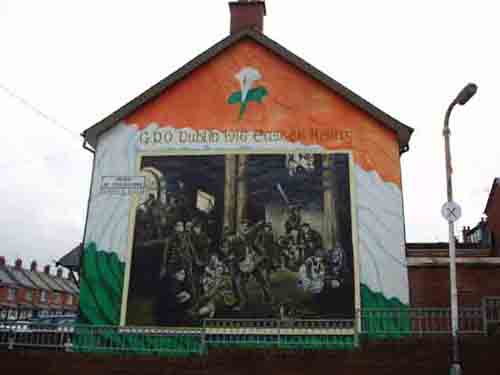
MacNeice writes as a part of a committed lefty poetic community in England, who comes from a country that had its revolution and is now sticky with its afterbirth. Unlike English retrenchment in the 30s in the face of a crumbling empire (the "Shrinking Island" described by Jed Esty), Ireland's localism was paradoxically what made it "big" enough to be divided against itself: both fringe and cause of the empire's dissolution. As MacNeice writes in The Poetry of W.B. Yeats (1941), Ireland's "characteristic smallnesses [by which he means population, income and even meals], while uniting the country against England which is regarded as essentially big, divide it against itself." Thus, for MacNeice it's both easy and not easy being green: easy because "the Irishman can trade on the glamour of minorities" but tough cause the modern world makes the "traditional Irish aim" of spiritual self-support (think the last chapter of Portrait) as impracticable in the small country as is material self-support.
As Esty writes, "the end of British hegemony was a fait accompli to the Auden-Greene generation...they inherited the cultural detritus and political guilt of empire without the corresponding advantages of metropolitan perception" (8). MacNeice partakes of this guilt, and it's weird that he does because he also (to borrow something he says of the later Yeats) can and does "parade his sensuality like a released prisoner conscious of his freedom" [for "sensuality" here read literally: some accumulation of sense data, all those newspaper details]. Esty describes the Auden generation's characteristic desire to eulogize English culture as one result of growing up at the start of shift toward England being home to a "minor literature"; and it might be worthwhile to compare this generational trend to MacNeice's relentless need to eulogize puritanical Ireland in the days of its history-fraught infancy (or, furthermore, interesting to put his eulogistic 'farewell...in perpetuum' alongside the Irish gothic tradition - still being well represented at this point by Elizabeth Bowen, among others - which could imply a need for constant eulogizing in traumatized response to the nation figured as constantly dying, being reborn, dying, etc.).
So, with these historical conditions perhaps too determinately in mind, check out all the images of fire freezing in MacNeice's early books. In fact, check out all of "Snow" from Jan. 1935:
The room was suddenly rich and the great bay-window was
Spawning snow and pink roses against it
Soundlessly collateral and incompatible:
World is suddener than we fancy it.
World is crazier and more of it than we think,
Incorrigibly plural. I peel and portion
A tangerine and spit the pips and feel
The drunkenness of things being various.
And the fire flames with a bubbling sound for world
Is more spiteful and gay than one supposes -
On the tongue on the eyes on the ears in the palms of one's hands -
There is more than glass between the snow and the huge roses.
A poem about portioning and about partition, with a little or a big "p", describing how borders create the things they separate. It is a view of snow falling past a window, as at the end of "The Dead," that conversely describes profusion, confusion, incompatibility rather than generality over Ireland. At the center is the lyric I as the familiar Joycean God, sitting back and paring his fingernails - here peeling a tangerine (i.e. specifically not an orange, to point the more obliquely at the Protestant majority in the North). His "spit" seems to grow without clear provocation to "spite" when reflected in the fire's mirror. MacNeice's omission of articles and pieces of sentences convey the sense that by imposing form the speaker is finding ways to deal with surplus and where to "leave" it, though this vague, spreading "more"-ness cannot be named and is "incorrigible" or incapable of reform/re-form.

As in the "Last Will and Testament" to which Evan pointed us yesterday, MacNeice's "Train to Dublin" (Sep-Oct 1934) ends with a list of gifts, including "I give you the disproportion between labour spent/ And joy at random". The last stanza is basically "Snow" in reverse ("suddenly rich" to "more than glass between" vs. "give you more" to "they are rich"):
I would like to give you more but I cannot hold
This stuff within my hands and the train goes on;
I know that there are further syntheses to which,
As you have perhaps, people at last attain
And find that they are rich and breathing gold.
The knowledge in the poem's closing "I know" is that of "half-thought thoughts divid[ing]" (line 1), or further portioning and division. Notice that the inability to maintain the surplus - "I cannot hold/ this stuff" - recalls Yeats's vision in "The Second Coming," where "the centre cannot hold". Yeats's vatic assurance that a new golden age is "at hand" comes down to stuff, falling apart, and an "I" put boldly but hazardously at the centre.
David Lloyd has argued persuasively that "A major literature is established as such precisely by virtue of its claims to representative status, or its claims to realize the autonomy of the individual subject to such a degree that this individual subject becomes universally valid and archetypal." MacNeice's best poems puzzle along on the fault line between the ability to assume that universality, especially as it would be an ordering principle, and the sense that systems of archetypes must be, if not rejected, at least revealed as systems. Yeats gave one particularly polarized model of Anglo-Irish claims to universality, as is stated in 1940 by a skeptical T.S. Eliot in a talk he delivered as the first annual Yeats lecture at the Abbey Theater (with Patrick Kavanagh in attendance), where T.S.E. notes "that in becoming more Irish, not in subject-matter but in expression, [Yeats] became at the same time universal." By the time of Autumn Journal, Yeats's "rough beast slouching" may as well be the diaspora, "Who slouch around the world with a gesture and a brogue/ And a faggot of useless memories" (section XVI, my italics). Much of MacNeice's book on Yeats is written with a flat objectivity that registers Yeats's fabrications about and of Ireland as strategic, rather than malicious or misinformed; and it is thus the next generation's task to try to be less strategic in the use of national history - more quotidian, less vatic reportage.
He writes, "Poets like Auden and Spender abandoned this feminine conception of poetry and returned to the old, arrogant principle - which was Yeats's too - that it is the poet's job to make sense of the world, to simplify it, to put shape on it" (223). Could it be said that in this sense MacNeice is both of and to the side of the Auden generation? To put a shape on the world is to begin portioning up the world, and will result, he knows, in an uncountable pile of spit pips.
Sunday, August 12, 2007
$$$ ₤₤₤ ₣₣₣ ℳℳℳ
 H0w much of the particular character of Modernism can be accounted for by major transformations in the world economy in the first 30 years of the century: e.g., the Panic of 1907 and subsequent bail-out by J.P. Morgan (see Williams' poem on this subject in Spring and All); the slow collapse of Germany's national economy under the mountain of national debts incurred after the First World War; and, climactically, the stock market crash of 1929? Think of some of the individual modernist authors who experienced drastic changes in their financial positions during this period, for these and a variety of other reasons: Proust; Eliot; Yeats; Woolf; Stephen Spender; George Oppen; Nabokov. (You'll have to help me out with the Americans, Adrienne. Didn't Faulkner's family lose a bunch of money? Or was that during Reconstruction?) For these writers, all of whom were raised in an atmosphere of affluence that was later significantly reduced or threatened, how could the expression of despair and cynicism one normally associates with the Modernist moment not also be, in some way, a panic fear about a change in their personal situations? (Others, of course, improved their situations in this period, notably Pound and Joyce — mostly because they were both relatively poor to start with. And how significant is it that, despite living until almost the end of WWII, Joyce never wrote any fiction set later than 1904, when all of these catastrophes were still on the horizon?)
Thus those who become writers during the time of Modernism often give the impression not of entering a new, higher rentier class (which would be the typical role of the author in the eighteenth and nineteenth centuries) but of giving expression to a certain loss of value, a certain fall from grace. (In contrast, the postmodernists — the Americans, anyway — are largely back in the upwardly mobile position, though at this point they are competing for smaller slices of the cultural capital pie, and those usually attached to positions at major American universities. In this context, Nabokov, who grew up as the child of liberal aristocrats, becomes an impoverished European émigré, moves to the U.S. and gets on the academic-job treadmill, and finally finds himself accidentally a Great American Author and rich and famous culture hero, cuts a particularly interesting figure.)
With these circumstances in mind, I can see why Anglo-American Modernism displays such a cautiously exploratory attitude toward the radical positions of Continental Modernism (Surrealism in particular), which by 1920 had largely accepted that important literature was now the province of either the radical Bohemian fringes or the future Marxist state.
So I think we need (if it doesn't exist already) a financial history of these and other relevant figures: an audit of Modernism, as it were. Who got poorer, who got richer, who was in danger and who was not, and how do these various positions affect their writing?
Yes, this has got me thinking.
Friday, July 13, 2007
Yeats on Owen
With that, I will arise and go now, and go to Nantucket.
Wednesday, July 11, 2007
"Let us go then, you and I…"
Tuesday, July 3, 2007
Renaissance to Reconnaissance
But last night I took a break from one war of attrition to entertain myself with another, watching Neil Jordan's 1992 film The Crying Game (it's on my Irish list and thus, technically, "work"). [I'm assuming we've all got the Boy George goods on this film, but in case I'm mistaken: SPOILER ALERT.]

The film begins with the seduction and kidnapping of Jody (a British soldier, originally from Antigua, played by Forest Whitaker) by the IRA, who will shoot him unless one of their political prisoners is freed. Eye-for-an-eye. Stephen Rea's character Fergus begins to identify with this soldier, another colonial, and befriends him. Jody tells Fergus about his "girl" in London, Dil. When the time comes to shoot the captive, Fergus hesitates, Jody runs, and is "hit by a Saracen" as the British pull up to blow the IRA holdout to pieces. Fergus escapes to London where he assumes the name Jimmy and seeks out Dil, with whom he begins an affair; he is constantly asking questions about Jody and having visions of him wearing cricket whites, pitching a wicked "wrong 'un". Then there's the big penis-reveal (actually, not that big) and Fergus's past comes back to haunt him (another dominatrix Kathleen ni Houlihan in the form of Miranda Richardson), and so on. (I don't want to spoil the whole thing.)
What I noticed on a second viewing of the film is the way the retributive economy of the opening scenario (eye-for-an-eye) is tested and rethought in the films second and third acts as the characters attempt to take one another's places, subjectively crossing divides of gender, race, nationality and sexuality (I-for-an-I). The plot is an ingenious attempt to extricate a "mate" from "stalemate", and it possesses all the optimism, ultimately, of a romantic comedy (an alternate ending, included on the new DVD of the film, ends with Jimmy/Fergus telling Dil, "nobody's perfect," a la Some Like It Hot; the true ending blares "Stand by Your Man" with a triumphant wink).
Insofar as Fergus, calling himself Jimmy in London, wants to take care of Dil in Jody's place, he continually speaks from the position of the dead, with whom he can never entirely identify. This is something I'm working through right now, especially in relation to poets like Owen and Rosenberg, and for my elegy list. So more on it soon.
But the film also comes in a tradition of cross-dressing and gender play in Irish drama which may have it's best start in Synge's Playboy of the Western World (where Christy exits in drag, having cocked up his stab at Oedipal violence) and continues in the plays of Frank McGuinness. McGuinness's 1985 play Observe the Sons of Ulster Marching Toward the Somme provides a shrapnel-scarred narrative of homosocial institutions and homosexual prohibitions in the traumatic landscape of "No Man's Land." McGuinness, like Jordan and Synge (and, I think, like Owen too, in his melodramatic, sado-masochistic anti-elegies), is investigating the potential for "camp" to subvert nationalism (by, as they say in the trenches, "going over the top") when he stages the ghosts of the 36th Ulster Division.

[[Of course, the name "Fergus" brings me to look back at Yeats's "Who Goes with Fergus?" and, though it doesn't connect particularly, it has one great effect worth noting here: check out how Yeats collapses all the sounds of "dance upon the level shore" in line 3 into the single word "dishevelled" (as in "dishevelled wandering stars") in the last line. Neat!]]
Sunday, July 1, 2007
Grumpy Old Modernism

Further conjectures about the premature senescence of Yeats, Eliot, Frost et al:
1. Thomas Hardy's age in 1898, the year his first volume of poetry (Wessex Poems) is published: 58. This unusual late debut makes him to a certain extent the Modernists' contemporary. His subject matter, moreover, is an old man's through and through: poems about friends and lovers dying, not being able to change things about yourself, rain on graves, etc. But in the figure of Hardy, age is not associated with a failing of powers (as it would have been in Tennyson or Swinburne) or even with a development or consolidation of old achievements (as with somebody like maybe Browning), but with a new aesthetic and a fresh start: Hardy, having experienced enormous disappointment and pain, is now finally ready to write and publish poetry. (Slight problem with this theory: Eliot didn't really like Hardy's work, and Yeats started publishing before him, so his example might not have meant much to them. Who did like him? Marianne Moore? But she's got to be one of the sprightliest of the Modernist bunch.)
2. The poets of the 1890s (especially Ernest Dowson and Lionel Johnson) were seen as dissolute, drunken messes who wasted their talent and died unnecessarily early deaths — i.e., as cautionary tales about what the post-romantic/aesthetic embrace of youth could lead to. Cf. Yeats' "The Tragic Generation," and Eliot's remarks on these people in the back of Inventions of the March Hare (quotes t/k?).
Thursday, June 7, 2007
Additional Fun Fact
Wilson's Castle

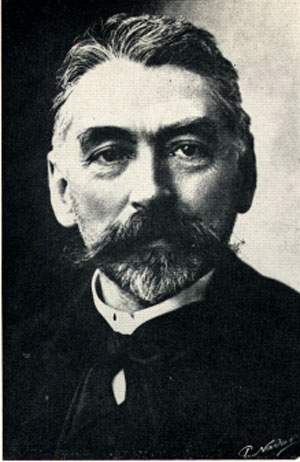
So I’ve been reading, alongside Papa Yeats, this crazy cat name of Stéphane Mallarmé. Don’t get me started. As I understand it, Mallarmé’s oeuvre is pretty much the beginning of French literature’s transformation from a highly classical, conservative corpus into what we know it as today: i.e. the sexy mess of decadence, philosophical theory, radical rhetorical gestures, delicate aestheticism and willful oddness that proves so endlessly generative for English and American literature over the course of our long twentieth century. I’ll try to say more about the actual poetry of M. Mallarmé in the coming days; I’m still coming to grips with it at the moment. It’s difficult stuff, especially for someone with as shaky a grasp of French as my recent experiences in Paris have just proven me to have.
Lucky for me, I have the most reassuring tour guide I could wish for, that redoutable Princeton alumnus Edmund Wilson. His first book Axel’s Castle deals with the legacy of French Symbolism in the work of several of the major Modernists, including Yeats, Eliot, Proust, Joyce and Stein. Wilson’s thesis, set forth in his first chapter, is that what we call Modernism is “not merely a degeneration or an elaboration of Romanticism, but rather a counterpart to it, a second flood of the same tide." Both Modernism (a term not yet in vogue by 1931, the year of Wilson’s writing) and Romanticism are seen as reactions against a rational, scientific view of the universe and human nature, which he associates with classicism and an obsession with perfected form, in favor of a more subjective aesthetic grounded in individual singularity, experience, and fantasy.
What I find more interesting than this basic framework is Wilson’s account of the triangulation of influence between American, French and English literature in the mid-19th century. According to Wilson, English literature had largely been running on its own steam, reacting to the anomaly of eighteenth-century classicism with the revolt of Romanticism and then a steady tempering of that impulse with Victorian poets, like Browning and Tennyson. Meanwhile France, which has a much stronger tradition of classicism than England, adopts the measures we associate with Romanticism, or even Elizabethan poetry (irregular meters, mixed metaphors) but value those measures not as though they were traditional but as though they were radical, which for French poets they were. “The French called [poetry written in English meters] vers libre, but it is ‘free’ only in the sense of being irregular, like may poems of Matthew Arnold and Browning." The technical innovations of Symbolism, then, are in a certain way only a catching up to what the English had already, unintentionally, done: “it will not be till the advent of the Symbolists that French poetry will really become capable of the fantasy and fluidity of [Shakespearean] English.”
Where America comes in, according to Wilson, is in providing a kind of late-Romantic aesthetic theory which the British, finding the gestures of Romanticism to be more or less conventional, had little interest in formulating. The French, on the other hand, eat aesthetic theory for breakfast, and so stuff like Poe’s theory of poetic composition (translated by Baudelaire in the 1850s) becomes a key basis of Symbolist thought and self-explanation. What we have emerging here is a picture where the British are Romantic, or anyway steeped in Romanticism, without even having to think about it; the Americans, having inherited the English language and culture, are slightly more prone to analyzing that tradition; and the French, emerging out of a completely different and more rigorous tradition, are dutifully striving after a freer, more irregular aesthetic which they feel they can only achieve by following the dictates of American literary theory. (I think, to a reader today, the similarity to the situation of New Critically-trained Americans attempting to absorb French existentialism and post-structuralism in the 50s and 60s will be immediately striking.) What the French really bring to the table, then, is an idea that the old Romantic ideas and methods are somehow new and unprecedented — and more than that, that their newness, their ability to bring about and sustain a sort of poetic revolution, constitutes their a priori literary value. Thus the revolutionary, generative strangeness of much late 19th-century French poetry is, in Wilson’s account of things, more a matter of revaluation than actual innovation; a decision that literature is at the beginning of something, despite historical evidence to the contrary.
Then there’s the question of the actual symbols used in Symbolism, and what they have in common with the more immediately readable symbols of a writer like Yeats. Greg mentioned Yeats’ investment in allegorical figures like Cathleen ni Houlihan as a hallmark of Modernism’s simultaneous oldness and newness, its appeal to ancient communal traditions without losing the emphasis on strangeness, fantasy and subjective experience which Romanticism had brought in. Wilson is very good on these matters, I think, and interestingly he seems to define French Symbolism in contradistinction to the sort of national and religious symbols Yeats is habitually attracted to: he says that "the symbols of Symbolism are to be defined a little differently than symbols in the ordinary sense – the sense in which the Cross is the symbol of Christianity or the Stars and Stripes is the symbol of the United States. This symbolism differs even from such symbolism as Dante’s. For the familiar kind of symbolism is conventional and fixed; the symbolism of the Divine Comedy is conventional, logical, and definite. But the symbols of the Symbolist school are usually chosen arbitrarily by the poet to stand for special ideas of his own — they are a sort of disguise for those ideas."
In light of this formulation, then, could we say that Yeats is applying the personalizing techniques of the Symbolists, which they used only for very specific idiosyncratic constructions without obvious referents (Mallarmé's faun, for instance), to the more definite symbols of conventional allegory, ones like a cross or a flag or a Cathleen or an Uncle Sam? In order to reveal how these seemingly “definite” symbols (Barthes, of course, would call them signs) are themselves “a sort of disguise for … ideas”? I think Yeats is both too much of a mystic and too much of a propagandist for the charge to really stick, but we could certainly say it of Joyce, and Yeats’ dual engagement with the arcane algebra of French Symbolism on the one hand and the rallying points of Irish national feeling on the other clearly points the latter author on his way. I’ll say for now that I’m very interested in how Yeats gets from attending Mallarmé’s salons in Paris where “literature was unknown as a trade” (according to Arthur Symons’ The Symbolist Movement in Literature) to being “the sixty-year-old smiling public man” of “Among School Children,” without ever fully renouncing the aesthetic stance of the former — and I’ve got a feeling this dual definition of the symbol as personal mask and cultural totem has something important to do with it.
Tuesday, May 29, 2007
old folks, home
Evan, hopefully you’re not worrying Paris with the later Yeats; but if the vacation has found café-front time for further reading, you’ve no doubt found that the “king of the cats”* follows that obsession with age for his entire long lifetime. The verses he deliberately set at the end of his collected poems, “The Circus Animals’ Desertion” and “Politics,” are both self-elegizing and a cyclical cosmic way of calling “do-over.” Take a look also at the many later poems that reflect on the accomplishments of Yeats and the Republic’s youth, in particular “Under Ben Bulben,” with its enjoinder,
Irish poets learn your trade
Sing whatever is well made,
Scorn the sort now growing up
All out of shape from toe to top,
Their unremembering hearts and heads
Base-born products of base beds.
Which, for poets writing in Yeats’s wake (esp. Irish poets), can either sound like a job description by the boss or like an old man shaking his fist at the kids playing on the damn lawn. And “Politics” never quite settles for me into being entirely saccharine or entirely poignant:
And maybe what they say is true
Of war and war’s alarms,
But O that I were young again
And held her in my arms.
(I’d be interested to hear if/how you think the place of sentimentality shifts throughout his career.)
I’m fascinated by this question of age too, especially insofar as late nights spent reading for generals will slowly blind me and the approaching exam will pull out my increasingly wispy hair, such that y’all can expect the full emergence of “Old Greg,” slouching toward McCosh Hall, sometime around the first week of September. But while I’m still chipper and spry, I’ll say this:
Your wonderful phrase “voluntary senility,” though especially apt given Yeats’s occasional tone of patrician weariness and creaking joints, sounds to me too much like he’s giving in to age, rather than forcefully claiming it in the face of broader cultural infantilization. It may be of use here to think of the imperative Irish literary nationalists faced around the turn of the century to forge an indigenous and rooted tradition – that is, to imagine the nation and its folk as both new-born and old with Gaelic tradition. Within that cultural fund are important precursors to the modernist age fetish, such as the allegorical Kathleen ni Houlihan (as in Yeats and Lady Gregory’s 1902 play) who appears as an old woman begging sacrifice of young Irish men, and who turns young and beautiful when they vow their love and lives.
The bardic voice might be the Romantic counterpoint to the “youth-cult” you mention, since Blake is a particular grandpappy to keep in mind for Yeats. For Yeats, there’s a willingness and a desire to make of himself a relic while, as you say, asking his rhythm to test ideas and words til they become old in the way polished stones in creeks are old. (I’ll have more to say on this topic of rhythm, but will wait until I’ve re-read the poems again. The use of repetition to tune words comes into Geoffrey Hill’s definition of a poem’s “perfect pitch” and his ideas about poetry’s civic responsibility to/in language). That is all to say that there is a future tense to Yeats’s past tense -- which gets to the famous, occasionally derided repetition in the determined first line of “The Lake Isle of Innisfree”: “I will arise and go now, and go to Innisfree.” Or the apocalyptic perfect rhyme at the center of “The Second Coming”: “Surely some revelation is at hand/ Surely the Second Coming is at hand.”
But if Eliot follows these geriatric gestures, do you think he does so in the same way? Has he internalized it in some way, 'psychologized' it (to be waaay too quick with that word)? And, since Adrienne mentioned The Public Burning, do y’all think old greybeard Uncle Sam is in any way comparable to Kathleen in the nation-as-beckoning-old-person figuration? Both somewhat menacing figures in their respective calls to arms.
Anyway, this is a very quick reply, and one that is not yet informed by Official Generals Reading, since I’m still finishing up some writing. My plan is to start with Thomas Hardy and, on my Irish list, with Douglas Hyde (to get at some of these issues of cultural nationalism and aging, in his Love Songs of Connacht, 1893, and his pamphlet “The Necessity for De-Anglicizing Ireland”).
*Evan already knows this: The night on which Yeats first heard of Swinburne’s death, he wrote in his journal, “Now I’m king of the cats.” Thanks to Jim Longenbach for that un.
****Perhaps not particularly surprising tidbit of the day: Ezra Pound was a bad dancer (according to H.D., in her memoir of Pound called “End to Torment”).****
Tuesday, May 22, 2007
The W.B.
 I figured I would begin with Yeats, since there are reputedly worse places to start in order to understand this whole Modernism schmegegge. Plus, he has the added bonus of being a major, major writer whose work I don't really know, other than a few isolated greatest hits. (As a matter of fact, I think I've avoided reading him until I had the opportunity to do something like this. Do either of you ever do that — save up authors you know you'll like, or that you know are important, until you can really focus in and give them your full attention? Stanley Cavell supposedly did this with Heidegger, waiting to read him until he was in his forties or something.)
And what do you know: the kid's pretty good! So far I am up through "Responsibilities" (published 1914) which I take it is kind of the middle of the middle phase. One thing that's been interesting is the sort of "a-ha" effect of recognizing Yeats' influence retrospectively on poets whose oeuvres I know quite a bit better: not just the obvious ones, like Pound and Eliot and Auden, but even people like Marianne Moore and Kenneth Koch, whose late poems especially are, I now realize, very Yeatsian underneath the surface craziness and Francophilia.
Anyway, I'll just note a couple of general features that strike me as I read, one thematic and one formal, possibly to be elaborated on further later:
1. Yeats' obsession with age — starting from very early on; there are poems from the perspectives of old men written when he was still very young, a habit he clearly passed on to Eliot. This is kind of a stock affectation among the Modernists for a while — I guess as a way of counteracting the youth-cult of Romanticism? Or am I missing some more obvious literary precursor to the tradition of voluntary senility?
2. His increasing, very admirable lack of fear about repeating words in poems. One of my favorite examples so far is from "The Secret Rose":
"… A woman of so shining loveliness
That men threshed corn at midnight by a tress,
A little stolen tress."
This is sort of a ballad-like device, but here it's not used as a refrain, nor is it exactly conversational: it's more like WBY was so pleased with the word he just wanted to use it again, immediately. Even better, perhaps, is this from "The Hour Before Dawn":
" … And he
Had dipped the wooden ladle deep
Into the sleeper's tub of beer
Had not the sleeper started up.
'Before you have dipped it in the beer
I dragged from Groban's mountain-top
I'll have assurance that you are able
To value beer; no half-legged fool
Shall dip his nose into my ladle
Merely for stumbling on this hole
In the bad hour before the dawn.'
'Why, beer is only beer.' "
To me this has a kind of mock-epic, even mythological, effect: "the beer" gaining, through repetition, something of the force of a Homeric epithet. But it also gives the impression of an extreme carefulness, like he isn't taking any chances and is deliberately restricting the range of his diction in order to get the rhythm absolutely perfect, beautiful, lifelike and metrical all at once. Which he does.
These are, quite possibly, two of the most obvious and stupid qualities of Yeats' poetry, but you've got to start somewhere, right? I don't know. What poems should I look out for?


