Showing posts with label Riding. Show all posts

Tuesday, August 21, 2007

Change of plans

I'm in a crisis. Originally I had planned to read English, American and a smattering of French poetry from 1870 straight through to 1970: basically the series that begins in Baudelaire and ends in John Ashbery, which we might reductively call French Poetry Coming In and Fucking With the English Tradition (or FPCIFWET for short). Piece of cake, right? In doing so, I'd hoped to avoid making a clear Modernism/Postmodernism break, basically relying on Ashbery's and the other New York Schoolers' productive re-readings of Modernism to help me tie it all up into a single revisionist Santa Claus narrative.

But now I think I need to stop at the 50s. It's just too hard to link it all together. Even by the beginning of the 40s the series is losing its internal coherence, everything is changing, you can feel it, the major Modernists are hardening into caricatures who can be toppled by the merest breeze of common-sense, England is a different England and America a different America and France is like the dozenth of a succession of different Frances, although not everybody in all of them seem to have realized it yet.

I'm reading Randall Jarrell's "The Obscurity of the Poet" today and the tone is so despairing and reactionary compared to earlier essays on Modernism and its social reception. The thing about this "early postmodern" period (let's say roughly 1940-1950) is that it can be easily overlooked because poetry doesn't actually change all that much: the work of Jarrell, Lowell, Berryman and Bishop seem pretty much like a natural outgrowth, maybe even a watering-down, of the expected Modernists like Yeats, Eliot and Auden, with Pound becoming ascendant in some of the more marginal quarters. But the self-justifications, and the climate in which such justifications seem necessary, are qualitatively different. The trajectory from Graves and Riding in 1927 (stubborn, brilliant resistance of Modernist dogma) to Burke and Wilson in 1931 (gentle skepticism about some of Modernism's larger claims combined with a firm laissez-faire attitude toward culture in general) to Jarrell in 1951 (hurt and freaked out that not just Modernism, but all poetry of all periods, is in danger of being permanently scrapped by the bourgeois democratic public) speaks volumes about the situation that eventually births full-fledged Postmodernism, in its heyday of 1960-1980, the simultaneous sprint into the arms of theory on the one hand and systematic dismantlement of Modernist prejudice and sense of superiority on the other.

Consider these representative excerpts from Jarrell's essay: "it is not just modern poetry, but poetry, that is today obscure" (3); "the poet seems difficult because he is not read, because the reader is not accustomed to reading his or any other poetry" (4); "Any American poet under a certain age, a fairly advanced age — the age, one is tempted to say, of Bernard Shaw — has inherited a situation in which no one looks at him and in which, consequently, everyone complains that he is invisible" (10); "today, many of the readers a poet would value most have hardly learned to read any poetry; and many of those who regularly read his poems have values so different from his that he is troubled by their praise, and vexed but reassured by their blame" (15); "the poet is a condemned man for whom the State will not even buy breakfast" (18); and finally, lazily, late-fortiesishly pinning it all on popular culture: "Boys who have read only a few books in their lives, but a great many comic books, will tell one, so vividly that it is easy to sympathize: 'I don't like books because they don't really show you things; they're too slow; you have to do all the work yourself.' When, in a few years, one talks to boys who have read only a few comic books, but have looked at a great many television programs — what will they say?" (19).

What these statements, en masse, add up to is an idea that Modernism, in its public character as a project of popular re-education, has utterly failed, not because of any lack of persuasiveness on its own terms but because the bottom fell out: there's no public worth convincing any more. As Jarrell himself admits, he can only be sure of this failure because he once passionately believed in such a project. (A quick perusal of his essays on Moore and Williams confirms this: he's drunk the Kool-Aid, all right.) As he puts it, "these are conclusions which I have come to slowly and reluctantly, as the world forced them on me. Would that I were one of those happy reactionaries, born with a Greek vocabulary as other children are born with birthmarks and incomes … But I had a scientific education and a radical youth; am old-fashioned enough to believe, like Goethe, in Progress — the progress I see and the progress I wish for and do not see. So I say what I have said about the poet, the public, and their world angrily and unwillingly." Even more discouraging is Jarrell's proposal for responding to this failure: "If my hearers say, 'But what should we do?' what else can I answer but 'Nothing'? There is nothing to do different from what we already do: if poets write poems and readers read them, each as best they can — if they try to live not as soldiers or voters or intellectuals or economic men, but as human beings — they are doing all that can be done" (21). In other words, the public apparatuses of Modernism are no longer worth wielding against a public that is more disinterested than it is hostile. Therefore, no more manifestoes, no more false claims to importance: the postmodern, for a while anyway, will take the path of least resistance. This is giving the argument up for dead, the argument for Modernism or for literature and art in general, not because art isn't something that can or should be argued about (Graves' and Riding's position, as I understand it) or because the argument is incorrectly framed (Burke's and Wilson's position), but because the argument is unwinnable. Which is a very different thing.

So: Postmodernism, for my purposes (for now), starts around about 1950, when all the arguments for and against Modernism (if not Modernism itself) are exhausted and familiar. There is an interregnum of a decade or so before there are theoretical issues to get worked up over again — namely, whether we ought not to do something to, and with, contemporary poetry after all — though this time they will be fought out almost entirely inside the academy, and be more markedly metaphysical than social in character.

And I need to stop here. I'm fascinated by this shift, I love some of the poetry that results from it, I want to know everything about it, but, for God's sake, you have to stop somewhere — sometimes. Plus we have World War II to worry about.

Next week I'm gonna read a lot of Hugh Kenner and try to make sense of my life.

Friday, August 17, 2007

Highlights from the Last Will and Testament of W.H. Auden and Louis MacNeice

As put down in 1937's Letters from Iceland. It's an amazing poem, a crazy mixture of undergraduate in-jokeyness, sincere political concern, and a sort of passionate desperation to bid farewell to the "low dishonest decade" of the 30s three years early. You get the feeling that Auden and MacNeice really believed they were going to die soon, or that the world would end. These were some of the choicer bits that I copied out in the New York Public Library; I really need to get a copy of this for myself:

"First to our ancestors…
We leave the values of their periods,
The things which seemed to them the things that mattered"

"all the lives by France gently stopped
We leave to Rome"

"Item, to Wittgenstein who writes such hits
As the Tractatus Logico-Philosophicus
We leave all readers who can spare the wits"

"…the Surrealists shall have
J.A. Smith as an Objet Trouvé in disguise."

"To our fellow writers, to the whole literary race
The Interest itself in all its circumstances
That each may see his vision face to face."

"To our two distinguished colleagues in confidence,
To Stephen Spender and Cecil Day-Lewis, we assign
Our minor talents to assist in the defence
Of the European Tradition and to carry on
The Human Heritage."

[W.H.A.] "For my friend Benjamin Britten, composer, I beg
That fortune send him a passionate affair."

"…to Alfred Hitchcock, with sincerest praise of Sabotage"

[L.M.] "a copy of Marx and £1000 a year
And the picture of Love Locked Out by Holman Hunt"

[both] "To Dylan Thomas a leek on a gold plate"

"A terrible double entendre in metre or in prose
To William Empson"

"We leave with our best compliments the Isle of Wight
To Robert Graves and Laura Riding, because
An Italian island is no good place to write."

"The twin towers of the Crystal Palace we would leave
To Leonard and Virginia Woolf"

"our pudenda we leave or rather fling
Our biographers and The Thames Conservancy Board"

"Our humour, all we think is funny,
To Dr. Leavis and almost every psychoanalyst"

[W.H.A.] "hope that Erika, my wife, may have her wish
To see the just end of Hitler and his unjust rule"

[both] "We leave their marvelous native tongue
To Englishmen, and for our intelligent island pray
That to her virtuous beauties by all poets sung
She add at last an honest foreign policy."

Saturday, July 28, 2007

The End of the 20s (Part 1)

Monday: T.S. Eliot vs. Ezra Pound
Rematch! This time Eliot fared a litle better: I read his two works published in 1925, "The Hollow Men" and two scenes from his unfinished first play Sweeney Agonistes. What I'll remark on here is the fact that, three years after The Waste Land, it's as if Eliot has wholly compartmentalized the two sides of his poetic personality: "The Hollow Men" has all the oracular gravitas, the violent imagery, the mantraic repetitions, the dried-out landscape, just as if it were a continuation of "What the Thunder Said." Sweeney Agonistes, on the other hand, has all the dark humor, dramatic interest, and fascination with pop culture and the underclasses typical of "The Burial of the Dead," "A Game of Chess" and "The Fire Sermon." I wonder if this was a reaction to negative criticism of The Waste Land as being too divided, or schizophrenic? It would be interesting to compare Eliot's use of repetition in the two works: the first operating more, I guess, "poetically" (the words taking on strength and symbolic/rhetorical power through reiteration), and the second more idiomatically, to indicate the inadequacy of contemporary conversation. (Words to live by: "I gotta use words when I talk to you / But if you understand or if you dont / That's nothing to me and nothing to you / We all gotta do what we gotta do," Complete Poems, 84). Of course, the two might not really be so different after all… In any case, I find Sweeney (which I'd never read before) by the far the more intriguing piece of writing, particularly in its recordings of the language of American businessmen (named, um, Klipstein and Krumpacker), an idiom which Eliot had now been separated from for about a decade. (There are no Americans in The Waste Land, are there?) There's a kind of conflicted loving irony in the way Eliot presents these characters; it reminds me of John Ashbery's remarks about his addiction to American newspapers and comic books when he was living in Paris in the early 60s.

As for Pound, I read the first sixteen Cantos (first published together in 1925). If Eliot was trying to separate out the strands of his sensibility in this period, Pound was clearly going in the other direction: developing the "ply over ply," hopelessly texturally enmeshed style that becomes literally inescapable for him in his later work. I don't have much to say about The Cantos (yet) except that they become much more fun to read over time, once you stop worrying about "getting it" (or worse, agreeing with it) safe in the knowledge that no-one ever really has or will and just bask in its shameless Poundness. I also never noticed before how many animals there are in the beginning of the poem, especially cats. Modernists love their critters!

Winner: Eliot.

Tuesday: Langston Hughes vs. E.E. Cummings
What these two dudes have in common is a reliance on a semi-consistent "poet" persona: they both usually write in the first person, tackle time-honored topics like love, nature and sadness, and in many ways dispense with more than a century's worth of abstruse poetic theory in order to embody the good old Wordsworthian values of "a man speaking to men" and "emotion recollected in tranquility." Though adopting such a mode might seem like the path of least resistance today, in the context of both High Modernism and traditional verse culture of the 1920s, it does feel fairly radical — and, of course, radically populist.

I think Hughes could do this because he was stepping into a cultural role that, by 1926 when The Weary Blues was published, was firmly, if newly, defined: that of a "Negro poet." Because writers like Countee Cullen and Claude McKay had preferred to demonstrate competence in traditional English versifying in order to back up their claims of racial and social equality, Hughes' insistence on using loose, non-English forms like the blues and Whitmanian free verse is especially provocative, opening himself up to hostile charges of simplicity, primitivism, or illiteracy. But it also gives his work the force of naturalness, and allows his inexhaustible talent for image selection and turn of phrase maximum room to maneuver. (I'm also interested, and this something to return to, in the traces here and there of a Symbolist inheritance in Hughes, though, particularly from Verlaine, in a poem like "Black Pierrot," for instance. What did Hughes read?)

One could make the argument that Cummings is playing with the expectations engendered by a similar readymade role, "the modern (or modernist) poet." Cummings' first book was published in 1922, the year of The Waste Land and Ulysses, "the year modernism broke," making him sort of New Wave to Joyce and Eliot's Punk: the slightly belated successor who can come in and benefit from the cultural capital accrued by previous experimentation (it is true, I think, that Cummings was more popular, at least in America, than any of the more reputable High Modernists). Cummings, at least by the time of is 5 (which I read), is aware of this precarious position and uses it to generate effects within his poetry: "what's become of (if you please) / all the grandja / that was dada?" (is 5, 11). Likewise all his unabashed liking for jazz and Krazy Kat, which Greg's analyzed well already. In Cummings, I see one of the first American expressions of what Stanley Cavell eventually comes to call a signal feature of modernist art: "the possibility of fraudulence" (Must We Mean What We Say?, 176). He exaggerates the distance between his technical oddity and his lyrical ego to the point where he's almost a "poet" before he is a writer of poetry. (One indicator of Cummings' almost Duchampian provocativeness is his extensive treatment in Laura Riding and Robert Graves' 1927 Survey of Modernist Poetry, which effectively calls Cummings' bluff by deciding that he is a real poet after all — just not a very interesting one.)

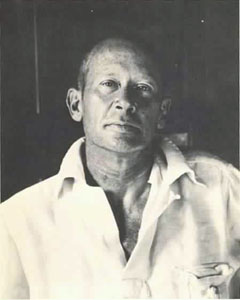
In any case, I think he certainly sets the stage for the Beats, and their particularly male forms of poetic self-display (and incidentally, take a look at that photo: EEC's definitely the buffest Modernist by a considerable margin).

Winner: Hughes. When it comes down to it, Cummings, for all his historical importance and surface amiability, is just too jokey — without being all that funny.


I'm going to stop at hump day for the time being, but there's more to come. Next up: Hart Crane vs. the Atlantic Ocean!

Tuesday, July 24, 2007

File Under Krazy

From the foreword to E.E. Cummings' is 5 (1926):

"At least my theory of technique, if I have one, is very far from original; nor is it complicated. I can express it in fifteen words, by quoting The Eternal Question and Immortal Answer of burlesk, viz. 'Would you hit a woman with a child? — No, I'd hit her with a brick.' Like the burlesk comedian, I am abnormally fond of that precision which creates movement." (vii)