Showing posts with label Whitman. Show all posts

Wednesday, April 16, 2008

Director's Cut

So I'm preparing my conference paper for the 26th, which is largely composed of quotations from letters by famous poets writing about little magazines, followed by tiny little commentaries from me. However, there a few choice quotes I'm not able to fit into the paper proper. Once again, legitimate academia's loss is the blogosphere's gain! Behold:

Randall Jarrell on the Partisan Review coterie:

“Although its politics are doctrinaire and academic in that funny New York professional-left way, they haven’t prevented it from printing other groups, Stalinists excepted. It’s an awfully shrewd, professional, competent magazine, so far as the editing is concerned. The worst things about it are its extraordinary limitations and lack of imagination: everything is looked at from the point of view of someone who’s semi-Marxist, fairly avant-garde, reasonably Bohemian, anti-bourgeois, cosmopolitan, anti-Stalinist, lives in New York, likes Mondrian, etc., etc., etc. It assumes that New York is the Paris of America, that the United States is Europe all over again, a backward Europe: in fact, it’s barely an American magazine, and always sinks with a sigh of joy into the friendly harbor of Sartre, Camus, [unreadable], the great European writers. (This Sartre-Camus isn’t my joke: I heard two of the editors said to me saying that American writers would be as good as Camus and Sartre if they had a movement like existentialism to organize and inspire them.)”


William Carlos Williams on Poetry:

“I have come to distrust the magazine Poetry. We are not fostering kindergartens and there’s no use paying good money for the sake of sentimentalizing over some new writer prodigy unless he produces. And if he does produce and is a prodigy there us [sic: is] no room for him in a mag like that because of ‘previous commitments’ with the young. It’s a rotten policy and produces unreadable drivel. The general criticism offered is litte [sic: little] better. Once in a while something does happen, of course, but that isn’t the point. The critical standards involved are woefully sophomoric. I don’t see any sense in paying good money for that. Perhaps such a first step should be retained because of its undoubtedly important history, perhaps there is no other way to serve the newcomer - keep the door open and all that. A hell of a lot of cheap stuff wanders in though. Certainly it’s unattractive to me.”


Edmund Wilson on The Kenyon Review:

“The Kenyon Review is indescribably awful.”

And on The Sewanee Review:

“Allen Tate, before he left the Sewanee, never succeeded in lifting the shadow of the influence of J.C. Ransom or being able to refuse filling its space with the writings of his cousins and aunts.”


Similarly, Kenneth Burke on Kenyon:

“I can’t discuss the matter at any length. For, honest to God, I just don’t know. Ransom gets all the farm boys to wiping the mud off their shoes in the name of ‘nice’ thinking – and the choice seems to be between that and muddy thinking.”


And, finally, Williams on better days:

“The vistas are limitless. But had damn well better be limited if any good is to be done.
“I think I’d vote for Whitman, in his time."

Tuesday, September 25, 2007

Translatedness

comes into American poetry in a big way in, or at least by, the mid-1950s. By this I mean not just the foreign but the obviously translated, the slightly awkward, the conspicuously non-American and non-English. Exhibit A: Frank O'Hara's Meditations in an Emergency (1957), particularly the poems "The Hunter" and "On Looking at La Grand Jatte, The Czar Wept Anew":

"He went to strange hills where
the stones were still warm from feet,
and then on and on. There were clouds
at his knees, his eyelashes
has grown thick from the colds,
as the fur of the bear does
in winter. Perhaps, he thought, I am
asleep, but he did not freeze to death." (CP, 167)

"He cannot, after all, walk up the wall. The skylight
is sealed. For why? for a change in the season,
for a refurbishing of the house. He wonders if,
when the music is over, he should not take down
the drapes, take up the rug, and join his friends
out there near the lake, right here beside the lake!
'O friends of my heart!'" (CP, 63)


The tone in these passages is odd but not too odd, less formally idiosyncratic than idiomatically off. A phrase like "the fur of the bear" could easily be made to sound less ridiculous (probably not O'Hara's purpose in this poem which, like so many others, verges on camp mockery) but the juxtaposition of images (frozen eyelashes and bear's fur) wouldn't be as striking if it were smoothed out that way. Even more noticeably, "For why?" is not exactly English: it's the sort of endearing mistake non-native speakers make all the time, but which in a poem achieves an uncanny effect unavailable to "Why?" or "What for?" The sense I get is that O'Hara is tentatively approaching, through parody, a style that in the 70s and 80s actually becomes a mainstream mode of American poetry, with Deep Image, Charles Simic et al: a style whose hallmark is the combination of a semi-colloquial simplicity coupled with a more formal-seeming resistance to contractions ("I am" not "I'm," "should not" not "shouldn't").
This is happening in other avant-garde work of the time, too. Exhibit B: Jack Spicer's After Lorca (1956), which purports to be an actual volume of translations though, as the ghost of Lorca writes in his introduction, "Mr. Spicer seems to derive pleasure in inserting and substituting one or two words which completely change the mood and often the meaning of the poem as I had written it" and "there are an almost equal number of poems that I did not write at all (one supposes that they must be his) executed in a somewhat fanciful imitation of my earlier style" (11). The poems themselves are good but, to me, unremarkable; however,
they are interspersed with fascinating micro-manifestoes, in the manner of Williams' Spring and All, which explicitly throw over Modernist precepts by declaring that the specific words of the poem, and whatever intricate changes are wrought on them, do not matter, since all such tinkering is doomed to be lost in translation anyway. Here's one of the more provocative moments:

Most of my friends like words too well. They set them under the blinding light of the poem and try to extract every possible connotation from each of them, every temporary pun, every direct or indirect connection — as if a word could become an object by mere addition of consequences. Others pick up words from the streets, from their bars, from their offices and display them proudly in their poems as if they were shouting, "See what I have collected from the American language. Look at my butterflies, my stamps, my old shoes!" What does one do with all this crap?

Words are what sticks to the real. We use them to push the real, to drag the real into the poem. They are what we hold on with, nothing else. They are as valuable in themselves as rope with nothing to be tied to. (Collected Books of Jack Spicer, 25)

Note that Spicer's reasons for writing in this style is not metaphysical but rhetorical: it's not that he values "the real" in and of itself, but that he wants his poems to last, and to travel. Haunting the first of these paragraphs is a judgment that two of the most influential strains of Anglo-American Modernism in the first half of the 20th century — the "blinding light" school of Eliot and Empson and the "stamp collection" school of Moore and Pound — are not aging, or translating, well. (This might also be the place to note that Spicer, like O'Hara, comes to this partial rejection of Modernist aesthetics through the oblique channels of camp. After Lorca is a very funny book.)

Final question: is this kind of thing really new? Though imitation of non-English sources had been going on for a long time (at least since Whitman, and probably earlier), most of those give the impression that the writer read those sources in the original: they imitate them as they were familiar with the work on its own terms, trying to replicate some quality in the language. Or, more rarely, they just ignore the poem's original linguistic presentation and engage them solely on the level of theme. But part of what interests Spicer and O'Hara, in different ways and for different reasons of course, is the style of translation itself, and the then-novel fact that they're even able to read poetry so geographically and linguistically remote from them as if it were written in English. (To my mind, this also distinguishes what they're doing from Pound's material reminders to the reader of his work's translatedness — "lie quiet Divus" and the like — which still imply a first-order encounter with the original text, won through the poet's own attention and labor.)

That's all I got for now. But the magazine New World Writing, which appeared from 1952 to 1959 and which O'Hara mentions in a later poem (he buys it in order "to see what the poets in Ghana are doing these days"), might be an interesting place to look in pursuing this question.

Monday, September 24, 2007

Howl, New Jersey, Holla

Have either of you looked at a little book called The Poem that Changed America: "Howl" Fifty Years Later? Silly title, I know, but it's actually pretty useful. The collection is edited by Jason Shinder, Ginsberg's personal assistant from the late 70s on, and his introduction is kind of embarrassingly idolatrous and not very well-written. But the volume does bring together a number of interesting reactions to "Howl" (by, among others, Amiri Baraka, Marjorie Perloff (who argues that Ginsberg is a direct inheritor of Modernism [OK, fine, whatever] and that "Howl" is really about WWII [more interesting]), Billy Collins (!), John Cage, and Rick Moody) as well as including a facsimile of the original mimeographed edition, which "costed [sic] $10.00 typed by poet Robert Creely [sic] dittoed by Martha Rexroth transported by me to the hands of Robert Lavigne [sic] in exchange for several drawings," according to Ginsberg's inscription. (Doesn't $10 seem like kind of a lot of money for 1956? Seems like one could do a Lawrence Rainey-esque analysis of the economics of this first presentation.)

A couple of remarks about the poem itself: has anyone written on the possible influence of W.H. Auden on Ginsberg? Auden is mentioned in Shinder's preface as one of Ginsberg's "'enemies'," but also an "eternal presence": I don't know much about their personal relationship. But on this reading I notice quite a few touches which seem Audenesque; for one, the unexpected dropping and adding of definite articles (examples include "the drear light of Zoo" and "the last fantastic book thrown out of the tenement window"). This is something Auden does a lot, and I think the effect in his poems is usually to either particularize or universalize the rhetorical situation of any given poem: kind of a Zoom-In/Zoom-Out effect. In "Howl," Ginsberg utilizes this to keep the reader involved on a macrosociological level ("this is an important poem: it's about a generation, it's about a nation, it's about history") and on a more micro-, affective/emotional level ("this is about the author, his friends, his mother, or me"). It's a technique Whitman uses too, of course, but Ginsberg's interest in including shabby, sordid or ironic details which temporarily undercut the grandeur of the macro-phrases (e.g. "in beards and shorts with big pacifist eyes sexy in their dark skin passing out incomprehensible leaflets"; compare "Spain 1937") is closer to (early) Auden, I think.

Second idea: Ginsberg's insistent return to New Jersey place names ("Paterson," "Newark," "the filthy Passaic," etc.), among, admittedly, a lot of other place names, has to be understood, in its historical context, as a very complicated rhetorical move. Because New Jersey was not just where Ginsberg was from, and thus a signifier of the "real" or the "autobiographical," but also, by the mid-1950s, a landscape that was newly literary, thanks to the ecstatic critical reception of William Carlos Williams' still-in-progress Paterson. As Perloff points out her chapter on him in The Poetics of Indeterminacy, the publication of Paterson had finally secured a major reputation for Williams, long considered a marginal figure of the Modernist movement. Thus Paterson, which ten years earlier would have been fairly meaningless as a literary signifier, now evokes a whole complex of ideas about Modernism and American poetry that Ginsberg slyly insists upon. (And WCW also wrote the introduction to Howl's first commercial edition, as Adrienne pointed out months ago.)

Anyway, it's interesting to think of the symbolic capital that New Jersey acquires in this period, as the breeding ground of the only ideologically correct,* homegrown version of High Modernism (Williams') as well as the most incendiary updating/challenging of the academic version of Modernism: significantly a humble state, in proximity to a great metropolis but not containing it, a place synonymous with the simple, homely and plain, which also just happens to be the site of some of the worst industrial exploitation and ecological spoilage in the entire country. This is quite a different pole to orient us than London or New York, and the attitude of its writers to it is also significantly different: sure, it's a waste land, they tell us, but it's our waste land, and we like it that way. And this in turn might have something to do with the remarks by Leslie Fiedler that Adrienne just posted, about the American mediation (some would say adulteration) of Modernism through regionalism. But I'm getting hungry, so I'd better stop here and drag myself through some Brooklyn streets to go looking for a sandwich fix.

* If you ignore the Communism.

Sunday, July 29, 2007

Fiedler on Crane (via Whitman)

I'm reading some Fiedler tonight and he has an essay called "the Images of Walt Whitman"; starting with Whitman's own creation of an avatar of Walt Whitman and following his reception globally (what Whitman came to mean in Russia, Europe, etc.), ideologically (Marxists, New Critics, etc.) and his flux in reputation among Americans.

Fiedler writes that in the Cape Hatteras section of The Bridge, Crane's ode to Whitman is what does the poem in for so much criticism. He says, first of all, its not Crane at his best, and even Crane acknowledged this in a letter to Allen Tate..."It's true that my raphsodic address to him in the Bridge exceeds any exact valuation of the mind..." Fiedler says Crane had to work up this ode to Whitman, work up this version of Whitman via America, whether he believed it or not.

Fiedler writes that "the failure of The Bridge was interpreted not as Crane's failure, but as Whitman's. Tate, Blackmur and other seconded Winters and this judgment of the Whitmanian imago via the Bridge soon became a standard conviction of the 'new critics'."
Fielder than writes that, according to critic Van O'Connor, to follow Whitman is to follow the 'bad strain' of American fiction. It's Whitman vs. the tradition from Hawthorne to Melville through James and Eliot in the battle for American literary tradition

Before this, Fiedler traces Whitman in relation to Pound and Amy Lowell. It's really a beautiful essay. All should read!

Best passage:
"One does not easily come to love a poet who is used as a weapon against oneself and one's favorite writers. And Whitman has become precisely such a weapon in the hands of those who condemn Eliot or Pound on the grounds that they have rejected all that Whitman affirms. It is vain to retort with the commonplace that 'poetry affirmeth nought' for Whitman has taught us otherwise. Besides, it is turn and turn about; once the sides were chosen up--Baudelaire against Whitman; Poe, Melville, or Hawthorne against Whitman; Eliot against Whitman--warfare was inevitable. You cannot beat Whitman over the head with Eliot and be surprised when the process is reversed. Such conflicts have a certain strategic value so long as we remember that the causes for which they are fought are not really the poets who bear the same names, but merely their images, tricked out to horrify or allure. Whitman is no more devil than messiah. He is a poet whom we must begin now to rescue from parody as well as apotheosis."

The End of the 20s (Part 2)

Wednesday and Thursday: Hart Crane vs. Harold Bloom and R.P. Blackmur
I took two days for Hart Crane, because I was determined that this time I was going to learn to like him. Without quite knowing why, I've never quite gotten the big deal about Crane; even Angus Fletcher couldn't convert me, and that guy is pretty persuasive, so I was more or less ready to give up on him after one final graduate-school try. That's not quite what happened, though; read on…

Part of the problem, I suppose, is that a lot of other people haven't quite decided whether they like Crane either. If most of the Modernists have clearly benefited from the influence of academic criticism, and the New Critics in particular, then Crane has probably mostly suffered. Certainly he suffers, in my opinion, from having such a pompous defender as the latter-day Harold Bloom, one of whose ubiquitous introductions adorns my copy of The Complete Poems of Hart Crane. It begins, unpromisingly: "Born in the year 1930, the year Hart Crane published The Bridge, I never reflect on that year of my birth without also meditating on Crane's visionary epic" (xi) — I know just what you mean, I feel the same way about The Muppet Movie. Bloom (who says he's been reading Crane since the age of ten!) spends much of his introduction talking not about Crane but about his critical reception, including (of course) Bloom's own late, heroic intervention in that reception, a story which allows him to do a lot of name-dropping about how he convinced Empson and Kenneth Burke to like Crane after all.

For all his trademark windbaggery, though, Bloom does put his finger on the big historical problem with Crane: as the one Modernist who openly embraces the heritage of Romantic-era American poetry — running from Whitman through Dickinson — he is easily detachable from the master-narrative of early 20th century literary history, which states that the important Modernists either rebelled against Romanticism or repressed it. Of course, this same apostasy makes him perfect for Bloom's counter-canon, which essentially regards Modernism as an enormous distraction from the genuine series of strong American poets, which goes (say it with me now) Emerson-Whitman-Dickinson-Stevens-Crane-Ashbery. Seen in this light, Crane is either everything or nothing: either the one visionary Romantic who saw through Modernism's revisionist narrative (Bloom's take), or an ambitious also-ran who failed to get with the program of the moment, to his work's and reputation's detriment (R.P. Blackmur pretty much sums it up when he attributes to Crane's work "the distraught but exciting splendor of a great failure," 316).

Both schools of criticism deal with Crane by treating him as an exception, and this seems unfair, because in the end Crane's not so radically (or conservatively) different from his Modernist compeers: he's clearly read a lot of the same books (White Buildings has epigraphs from Rimbaud and Ben Jonson); has the same love/hate relationship to democratic institutions and popular culture; in fact, on the evidence of The Bridge, he would've been a better standard-bearer for early Eliotic critical values than Eliot himself ultimately became.

What he is is slightly belated, in much the same way as Cummings: that is, his work emerges first into a climate of criticism founded on essentially the same tenets in which he himself believed. Presumably poets like Pound, Eliot, Moore and Williams gained something from bringing their work first in an atmosphere of general incomprehension: it allowed them to experiment more recklessly, and to exhibit a wider range of quality and "neatness of finish" (to borrow a borrowed phrase from Marianne Moore). They didn't have to worry about producing perfect poems, because there was no clear standard of perfection: the criteria to judge their poetry didn't yet exist. It's no wonder, then, that in some cases (notably the case of Eliot) their reputations would swell to gigantic sizes: such overcompensation was necessary to counteract the assumed prevailing hostility, whether it really existed or not. (This is, naturally, the story of postmodernism as well, as it was advocated for by cheerleaders like Charles Altieri and Marjorie Perloff. Thank you for allowing me a Jim Longenbach moment.)

By the time the likes of Blackmur and Burke were writing, though, Modernism had Modernist critics to contend with, critics eager to do something with their criteria besides enshrine new demi-gods. Thus poets who began publishing after 1922, lacking sufficient time to gain the prestige of incomprehensibility, were at a serious critical disadvantage. You can sense the passion which Blackmur brings to demonstrating that Crane is almost, but not quite, a great poet; he mercilessly picks apart Crane's obscurities in order to judge whether or not they are earned, and you can't help but feel that if he were to apply these same tests to many of his beloved Stevens' lines, he'd be forced to reach the same conclusions. (In this criticism of small differences you can really see the influence of Blackmur on his student Michael Fried: compare the famous ending of his 1968 attack on minimalism, "Art and Objecthood.")

So, in short, I think the problem is not so much that Crane was "a High Romantic in the era of High Modernism" (which is how Bloom puts it) as that he was a High Modernist in the era of High Modernism. He had the disadvantage to be writing in a period when, to some degree anyway, Modernism had become the norm: when the burden was not on the critics to find some redeeming value in the work of les jeunes but on the poets to measure up to the established recent canon. Many of Crane's poems, interestingly, include anxious references to books or pages, a habit he may have picked up from Mallarmé but which also places him as a reader of Modernism and not simply a writer of it, and which may bespeak a fear of close reading that his immediate predecessors didn't have to suffer (they were presumably more worried about being read at all). Examples include "Possessions" with its "page whose blind sun finally burns / Record of rage and partial appetites"; "Passage" which seems to meditate on some obscure connection between plagiarism ("my stolen book in hand") and self-plagiarism ("Memory, committed to the page had broke"); and the "scattered chapter" Crane tries to recover "At Melville's Tomb." (He also writes quite a lot about "hair," here and in The Bridge; not sure what to make of that.)

All that said, I think I basically agree with Blackmur that most of Crane's short lyrics in White Buildings don't really come off, though there are extraordinary lines in almost all of them. (Bloom would probably tell me to shut up and come back when I've read more Shelley.) The Bridge, though, is another story. I'm not sure that I've read the entire thing before, and on this reading I finally see why Crane's reputation rests on it: it really is one of the great long poems of the 20s. Blackmur's major criticism of it is that "Crane had the sensibility typical of Baudelaire and so misunderstood himself that he attempted to write The Bridge as if he had the sensibility typical of Whitman" (303-304); that is, he was a natural representative of "the school of tortured sensibility" writing in the affirmative heroic/patriotic mode of "Song of Myself." I wouldn't say Blackmur's wrong, but I would contend that this unlikely cross between Baudelaire and Whitman is exactly what's interesting about The Bridge. But of course I would say that, because in many ways it looks forward to what the New York School poets would eventually be doing: Frank O'Hara in particular, who absolutely insists on a productive tension between poétè maudit-esque "tortured sensibility" and Whitmanian democratic grandeur. (This was kinda, sorta what I wrote about in my paper on O'Hara for Jeremy's class; Jeremy, if you're reading this, I'm sorry I didn't make this clearer at the time.) A fuller reading of Crane's poem will have to wait until I have some more time on my hands, but let me just remind myself to consider it alongside O'Hara's "In Memory of My Feelings" some day — I think the contrast would be revealing.

Winner: Crane!

Friday, July 20, 2007

D.H. Lawrence is Twee as Fuck

From "Tortoise-Shell":

"It needed Pythagoras to see life playing with counters on the living back
Of the baby tortoise;
Life establishing the first mathematical tablet,
Not in stone, like the Judean Lord, or bronze, but in life-clouded, life-rosy tortoise shell.

The first little mathematical gentleman
Stepping, wee mite, in his loose trousers
Under all the eternal dome of mathematical law." (Birds, Beasts & Flowers, 115)

I won't even get into "Bibbles," where he calls his French bulldog "[y]ou little Walt-Whitmanesque bitch."

Thursday, July 12, 2007

EXTRA! EXTRA! Sandburg's class war looks toward Great War!

Check out Sandburg's draft card. Gray eyes. Sexy.

Anyway, I'm finding Sandburg more complex than I had remembered. I think I was swayed too easily by Bill Williams's scathing review of Sandburg's 1951 collected poems, where he denounces the mere accumulation of images and people in Sandburg's verse. Mere outcry, says WCW, does not cry out with the democratic directness Sandburg assumes. The truly democratic poet, for Williams, "digests that powerful incentive and puts it out as imaginative design, a new thing that embodies all their timeless agonies" (Selected Essays 276). But Williams's "poem as a field of action" has such a terribly different view of "fields" from Sandburg's midwestern vantage that his desire that Sandburg should be "disengaged" sounds faintly ludicrous (that is, if you take it as anything other than a self-analysis on Williams's part).

But listen to Sandburg the journalist, writing in the International Socialist Review (May 1917) about the question "Will Marshall Field III Enlist?". We've heard this recently: should the torpid, useless heir or heiress get it together, go to the front lines? (Whee!: "The general theory is that if he hadn't picked the world's greatest merchant's loins to spring from he would on natural form and ability be selling sox at the well-known wages paid by Marshall Field & Co. and without bonus payment at New Year's in war time with record-breaking profits.") At one point Sandburg notes, "When Marhall Field III. sings "My Country, 'Tis of Thee" with the accent on "MY," he is singing true to form, because he is chief designated heir to an estate of $350,000,000 at 50 years of age, and a big share of the country will be his." I take this to be a point about the interaction of class and prosody, and an especially interesting one as it comes up in relation to America's movement out of isolationism.

The question of the cost of poetic form comes up all the time in Chicago Poems (1916), most memorably in his most famous poem, "Chicago," with its incantatory, braggadocious rhythms of market accumulation. But poems like "Graceland" and "The Right to Grief" raise lots of questions for me: which poets were writing elegies for millionaires? Is the latter poem, which contrasts the amply commemorated rich with the neglected death of a poor girl whose father returns the day after to his job in the slaughterhouse, in any way an elegy for the hog's being butchered? Or what does it mean to compare the father sweeping pigs' blood away to the father pushing past his grief? Is grief, for Sandburg, qualitatively different across class lines, or just the degree of attention paid to it?

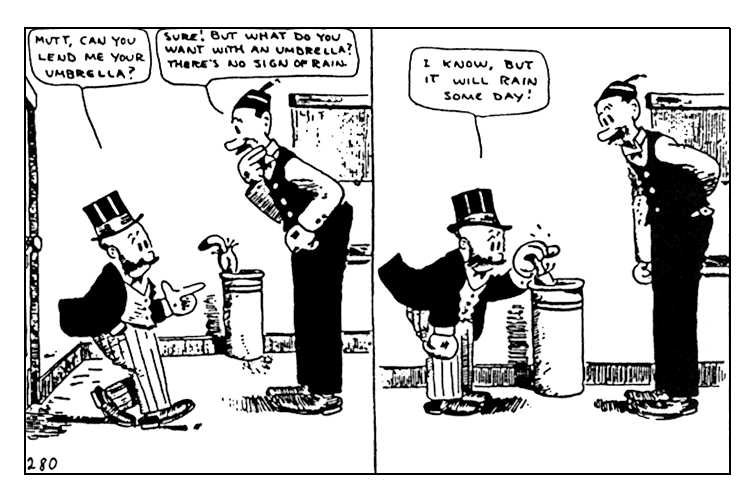
(ASIDE: The millionaires in Sandburg seem to me always to be cartoon millionaires, and S.'s invocation of the "cartoonist" in "Halsted Street Car" an allegory for the sort of sketching he is doing in verse; comp. to those other newspapermen like Mutt and Jeff, Krazy Kat, etc. as Gilbert Seldes analyzes them in the early 20s. END ASIDE)

Sandburg's exclamation, "I have a right to feel my throat choke about this" (in "The Right to Grief") pulls a broader social awareness of the poor, dead girl back to the individual speaker, with his very American "right" to grief. But it also recalls the singing contests that are among elegy's oldest conventions, and the origin of such contests in legitimating who had the right to bury and to mourn the dead. There is thus a kind of jockeying for possession of the poor ("stewardship" would be a more neutral word here, but i'm going with "possession"), between Sandburg's speaker and the vague top-hatted crowd.

I should say that Sandburg's reaction to the war was ambiguous, from what I understand, with his sentiment pulled between the dominant socialist opposition to the war and his own sense of America's necessary involvement. This page is better than I could be at breaking it down.

Copper and Bronze: In the brief poem "In the Back Alley," the Lincoln-head on the penny makes any circulation of the coin a sort of memorial for the great man, even if it's just newsies pitching pennies back of the tenements (and it's notably that the penny-handlers earn their keep by spreading the word, as opposed to any other job S. could have picked). But the most interesting poem I've seen yet is "Bronze," which has the statue of General Grant in Lincoln Park watching the motorized cars whizz past, as newsies yell out headlines of the "forty thousand men are dead along the Yser". The news of Battle of the Yser (16-31 Oct, 1914), which is heralded in the poem by the noise of mechanized transportation, almost rouses the statues to battle, but cannot. They sit on their pedestals, reminders of actions (Garibaldi and Shakespeare look on as well). But they are also, in their stillness and sentience, valuable stoics set apart from and maybe above the cold world (in short, the poem seems to be using these statues to test two versions of art's relation to the news of war).

What I'm wondering about a poem like this is to what extent the poetics of accumulation that Sandburg is constructing in a book like Chicago Poems (I'm not familiar enough with the full oeuvre to speak outside of this collection) are shaped by the U.S.'s neutrality? (I'll nod to Whitman here, since I haven't really considered that legacy of war verse yet, and need to.) Clair Wills has a brand new book on the neutrality of the Irish Free State during "the Emergency" (aka WWII), in which she discusses the local particularity and self-anthropologizing that was fostered by the insular gaze that became the nation's necessary policy (e.g. Patrick Kavanagh writing "The Great Hunger" at this moment).

Have either of you encountered works that speak to the contours of American responses to, or figurations of, neutrality? More broadly, what are the poetics of peace, within visible range of war?

(Lordy, I meant for this to a be a short posting...)