So I have finally started reading Paul Fussell's
The Great War and Modern Memory, and I'm struck, as who wouldn't be, by this sentence at the end of his first chapter: "I am saying that there seems to be one dominating form of modern understanding; that it is essentially ironic; and that it originates largely in the application of mind and memory to the events of the Great War" (35).
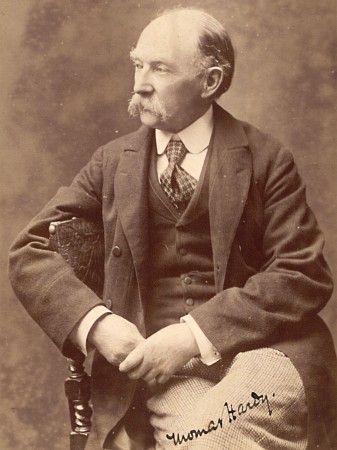
Yeah? You and what army? As always with this kind of pronouncement, it depends when, and where, you situate the "modern," and Fussell is situating it in the England of the 1910s, by which point modernity, by most people's lights, had already been going on for some forty years, if not fifty or sixty. (It's a weird experience to read critical texts semi-chronologically and see the date of the beginning of "modernity" recede further and further into the past; I think it's about at 1550 now.) All of this is just semantics, though, and doesn't affect Fussell's basic argument (in his first chapter; not in the whole book) that a form of irony associated primarily with Thomas Hardy became, as a result of the colossal social disillusionment by the events of World War I, the modern literary temperament, preparing the way for Eliot, the later Pound, and all the rest of the Modernist gloomy gusses. This irony, put in the simplest possible way, posits an innocent Before and a terrible After, with the author/speaker situated firmly on the latter side, the After (whether it be of war, modernity, death, classicism, revolution).
While not exactly disagreeing with this analysis, I'm interested in the fact that it so obviously doesn't apply to the two modernist writers I've been reading most intensively lately, namely Gertrude Stein and Guillaume Apollinaire. While Fussell locates the force of Hardy's irony in "a collision between innocence and awareness" (5), it seems to me that both Apollinaire and Stein skirt these categories in favor of a thoroughgoing, incorruptible
naïveté which simply cannot be mapped on to the before/after structure Fussell sets up. This
naïveté seems, more than anything else, to be what links these two seminal figures, and on Fussell's reading it is utterly opposed to the definition of "modern" sensibility that the Great War puts forward and that, on his reading, is apotheosized in a postwar modernist like Eliot. So, is it only because Stein and Apollinaire came of age well before the War that they are so invested not in knowingness (which is what irony, in Hardy's sense, is all about) but in ignorance, in lack of knowledge? Is it because they are American, and French/Italian/Polish, rather than British? Or what?

I'll start with Stein. I keep thinking of a remark made I think by Tristan Tzara in that amazing
Pamphlet Against Gertrude Stein that Jeremy assigned us last semester, to the effect that Stein has a "baby style": not quite right, I don't think (she's more like an extremely excited and confident six-year-old) but close enough to suggest the lack of sophistication that Stein so willfully projects in her writing, a lack of sophistication coupled with a dogged urge to pronounce, to state, to display authority.
Two procedures seem important to Stein in maintaining this tricky balance between
naïveté: repetition (yes, that again) and time-framing. I was very interested, Greg, in what you wrote
a while back about Yeats "testing" his words through repetition, or, to quote you specifically, "asking his rhythm to test ideas and words til they become old in the way polished stones in creeks are old." It's tempting to apply this description to Stein as well: certainly,
The Making of Americans (when it's not
reminding me of a vacuum cleaner) has the feel of a verbal laboratory, in which the author tries tiny variations on a limited number of formulae, hoping to produce some long-promised extraordinary effect. But Yeats' testing, one could say, attempts to create a sort of eternal present through the construction of a usable mythic past; whereas Stein is always oddly oriented toward the future, at the expense of the past and present. What's interesting in
The Making of Americans is how she continually dispels the incantatory power of her repetitions with little reminders that she's driving at something: "soon there will be a history of the Hersland children," "later it will become clearer the kind of being that each one had in them," etc. (I'm paraphrasing; you know how it is, the book's all the way on the other side of the room). These reiterations aren't allowed to seem old, or familiar, or even properly symbolic, the way Yeats' (or Eliot's or Pound's) repeated words are, because they're so obviously temporary: they're not mantras but coordinates on an enormous map we will soon (but when?) be able to step back and admire.
All this to say, Stein is
not a
Symbolist: where Mallarmé or Verlaine or Symons or Yeats take aesthetic pleasure in the symbol, the image and the word in and of themselves, Stein is so focused on her version of the novelist's traditional "big picture" that she refrains from putting too much weight on any one detail or image or construction. What's happening in
The Making of Americans is happening sentence by sentence, but it's not happening within the sentence; and it is, for that reason, impossible to excerpt. One could say that it's happening in the next sentence, only by the time we get there it no longer is. Again and again, we confront Stein's "sometime," "someday," "soon," and, occasionally, a "now" that projects us into the next sentence or paragraph hopefully only to confront us with another delay, or another restatement. This stops being incredibly frustrating only once (and
if) you begin to view Stein's progress as incremental, that is, that she is actually accomplishing what she claims to be putting off until later: viz., narrating the history of a family's progress.

Another kind of modernist
naïveté is displayed by Stein's contemporary and friend Guillaume Apollinaire. Even more than
poétès maudits like Rimbaud and Verlaine, Apollinaire writes a style of French that is intentionally awkward: polyglot, crude, often obscene, syntactically either overly simple or ridiculously muddled. (It may or may not be necessary to emphasize that he did this on purpose; his critical prose is perfectly literate, even elegant.) The title of his most famous volume is
Alcools and I think more than a few times in it he is endeavoring to mimic drunkenness (and in the last poem he turns into the mouth of Paris and drinks the blood of Europe like wine). Like Stein, he uses repetition to an effect that is less authoritative than childlike ("Les anges les anges dans le ciel," e.g.). And he also likes to play with the time-frames of his works, most obviously in his landmark poem "La Chanson du Mal Aimé," which begins:
Et je chantais cette romance
En 1903 sans savoir
Que mon amour à la semblance
Du beau Phénix s'il meurt un soir
Le matin voit sa renaissance
(And I sang this ballad
In 1903 in ignorance
Of love's resemblance
To the Phoenix dead at evening
Resurrected by morning) (
Alcools, 14-15)
Apollinaire is effectively beginning his poem with a disclaimer:
this poem was written in 1903, when I knew less about the subject; I no longer feel this way. But somehow rather than undermining the lyric intensity of the poem that follows, this bizarre flash-forward heightens it (and the tension builds as Apollinaire goes on to interpolate three further poems, taking place further back in the speaker's past or in his fantasy, all of which complicate the lyrical "now" of his "Chanson"). The reason for this is that the ignorance of the speaker is exactly what conditions his utterance: it is Apollinaire's favored pose to be bewildered, melancholy, and slightly drunk-seeming, just as it is Stein's to be earnest, relentless, and positivistic. The poem works if we are affected by this state of confusion and ignorance, and identify with it. But unlike in traditional dramatic irony, where the speaker's ignorance helps us to attain a position of interpretive power over him (because we know more than he does), here the effect relies on us sharing for the most part in the speaker's ignorance, while still recognizing it as ignorance.
Like Stein, then, Apollinaire makes us feel that we aren't fully in possession of the equipment we need to read his work: that it would not just be a matter of understanding how he feels now, but also who he used to be. And of course this knowledge is not just difficult to acquire, it's impossible, and not just for us, but for the speaker himself. The proper time of understanding the poem is not now and not then, and not a simple mediation between the two (as in Hardy's customary irony). For in Apollinaire's poems, each line is an experience of its own: they float on the page, abutting but not intruding on each other (an effect which is enhanced by Apollinaire's removal of all punctuation from the book at the proof-correcting stage).
What I am (very provisionally) theorizing here is a sort of
naïve irony common to Apollinaire and Stein, a chosen
naïvete, one which always retains the suggestion of a state of greater knowledge to come but which prefers to write out of ignorance (thus, perhaps, anticipating Beckett and his epochal rejection of Joyce's "omniscience and omnipotence"); and that this stands apart from the essentially ironic, elegiac strain of Modernism that Fussell sees as coming to fruition during the Great War. I can't decide whether this type of irony — if it even
is irony — is the opposite of Hardy's, or just a lot more complicated: for Hardy there is only before and after, now and then, while for Apollinaire there is a complex weft of nows and thens, perhaps as many as there are lines in the poem.
Question: does this kind of
naïve attitude make irony, as such, impossible?
OK, I am probably sounding like Marjorie Perloff with a couple of drinks in her. Sorry to go on so long.
I haven't even gotten to Apollinaire's war poetry yet, but I think it will make a fascinating comparison with the kind of stuff Fussell writes about in his book (about which also more anon).


 Senegalese and other French-African colonial soldiers:

 H0w much of the particular character of Modernism can be accounted for by major transformations in the world economy in the first 30 years of the century: e.g., the Panic of 1907 and subsequent bail-out by J.P. Morgan (see Williams' poem on this subject in Spring and All); the slow collapse of Germany's national economy under the mountain of national debts incurred after the First World War; and, climactically, the stock market crash of 1929? Think of some of the individual modernist authors who experienced drastic changes in their financial positions during this period, for these and a variety of other reasons: Proust; Eliot; Yeats; Woolf; Stephen Spender; George Oppen; Nabokov. (You'll have to help me out with the Americans, Adrienne. Didn't Faulkner's family lose a bunch of money? Or was that during Reconstruction?) For these writers, all of whom were raised in an atmosphere of affluence that was later significantly reduced or threatened, how could the expression of despair and cynicism one normally associates with the Modernist moment not also be, in some way, a panic fear about a change in their personal situations? (Others, of course, improved their situations in this period, notably Pound and Joyce — mostly because they were both relatively poor to start with. And how significant is it that, despite living until almost the end of WWII, Joyce never wrote any fiction set later than 1904, when all of these catastrophes were still on the horizon?)
 John Dewey, in 1927, on WWI, offered as a corrective (or, if you like, addition) to Paul Fussell's The Great War and Modern Memory:
 Anyway, I'm finding Sandburg more complex than I had remembered. I think I was swayed too easily by Bill Williams's scathing review of Sandburg's 1951 collected poems, where he denounces the mere accumulation of images and people in Sandburg's verse. Mere outcry, says WCW, does not cry out with the democratic directness Sandburg assumes. The truly democratic poet, for Williams, "digests that powerful incentive and puts it out as imaginative design, a new thing that embodies all their timeless agonies" (Selected Essays 276). But Williams's "poem as a field of action" has such a terribly different view of "fields" from Sandburg's midwestern vantage that his desire that Sandburg should be "disengaged" sounds faintly ludicrous (that is, if you take it as anything other than a self-analysis on Williams's part).