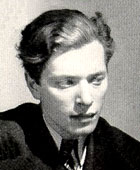

 By two of his former students:
My House
By Lou Reed
The image of the poet's in the breeze
Canadian geese are flying above the trees
A mist is hanging gently on the lake
my house is very beautiful at night
My friend and teacher occupies a spare room
he's dead, at peace at last the wandering Jew
Other friends had put stones on his grave
he was the first great man that I had ever met
Sylvia and I got out our Ouija Board
to dial a spirit, across the room it soared
We were happy and amazed at what we saw
blazing stood the proud and regal name Delmore
Delmore, I missed all your funny ways
I missed your jokes and the brilliant things you said
My Dedalus to your Bloom, was such a perfect wit
and to find you in my house makes things perfect
I really got a lucky life
my writing, my motorcycle and my wife
And to top it all off a spirit of pure poetry
is living in this stone and wood house with me
The image of the poet's in the breeze
Canadian geese are flying above the trees
A mist is hanging gently on the lake
our house is very beautiful at night
Our house is very beautiful at night
our house is very beautiful at night
Our house is very beautiful at night
A Momentary Longing To Hear Sad Advice from One Long Dead
By Kenneth Koch
Who was my teacher at Harvard. Did not wear overcoat
Saying to me as we walked across the Yard
Cold brittle autumn is you should be wearing overcoat. I said
You are not wearing overcoat. He said,
You should do as I say not do as I do.
Just how American it was and how late Forties it was
Delmore, but not I, was probably aware. He quoted Finnegans Wake to me
In his New York apartment sitting on chair
Table directly in front of him. There did he write? I am wondering.
Look at this photograph said of his mother and father.
Coney Island. Do they look happy? He couldn't figure it out.
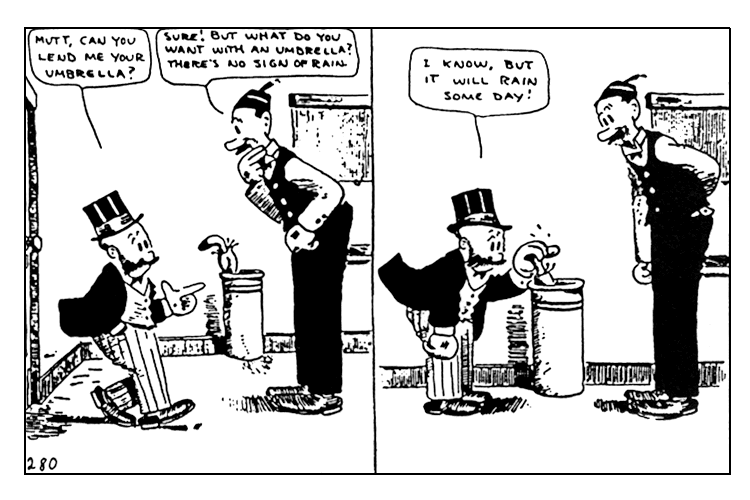
Believed Pogo to be at the limits of our culture.
Pogo. Walt Kelly must have read Joyce Delmore said.
Why don't you ask him?
Why don't you ask Walt Kelly if he read Finnegans Wake or not.
Your parents don't look happy but it is just a photograph.
Maybe they felt awkward posing for photographs.
Maybe it is just a bad photograph. Delmore is not listening
I want to hear him tell me something sad but however true.
Delmore in his tomb is sitting. People say yes everyone is dying
But here read this happy book on the subject. Not Delmore. Not that rueful man.
It's striking how similar these portraits are, and how both of them express a Yeatsian desire to communicate with Schwartz's spirit. The difference is that Reed is successful in speaking to Delmore — even has him living with him in his house! – while Koch only longs for contact.
It's also interesting to think about how Koch and Reed both cast Schwartz as the epitome of "seriousness," a role he also often claimed for himself (as in 1938's "Father and Son": "My father … taught me to be serious"). And I don't think I'm stretching it to say that the concept of "seriousness" is key for both of them: Koch making an effort to alleviate the monumental seriousness of mid-century American poetry (or rather, as he claimed many times, to give it a new definition of seriousness), and Reed, when he wasn't just trying to get or stay famous, to bring literary seriousness to rock music. In doing this both take enormous risks (Koch of being called trivial, Reed of being called pretentious) which ultimately pay off in some of the most exciting art of their respective fields and eras, at least in this blogger's opinion. What's funny is that both could have derived inspiration for these respective missions — in which they are, as it were, tunneling toward each other from opposite directions — from the same figure, although in different decades and in different cultural circumstances.
In "My House," Reed is settling into his self-consciously "mature" phase, which entails not only writing literary lyrics but also withdrawing from New York City, settling down with a woman after a few decades of bisexuality, and reclaiming the literary heritage of seriousness he had jeopardized by making records like Rock'n'Roll Animal. Schwartz is thus invoked like a guardian angel at the start of the record: "a spirit of pure poetry" to guide his passage back into the land of critical prestige, not so much Dedalus to his Bloom as Virgil to his Dante.
Koch's poem centers even more obviously around the question of seriousness, the value of the seriousness of culture, which of course was a more of a live issue in the "late Forties" (cp. Adorno's Dialectic of Enlightenment, which I'll be trying to wrestle with next week) than it seems to us now. Schwartz, in the scene recalled, shows a 40s intellectual's cautious approval of popular culture ("Believed Pogo to be at the limits of our culture") which nonetheless must still be assumed to spring from a reputable highbrow source ("Walt Kelly must have read Joyce"). Schwartz's uncertainty about the cultural status of Pogo somehow fuses, heartbreakingly, with his uncertainty about his parents' past happiness; and the fact that he is putting either of these questions to a student is, in itself, somewhat sad. Koch, of course, can't answer either of these questions for him: only Walt Kelly and Schwartz's parents can, all of whom are, momentarily or permanently, absent.
But the important thing is not just that Delmore Schwartz was depressed and tortured while Koch is/was saner and happier; I want to resist reading the poem reductively, according to the "Modernism = grumpy and conflicted / Postmodernism = well-adjusted and jouissant" fallacy. The starting point, after all, is the fact that Koch now "want[s] to hear him tell me something sad but however true." Leaving aside any temptation to read biography into it (oh why bother: the poem was written in 2001; New York had been attacked by terrorists and Koch was dying of leukemia), we see that Koch is nostalgic for Schwartz's "rueful" perspective, his High Modernist values, though that nostalgia is as tentative and uncertain as Schwartz's appreciation of Walt Kelly once was. I'll stop myself from going any further than that, for now, but what I'm interested in is the way both works interweave a sympathetic portrait of Schwartz the man with Schwartz — who might also, if we want to push things still further, stand in for "the university poet" as such — the bulwark of seriousness and bearer of cultural capital.