Showing posts with label Moore. Show all posts

Tuesday, October 27, 2009

Curiosity of the unprofound

"When in Maine the harbor-master is the habba-masta, when in New York seabirds are seaboids, when as in the Negro vernacular, the tenth becomes the tent, certainly is certainy, and Paris is Parus, the curiosity of the unprofound, with regard to the acoustics of speech, may seem like that of the Esquimaux listening for the first time to a phonograph. Our completely fascinated interest in these matters is, however, not to be disguised and our desire to know what topics may occupy the attention of the fastidious, is genuine."

— Marianne Moore on "a recent tract of The Society for Pure English" in The Dial, 80 (May 1926), 448

Sunday, October 4, 2009

Steady Job

Some intriguing remarks on literary professionalism from "The Art of Poetry: Marianne Moore," the 1960 Paris Review interview with Donald Hall:

Interviewer: I was intrigued when you wrote that ‘America has in Wallace Stevens at least one artist whom professionalism will not demolish.’ What sort of literary professionalism did you have in mind? And do you find this a feature of America still?

"Moore: Yes. I think that writers sometimes lose their verve and their pugnacity, and he never would.

“That question I am so often asked: ‘What work can I find that will enable me to spend my whole time writing?’ Charles Ives, the composer, says, ‘You cannot set art off in a corner and hope for it to have vitality, reality and substance. The fabric weaves itself whole. My work in music helped my business and my work in business helped my music.’ I am like Charles Ives. Lawrence Durrell and Henry Miller would not agree with me.

Interviewer: But how does professionalism make a writer lose his nerve and pugnacity?

Moore: I suppose money has something to do with it and being regarded as a pundit. Wallace Stevens was really very much annoyed at being catalogued, categorized, and compelled to be scientific about what he was doing — to give satisfaction, to answer the teachers. He wouldn’t do that. He was independent.

“I think the same of William Carlos Williams. I think he wouldn’t make so much of the great American language if he were judicious about everything. And that is the beauty of it — he is willing to be reckless, and if you can’t be that, what’s the point of the whole thing?”

— Reprinted in Marianne Moore: A Collection of Critical Essays, ed. Charles Tomlinson, 44-45

Saturday, September 26, 2009

L-R: Kenneth Koch, Alan Dugan, Robert Lowell, Stanley Kunitz and Marianne Moore at the New School for Social Research, 1962(?).

Tuesday, May 26, 2009

Go West

"Dear Hilda:

I am so glad that California has done you good. You have to forego life on the Acropolis I think, anywhere away from the east. I am like the man in Life who was shocked by the rawness of the west, deprecated the women — 'attractive of course but crude,' supposed that shoe polish had been cut off by the war and then when the frogs' legs were served, the smile appeared, so rare in an easterner but on second thought he said 'though superbly cooked, it strikes me that they are a little more bowed than those we get in the east.' Well, the main thing is that the climate has agreed with you and that you have all had time to think and follow your own devices secure from the inroads of eastern harpies."

— Marianne Moore to H.D., January 11, 1921, in The Selected Letters of Marianne Moore, 138-139

Monday, September 17, 2007

Moore, Moore, Moore

Just checking: are we talking Marianne tomorrow, after Diana's class? And if so, who else? Just want to know if I should do any prep (even just mentally).

Thursday, September 13, 2007

C'mere, you

I have a tremendous critical crush on Lionel Trilling. It's the dangerous kind of crush, one where you're not quite sure you really ought to like the other person, or whether your friends would approve: a certain sense of "What am I getting myself into here?" attends my reading, especially of his more sweeping and impressive moments. After all, Trilling in many ways represents what the radical energies of the 60s and 70s swept away, not without some very good reasons; and his general theoretical bent, though emerging out of Trotskyism and addressing itself to fellow liberal intellectuals of the 1940s, is usually seen as a harbinger of neoconservatism (the most substantial recent article I could find on him is from the Weekly Standard, which gives you some idea).

But as Trilling points out in his preface, "a criticism which has its heart the interests of liberalism might find its most useful work not in conforming liberalism in its general sense of rightness but rather in putting under some degree of pressure the liberal ideas and assumptions of the present time" (x). And putting ideas under pressure is what Trilling does brilliantly. I read just four essays (five including the preface) from his 1950 book The Liberal Imagination — I borrowed my dad's copy; it's apparently, Yaron informs me, out of print — but they were real doozies: "Reality and America," "The Function of the Little Magazine," "The Sense of the Past" and "The Kinsey Report." Each of them is amazing and challenging in its own way, devoting itself to very specific contemporary issues while nonetheless making up part of an expansive, deeply felt and cogently defended view of literature. (Adrienne, you might want to check out the first one; it has some really interesting insights about the realist novel and the liberal preference for Theodore Dreiser over Henry James. And he also has pieces, in the same book, on Sherwood Anderson, Huckleberry Finn, and "Manners, Morals, and the Novel.")

Anyway, all of the essays have a lot to recommend them, not least for their usefulness in summing up late 40s critical and political attitudes (often in the process of critiquing them). "The Sense of the Past," for instance, is an ambivalent meditation on the New Criticism and its methods, which Trilling argues have to be tempered with an awareness of literary works as "historical facts" — pretty much the deconstruction/new historicism debate of the 1980s in embryo. The one on the Kinsey Report, on the other hand, is the most unsettling, in part because Trilling violently resists the report's attempt to destigmatize homosexuality, a stance he takes in part because of his own strong allegiance to Freudianism. This is where you begin to see the pernicious side of Trilling's neoconservative leanings; though one wonders if Trilling were alive today, when homosexuality as a social fact seems so much more evident and has been so much more cogently argued for, if he wouldn't temper his objections so much. Maybe that's wishful thinking. At any rate, its early considerations of the role science can and should play in social discourse are fascinating and valuable.

Anyway, I'm just going to end with a list of quotes I liked. And I'm going to let out a little sigh as I finish typing each of them.

from the preface:

"in the modern situation it is just when a movement despairs of having ideas that it turns to force, which it masks in ideology" (x)

"Charles Péguy said, 'Tout commence en mystique en finit en politique' — everything begins in sentiment and assumption and finds it issue in political action and institutions. The converse is also true: just as sentiments become ideas, ideas eventually establish themselves as sentiments." (xi)

"the literature of the modern period, of the last century and a half, has been characteristically political" (xii) [interestingly contra Edmund Wilson]

"The paradox is that liberalism is concerned with the emotions above all else, as proof of which the word happiness stands at the very center of its thought, but in its effort to establish the emotions, or certain among them, in some sort of freedom, liberalism somehow tends to deny them their full possibility." (xii-xiii)

"literature is that human activity that takes the fullest and most precise account of variousness, possibility, complexity, and difficulty" (xv)

from "Reality and America":

"the culture of a nation is not truly figured in the image of the current. A culture is not a flow, nor even a confluence; the form of its existence is struggle, or at least debate — it is nothing if not dialectic. And in any culture there are likely to be certain artists who contain a large part of the dialectic within themselves …" (9)

"In the American metaphysic, reality is always material reality, hard, resistant, unformed, impenetrable, and unpleasant. And that mind is alone felt to be truly trustworthy which most resembles this reality by most nearly reproducing the sensations it affords." (13)
[Greg, I think this might be usefully applied to Pound and the Objectivists — what do you think?]

"We live, understandably enough, with the sense of urgency; our clock, like Baudelaire's, has had the hands removed and bears the legend, 'It is later than you think.' But with us it is always a little too late for mind, yet never too late for honest stupidity; always a little too late for understanding, never too late for righteous, bewildered wrath; always too late for thought, never too late for naïve moralizing. We seem to like to condemn our finest but not our worst qualities by pitting them against the exigencies of time." (18)

from "The Function of the Little Magazine":

"… [in the nineteenth century] it was the natural expectation that a serious idea would be heard and considered. Baudelaire is the poet from whom our modern disowned poets have taken their characteristic attitudes, yet Baudelaire himself was still able to think of 'success,' to believe in the possibility of being seriously listened to by the very society he flouted, and he even carried his belief to the point of standing for election to the Academy" (96)

"the emotional space of the human mind is large but not infinite, and perhaps it will be pre-empted by the substitutes for literature — the radio, the movies, and certain magazines — which are antagonistic to literature not merely because they are competing genres but because of the political and cultural assumptions that control them. Further, the politics with which we are now [1946] being confronted may be of such kind as to crush the possibility of that interplay between free will and circumstance on which all literature depends. These conditions can scarcely encourage us. On the other hand, they must not be allowed to obsess us so that we cannot work" (96-97)

"It is a striking fact about [the] literature of contemporary liberalism that it is commercially very successful — at the behest of the liberal middle class, that old vice of 'commercialism,' which we all used to scold, is now at a disadvantage before the 'integrity' which it once used to corrupt. Our dominant literature is profitable in the degree that it is earnest, sincere, solemn. At its best it has the charm of a literature of piety. It has neither imagination nor mind." (98)
[Adrienne, you mentioned you guys were talking about WCW's "earnestness" the other day — does this quote have any resonances for that discussion?]

[on the apoliticality of the great Modernists]: "If tolerance is in question, I am inclined rather to suppose that it should go to those writers from whom, whatever their difficulty, we hear the unmistakable note of seriousness — a note which, when we hear it, should suggest to us that those who sound it are not devoting their lives to committing literary suicide." (99)

"to organize a new union between our political ideas and our imagination — in all our cultural purview there is no work more necessary … There are manifest dangers in doing this, but greater dangers in not doing it. Unless we insist that politics is imagination and mind, we will learn that imagination and mind are politics, and of a kind that we will not like." (100)
[could be a gloss on Auden]

"We are dealing again with power. The question of power has not always preoccupied literature … Quality is the first, and perhaps should be the only, consideration. But in our situation today, when we think of quality, we must ask what chance a particular quality has to survive, and how it can be a force to act in its own defense and in the defense of those social circumstances which will permit it to establish and propagate itself in the world. This is not a desirable state of affairs. 'Art is a weapon' and 'ideas are weapons' were phrases that a few years ago had a wide and happy currency; and sometimes, as we look at the necessities of our life, we have the sense that the weapon metaphor all too ruthlessly advances — food is now a weapon, sleep and love will soon be weapons, and our final slogan perhaps will be, 'Life is a weapon.' And yet the question of power is forced upon us." (101)
[and this almost demands to be read vis-à-vis Marianne Moore and her constant concern with metaphorical "weapons" — maybe we can talk about this a little on Tuesday?]

"The word coterie should not frighten us too much. Neither should it charm us too much; writing for a small group does not ensure integrity any more than writing for the many; the coterie can corrupt as surely, and sometimes as quickly, as the big advertisement appropriation. But the smallness of the coterie does not limit the 'human' quality of the work." (102)

"When we try to estimate the power of literature, we must not be misled by the fancy pictures of history. Now and then periods do occur when the best literature overflows its usual narrow bounds and reaches a large mass of the people … It is what we must always hope and work for. But in actual fact the occasions are rare when the best literature becomes, as it were, the folk literature, and generally speaking literature has always been carried on within small limits and under great difficulties … But whenever it becomes a question of measuring the power of literature, Shelley's old comment recurs, and 'it exceeds all imagination to conceive what would have been the moral condition of the world' if literature did not continue in existence with its appeal to limited groups, keeping the road open." (103)
[this is problematic, probably, but so so beautiful]

from "The Sense of the Past":

"All sorts of studies are properly ancillary to the study of literature. For example, the study of the intellectual conditions in which a work of literature was made is not only legitimate but sometimes even necessary to the perception of its power. Yet when Professor Lovejoy in his influential book, The Great Chain of Being, tells us that for the study of the history of ideas a really dead writer is better than one whose works are still enjoyed, we naturally pull up short and wonder if we are not in danger of becoming like the Edinburgh body-snatchers who saw to it that there were enough cadavers for study in the medical school." (182)

"in an age of science prestige is to be gained by approximating the methods of science" (182)

"The faults of [the New Critics] we know. Perhaps their chief fault they share with the scientific-historical scholars themselves — they try too hard. No less than the scholars, the critics fall into the error that [John Jay] Chapman denounced, the great modern illusion 'that anything whatever … can be discovered through hard intellectual work and concentration.' We often feel of them that they make the elucidation of poetic ambiguity or irony a kind of intellectual calisthenic ritual [a little smack at Empson, I think]. Still, we can forgive them their strenuousness, remembering that something has happened to our relation with language which seems to require that we make methodical and explicit what was once immediate and unformulated." (184)

"even in the lyric poem the factor of historicity is part of the aesthetic experience; it is not merely a negative condition of the other elements, such as prosody and diction, which, if they are old enough, are likely to be insufficiently understood — it is itself a positive aesthetic factor with positive and pleasurable relations to the other aesthetic factors. It is part of the given of the work, which we cannot help but respond to. The New Critics imply that this situation should not exist, but it cannot help existing, and we have to take it into account." (185)

"The question is always arising: What is the real poem? Is it the poem we now perceive? Is it the poem the author consciously intended? Is it the poem the author intended and his first readers read? Well, it is all these things, depending on the state of our knowledge. But in addition the poem is the poem as it has existed in history … This makes it a thing we can never wholly understand — other things too, of course, help to make it that — and the mystery, the unreachable part of the poem, is one of its aesthet

"we have … to open our minds to the whole question of what we mean when we speak of causation in culture … 'There is no subject,' [Hume] says, 'in which we must proceed with more caution than in tracing the history of the arts or sciences: lest we assign causes which never existed and reduce what is merely contingent to stable and universal principles.' … But there is one fact, he continues, which gives us the license to speculate — this is the fact that the choice spirits arise from and are related to the mass of the people of their time … This gives us our charter to engage in cultural history and cultural criticism, but we must see that it is a charter to deal with a mystery." (188)

"We have come to believe that some ideas can betray us, others save us. The educated classes are learning to blame ideas for their troubles, rather than blaming what is a very different thing — our own bad thinking. This is the great vice of academicism, that it is concerned with ideas rather than thinking, and nowadays the errors of academicism do not stay in the academy; they make their way into the world, and what begins as a failure of perception among intellectual specialists finds its fulfillment in policy and action." (192)


I could go on and on (I haven't even gotten to the Kinsey essay yet), but if you've cared to read this far you should probably just buy the book. I'll close, though, with a sentence which might serve as Trilling's manifesto, though he attributes its idea not to himself but to Nietzsche: that "culture [should] be studied and judged as life's continuous evaluation of itself, the evaluation being understood as never finding full expression in the 'operating forces' of a culture, but as never finding expression at all without reference to these gross, institutional facts" (197). From my perspective, this is as close as we can get — as close as we need to get, maybe I should say — to a justification of what we should be trying to do.

Friday, August 24, 2007

BFFs

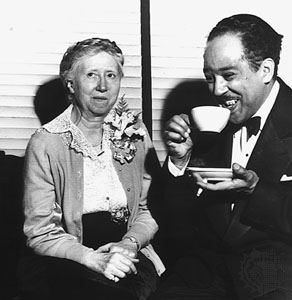
“I consider her the most famous Negro woman poet in America.” — Langston Hughes on Marianne Moore, 1967

Thursday, August 23, 2007

Jarrell on Moore

Greg, I'm curious what you think of this passage by Randall Jarrell on Marianne Moore, written in 1945 in response to her volume Nevertheless. He's commenting specifically on her poem "In Distrust of Merits" (which is here, if you're unfamiliar with it) which Auden and others called the best war poem of WWII. Of particular interest is the end of the third paragraph, which puts Moore in the context of other Modernist poets who were reacting against the memory of the poets of the Great War.

Anyway:

"Miss Moore's war poem, 'In Distrust of Merits,' has been called the best war poem so often that it should be treated in detail.

"The title is humility, not understanding — she distrusts her own merits, but trusts, accepts almost as if she were afraid to question, those of the heroic soldiers of her poem. She does not understand that they are heroes in the sense that the chimney sweeps, the factory children in the blue books, were heroes: routine loss in the routine business of the world. She sees them (the recurring triplet is the major theme of the poem) fighting fighting fighting; she does not remember that most of the people in a war never fight for even a minute — though they bear for years and die forever. They do not fight, but only starve, only suffer, only die: the sum of all this passive misery is that great activity, War.

"Miss Moore thinks of the war in blindingly moral terms. We are fighting 'that where there was death there may be life.' This is true, in a sense; but the opposite is true in a more direct sense. She writes at the climax of her poem, 'If these great patient / dyings — all these agonies / and woundbearings and bloodshed / can teach us how to live, these dyings were not wasted'; and ends the poem with 'Beauty is eternal / and dust is for a time.' (The armies and the peoples died, and it meant that Beauty is eternal.) Since Pharaoh's bits were pushed into the jaws of kings, these dyings — patient or impatient, but dyings — have happened, by the hundreds of millions; they were all wasted. They taught us to kill others and die ourselves, but never how to live. Who is 'taught to live' by cruelty, suffering, stupidity, and that occupational disease of soldiers, death? The moral equivalent of war! Peace, our peace, is the moral equivalent of war. If Miss Moore had read a history of the European 'colonization' of our planet (instead of natural histories full of the quaint animals of those colonies) she would be astonished at nothing in the last world war, or in this one, or in the next. She would distrust us and herself, but not at the eleventh hour, not because of the war (something incommensurable, beside which all of us are good): she would have distrusted the peace of which our war is only the extrapolation. It is the peace of which we were guilty. Miss Moore's seeing what she sees, and only now, betrays an extraordinary but common lack of facts, or imagination, or something. But how honest and lovable — how genuinely careless about herself and caring about the rest of the world — Miss Moore seems in this poem, compared to most of our poets, who are blinder to the war than they ever were to the peace, who call the war 'this great slapstick,' and who write (while everyone applauds) that they are not going to be foolish enough to be 'war poets.' How could they be? The real war poets are always war poets, peace or any time.

"For this poem Miss Moore has given up her usual method, because of the emotion and generality that have overwhelmed her. I wish that she had — as the world has — taken her little animals, her bric-a-brac with all their moral and aesthetic qualities, her individuals with their scrupulous virtues, and shown them smashed willy-nilly, tortured, prostituted, driven crazy — and not for a while but forever: this is, till the day they died. As it is she has handled not these real particulars but abstractions she is unfamiliar with and finds it hard not to be heroic about; and her poem is neither good nor bad, but a mistake we sympathize with thoroughly.

"I don't want to finish my review of Miss Moore without saying what a good poet she is, and how lucky we are to have her." (Kipling, Auden & Co., 129-130, emphasis mine)

Wednesday, August 22, 2007

Die, Modernism, Die

Yep, it was literary critics killed Modernism, not poets (though many of them poet-critics: not exactly sure what to make of that). And it was accomplished not through any sort of polemical attack, but through a simultaneous collective lowering of expectations, and a willingness to rest on laurels. We know everything we need to know, the argument ran, to write great poetry now: and if you don't know, you haven't been paying attention. In that case, God help you.

Exhibit A: R.P. Blackmur's "Lord Tennyson's Scissors: 1912-1950," an overview of the Modernist period published in 1951 as the epilogue to his collection Language as Gesture. "Forty years of poetry took their rise in Eliot, Yeats, and Pound," Blackmur says, condensing a half century's worth of complex aesthetic and political wrangling into three Big Names to set alongside Shakespeare-Marlowe-Jonson, Wordsworth-Coleridge-Southey and Shelley-Keats-Blake. I'm just going to quote some (OK, a lot of) stuff from this essay, because some of it is helpful, a lot of it is funny (and unfair), and all of it gives a good index of how even the most pro-Modernist critics wanted to wrap things up and move on to the next thing by the beginning of the 50s:

On Yeats: "neither his vices nor his poetry ever quitted him" (424)

On 1922: "1922 seems the great year of our time — especially if you let the months run a little both ways — for it holds a good many of Yeats' Tower poems, Pound's first eight Cantos, and Eliot's The Waste Land, not to mention Ulysses, the finishing of The Magic Mountain, and the beginning of The Counterfeiters. The year 1922 is almost inexhaustible in all the arts" (426)

On Pound and prosody: "The general prosody of the 'teens and 'twenties had equally little to do with the practice of Yeats, Pound, and Eliot … and with the practice of the old conservatives. The general prosody was perhaps the weakest and least conscious in English since the dead poetry of the mid-sixteenth century. It ran, under various guises and doctrines, toward a combination of absolute doggerel and absolute expressionism. Ezra Pound was as responsible as anyone for this condition, not by the progress of his own work but by the procession of manifestoes which he promulgated by letter and print. His doctrine, however it may have promoted the incentive of writing, only got in the way of full work and when it got stronger, deeply damaged, though it never destroyed, his expressive powers" (427)

On "the ideographic method" and expressionism: "The procedure is very tempting, always, to get rid of what is behind one and what is ahead of one, neither by capitulation nor by mastery, but by declaring an arbitrary substitute. Then expression becomes immediate, which is good, and spontaneous, which is not; for spontaneity is the curse of poetry to at least the same degree that neologism is the curse of language. But the temptation is very deep; Art, as Maritain says, Art bitten by poetry longs to be freed from reason, but so long as nothing is substituted for reason the longing is not fatal and may indeed promote a fresh and rejoicing sense of disorder, as The Waste Land did, or a new underground for reason, as the work of Valéry and Mallarmé did" (428)

On Basic English: "What, should we get rid of our ignorance, of the very substance of our lives, merely in order to understand one another?" (428)

On the "heroization of the sensibility": "What [the modern poets] did was to make just enough of a prosody to heroize the sensibility and not quite enough to make a heroic statement. Just enough meter to make a patter, just enough rhyme to make a noise, just enough reason to make an argument; never enough of anything to bind together what came out of the reservoir of their extraordinary sensibility into possible poetry … This bad poetry is not worth reference in itself; it is here only to represent the condition of the language and the state of ambition in which an unusually large amount of good — or partly good — poetry got written" (428-429)

On flatness/prosiness: "Verse should be written, said Pound, not to the metronome but in the sequence of the musical phrase. The prose tradition alone produces flatness, inhibits song, and excludes behavior; and I see no sense in welcoming these disorders, as Eliot has done in parts of the Quartets and as Schwartz has done in all but his earliest work, as other and desirable forms of order. I do not refer to careless writing but to deliberate flatness; which is only the contemporary form of Georgian deliquescence" (429)
[this opinion will become particularly interesting in the context of Ashbery, I think]

On solipsism and "the real world": "…it seems to have been an age when the sensibility took over much of the task of poetry. That is why we have created so many private worlds each claiming ascendancy over the real world about which nothing, or nearly nothing got said. That is why, too, Yeats and Eliot (though not Pound, except rarely) were almost alone able to express a version — an actual form — of the real world. In each the sensibility had other grounds than itself; the ground of beseeching, history, faith or momentum and the other ground, no less important to poetry, of prosody." (430)


Then there's a long section where RPB runs down all the various "schools" of Modernism (what Graves and Riding call "dead movements"), those not entirely assimilable to the traditions created by Yeats, Eliot or Pound. This is the fun part:

1. "the parallel Old-Timers' school, what we might call the school of Chaucer and the Ballad; think of Hardy, Housman, Robinson, and Frost … Reading them, we see why Pound does not occupy a first position, but a position on one side. The superlative metric of Pound may be a clue to their weakness but it would never furnish an understanding of their imperfect strength. Their work stands ready to infect the work of young men who have not yet found a form for their ambition and who can no longer, since they apprehend what has happened to it, heroize their sensibility. At least I should suppose there might be a coming race of poets who would want to reverse Maritain's phrase and say Art, bitten by reason, longs to be freed from poetry: from the spontaneous and the private and the calculated public worlds. There might be a race of poets, that is, who would woo the excited miracles of absolute statement, not as a refuge, but to get their work done" (432)
[to me, this seems to presage a lot of the most accepted poetry today, in both America and Britain; what Ron Silliman calls the School of Quietude. More on this some other day, maybe.]

2. "the Apocalyptic or Violent school … Here is where we find the remains of Vachel Lindsay, the evangel of enthusiastic rebirth; Robinson Jeffers, the classical Freudian; Roy Campbell the animal, authoritarian evangel of anti-culture; Carl Sandburg, the bard of demagogic anti-culture; and of course others … All these stem poetically and emotionally from Whitman-Vates: and all are marked by ignorance, good will, solipsism, and evangelism … nor should we think of them even so briefly as more than false alarms if it were not for the two extraordinary talents that must be grouped with them … D.H. Lawrence and Hart Crane … Each is a blow in the face but neither can hit you twice" (433)

3. "another school of anti-intelligence … They got rid of too much of their reason, and as a result they effervesced rather than expressed, and what is left is flat. Nameless they shall be here; they belonged only to their principal journal transition. What was wrong with them is clear when you see how weak is their imitation of Apollinaire, Aragon, Cocteau, Soupault [!], and how great their misunderstanding of Mallarmé, Rilke, Joyce, Kafka, and Pirandello: all men who longing to be freed from reason had a kind of bottom supply of it. Neither the English nor the Americans have ever been very good at this sort of thing. Let us say that we have not so much of reason that we can afford to lose any of it; we need it to make our nonsense real as well as genuine; and one would say that in this respect prosody was a form of reason" (433-434)
[obviously, this will have renewed significance in the 60s with New York School et al.]

4. "the school of Donne into which the largest number of individual writers of good verse fall when shaken up and let settle … they are difficult in style, violent in their constructed emotions, private with actual secrecy in meaning. There is in their work a wrestling struggle toward statement, a struggle through paradox and irony … and the detritus of convictions. The statements are therefore impossible to make, but the effort to make them is exciting because genuine …" [here he includes John Crowe Ransom, Allen Tate, John Wheelwright, William Empson and Hugh MacDiarmid]
"The general poetry at the center of our time takes the compact and studiable conceit of Donne with the direct eccentricity, vision, and private symbolism of Blake; takes from Hopkins the incalculable and unreliable freedom … of sprung rhythm, and the concentration camp of the single word; and from Emily Dickinson takes spontaneous snatched idiom and wooed accidental inductableness. It is a Court poetry, learned at its fingertips and full of a decorous willfulness called ambiguity. It is, in a mass society, a court poetry without a court" (434-435)

5. William Carlos Williams: "To him beauty is absolute and falls like the rain, like the dream of rain in a dry year. He is, if you like, the imagism of 1912 self-transcended. He is contact without tact; he is objectivism without objective … The neo-classicist and the neo-barbarian are alike in this: their vitality is without choice or purpose" (435)

6. Stevens/Moore/Cummings
"
Each, so to speak, is full of syllables where [Yeats, Eliot and Pound] are full of words. Each is a kind of dandy, or connoisseur, a true mountebank of behavior made song … let us say they make an equilateral triangle of three styles hung like a pendant from the three major styles" (436)

a. Wallace Stevens
is a dandy and a Platonist … You need an old dictionary and an old ear to get his beauty: as if he had to find an unfamiliar name before the beauty of his perception could emerge; and it is along these lines that you have to think of the French symbolists' influence upon him. They taught Eliot the anti-poetic and the conversational style; Stevens they taught the archaic and the rhetorical; that is, Eliot and Stevens saw the one prosody running in opposite directions. But Stevens is in essence of a very old tradition, French and Platonic, working on a modern substance … He should have lived in the age of Pope; with his sensibility and his syllables he could have made rational statements with more beauty than that age was capable of. But as he is, he is 'the tranquil jewel in this confusion'" (436)

b. Marianne Moore
"has written the most complex syllabic verse of our time: as if she brought French numbers to English rhythms with no principle of equivalence. But she is not the syllabist as dandy but as connoisseur; she is the syllabist of the actual, the metrist of the immediate marvel… There is a correspondence here to the coerced heightened perception (the forced close observation) in the painting of still-life. Poetry is to her, as she says, an imaginary garden with real toads in it. She knows all about the toads because she has imagined the garden; as you look suddenly everywhere there is the disengaged leap of a green or a brown toad, all warts, all soft, all leaping, all real. If there is not much other reality there, and there seldom is in a connoisseur's garden, you bring her, or ignore, the life she hasn't got just because what she has got is do real: you bring or ignore as with a shut-in whom you love" (436-437)
[this is, incidentally, both one of the most eloquent and the most spectacularly condescending statements about MM ever made]

c. E.E. Cummings "is the child turned poet, the child with that terrifying and incomplete dimension. Otherwise put, Cummings is the traditionalist who insists on the literal content of his tradition without re-understanding its sources: this is, of course, the easiest form of eccentricity and the most human form of fanaticism … He has too little a developed self ever to escape from it except waywardly, when you want either to console him or beat him … He was educated by Edmund Spenser, the English sonneteers, Keats, Swinburne, the funny-papers, and John Bunyan; but perhaps he was most educated by the things that were left out that would have gone to make a structured mind. All he knows is by enthusiasm, habit, and aversion. He refuses the job of the full intelligence, preferring intimacy with what he loves and contempt for what he hates; and he accepts what love and hatred give as if they made all the music of a full mind … if he were not part of a going concern larger than he, he would be nothing. Here again is a case where prosody is an instrument of reason. Like the wilder currencies in the age of Veluta (or like the serried marks of Hitler [!!!]) Cummings' experimental typography depends on the constant presence of the standard it departs from and would be worthless if not measured against it" (437-438)
[seems like some of these ideas — or prejudices, if you like — could be usefully applied to Kenneth Koch]


Blackmur finishes up by assessing "the further development and release, still inchoate to these observations, of the doomed school of Auden about 1930" with its "deliberate approach to doggerel through Skelton, the Ballads, the immediate situation, and the multi-valenced distrust of self combined to produce the new flat style" (438-439): again, this suspicion of "flatness," and an interesting offhand use of the rhetoric of "doomedness" so often applied to the poets of 1890s (which, as RPB must be thinking of, produced Yeats). He also looks toward "the generation born between 1913 and 1918: Shapiro, Barker, Schwartz, Thomas, Berryman, Manifold, Lowell, Betjeman, Meredith, and Reed" (I must admit I have no idea who half these people are). Solemnly passing the torch to these promising whippersnappers, Blackmur delivers the New Critic's version of "you kids today don't know how good you've got it": "they have the enormous advantage over their predecessors that there is an idiom ready for them to develop according to their own needs" (439). So this is what it has come to, Modernism is "an idiom," and no longer anything like a movement, or even a set of loosely concatenatable authors and texts. "We might have a great age out of them yet," he reckons, but if they do succeed it will be because they keep ploughing the same furrow as the Big Three (or at least their equilateral pendant): "[t]hey have more than a chance — it is half done for them — to develop out of personality the most objective of all creations, the least arbitrary and spontaneous, a style."

Countdown to "arbitrary and spontaneous" begins now.

Sunday, August 19, 2007

Pwned!


Watchers of this space will remember that, about a month ago, I declined to say who "won" in the contest between William Carlos Williams and Wallace Stevens — a pair who are always linked in my mind, somehow, maybe as the two "outsider Modernists" whose reputations actually improved after mid-century rather than declining. (Pound sort of belongs in this category, but only sort of.) And of course they were mutual admirers, as well, perhaps realizing that each were doing something for which the other had absolutely no talent. In a 1927 letter to Marianne Moore responding to a request to review WCW for The Dial, Stevens wrote that "[w]hat Columbus discovered is nothing to what Williams is looking for."

Well, without reservations, I'll say that in the 30s Williams beats Stevens hands down. This is largely because the field of American culture in that decade more closely resembled Williams' pre-formed vision of it than it did Stevens', I think. At the risk of generalizing wildly (you know you love it), I'll say that it's sort of a situation where Williams' long-imagined "America," the one the pure products of which go crazy, suddenly has direct reference to something — where the field his poetry has been gesturing toward suddenly fills up with content. (One could say, too, that a similar thing happened with Communism in the 30s: theories of Marx's that had seemed purely intellectual — to Americans, anyway — now seemed to directly address and describe current conditions, in a way that made them all but irresistible.)

In any case, WCW is on fire in the 1930s: the poems in An Early Martyr, Adam and Eve in the City and The Complete Collected Poems are, ironically, invigorated by the symptoms of material devastation that Williams records in them, from the old woman "munching a plum on / the street" (casting back to his own "This is Just to Say," the private domestic moment replaced by a public scene of degradation) to the pitch-perfect dramatic monologue concerning "The Raper from Passenack" to his at-once-Marianne-Moore-ish-and-militant (tough combination!) "The Yachts" to the "rumpled sheet / of brown paper / about the length // and apparent bulk / of a man" that is just symbolic enough to be moving in "The Term" (take that, American Beauty!). Best of all, maybe, is "The Crimson Cyclamen," an eight-page description of a blooming flower that also manages to be a meditation on Williams' own career, the process of poetic thought, the development of American culture in the Depression era, and an elegy for its dedicatee Charles Demuth, all without sacrificing the teensiest bit of grace or specificity. "It's the anarchy of poverty / delights me," Williams admits in "The Poor," but what impresses me most is his intuitive understanding of the structure underlying the anarchy, the distinctly American values and self-understanding that are not lacking in the poor (as Stevens seems to often imagine) but which display themselves more obviously in them, in both their positive and negative aspects, because they are unprotected, naked, left out in the sun. This compassionate humanism — not humanitarianism — is what impresses about Williams, as well as the sophisticated simplicity he invents and masters in order to express it. This attitude is to be preferred to Pound's bullying or Eliot's despair or Stevens' appalled detachment, but it's also better than the earnest but ultimately unconvincing work of other socially commited poets like Muriel Rukeyser (cp. 1938's The Book of the Dead): for her the poor are heroes, martyrs, victims. For Williams they're Americans, and so is he.

Stevens, on the other hand, runs into a twofold problem in the 30s. First, the constant flow of material and cultural amusements which supplied his 1920s poetry ebbs somewhat; thus the astounding catalogue of improbable nouns that filled Harmonium regularizes itself into a stock repertory of suns, moons, birds, books, masks, rabbits and guitars. (It's possible too that this represents a deliberate paring-down of his materials, in order to develop them into a somewhat coherent symbolic system in the manner of Yeats or Blake.) In that sense, then, the area that his poetry seems to be pointing to becomes less crowded, not more, as with Williams. More disastrously, though, the reigning assumption of Stevens' earlier poetry — that of the poet as a detached aesthete negotiating his relationship with the larger, essentially sympathetic culture carefully and almost disinterestedly — starts to fall apart around him. The evidence is rather that Stevens began to feel more and more alien in American culture, and interpreted events such as the Great Depression and the rise of Fascism in Europe as evidence that his early vision was unshared and unshareable. If he had remained happy to play around in his own imagination this would be fine, and if he had meaningfully synthesized his skepticism into his personal artificial vision (as did Eliot) it would be even better; but unfortunately (in my opinion) he makes the disconnect between his sensibility and the state of American political and poetic culture the theme of his poems in Ideas of Order and The Man with the Blue Guitar, rendering them, as a mass, colossally redundant. How many statements of the idea, "The kind of art I make and like seems useless today; I may be a bad person for making and liking this kind of art; but maybe if I just keep making the kind of art I make and like it will seem useful some day again" do we need from one poet? (This is a major component of at least 14 of Stevens' published poems from this period: "A Fading of the Sun," "Evening Without Angels," "The Reader," many sections of "Like Decorations in a Nigger Cemetery," "The American Sublime," "Mozart, 1935," "Sad Strains of a Gay Waltz," "Dance of the Macabre Mice," "Anglais Mort à Florence," "Mr. Burnshaw and the Statue," "Farewell to Florida," "The Men That Are Falling," "A Thought Revolved," and "The Man with the Blue Guitar" — in other words, a little less than half of them.) As a moral, poetic or philosophical stance, this is defensible; but as subject matter for poetry it's tame and dull and, after the dozenth revolution of Stevens' elaborate self-pity mechanism, starts to seem rather hypocritical as well. Over and over, Stevens fashions a gorgeous mental image, compares it to what he sees around him, despairs at the non-homology, and ends by drawing conclusions about the beautiful and/or impossible relationship of non-relationship between the Mind/the Self and the World. I'm not attacking the philosophical validity of such a view (though I could, I could) I'm just saying it's a boring basis for poetry. And Stevens, with some unerring self-sabotaging instinct, makes it more and more important to his work, as if forcing himself not to find a subject. (Well, we'll see if he turns it all around in the 40s.)

Other random notes I couldn't work in above: Stevens' style gets more epigrammatic in the 30s, more "French" in a classical sense, writing poems that often verge on being nothing more than strings of elegant pensées (and some which more than verge); also easier, a little more willing to telegraph the significance of his private ruminations. It's not a good look for a poet whose virtue is in being "fascinating."

God, I love value judgments.

Tuesday, August 7, 2007

Specters of Eliot

This week it's the 30s. A little depressing after all that terrible honesty and sexy Surrealism, but what are you gonna do, we've got to get to the 60s somehow.

Anyway. Anyone remember two weeks ago when I noted that T.S. Eliot seems to have developed a split personality in the mid-1920s? Well, what's interesting me currently is that these two sides of Eliot seem to have borne fruit in two different writers: significantly, one a novelist, one a poet. I'm reading Henry Green's Living at the moment, which I highly recommend to both of you and to anyone else who may be reading this: it's really an extraordinary book, and certainly a neglected Modernist text (it was first published in 1929). I sort of expected Green to be basically a novel-of-manners type, and I suppose in a way he is, but he's much weirder than I expected. He writes a very spare, almost telegraphic kind of prose, not a million miles away from Hemingway or D.H. Lawrence or even at times Gertrude Stein, full of abbreviated syntax and dropped articles (for example, here are the third and fourth sentences: " 'What we want is go, push,' said works manager to son of Mr. Dupret. 'What I say to them is — let's get on with it, let's get the stuff out,' " 207). But Green pushes it further, and to more striking effect, in my opinion, than any of them. At times it anticipates David Mamet! At other times, William Gaddis! As well as more expected people like Green's friend Graham Greene, especially his early stuff like Brighton Rock.

As the above comparisons should indicate, what Green is especially good at, and what his reputation rests on, is dialogue. The range of voices in Living is pretty extraordinary, encompassing upper-class and lower, young and old, male and female, etc. And he's especially interested in his working-class characters, the rhythm of their speech, their slang, their reflection of motifs and phrases from movies, music, and other pop culture. As I wrote before, this was a talent of Eliot's which he largely neglected to develop after Sweeney Agonistes, perhaps deciding that it wasn't really suitable to lyric poetry: at any rate, I think Green must have read Sweeney, and the relevant sections of The Waste Land, before writing his book. John Updike's introduction makes it seem as if Green wasn't all that avant-garde of a guy (for one thing, he was the managing director of an engineering firm, just like "Mr. Dupret's son" in Living) and suggests that his style is modeled on Charles M. Doughty's 1888 Travels in Arabia Deserta (also a big favorite of Marianne Moore's; clearly I need to take a look at this book); but I'm thinking that there just have to be some Modernist skeletons in Green's closet as well: certainly Eliot and Lawrence, if not Stein. He does admit to reading Proust (and refers to him, very amusingly, on page 261; apparently he was a big tipper) but that influence is more or less undetectable, whereas the English writers — who would, of course, have been right under Green's nose — are all over the place.

At the same time, more or less, W.H. Auden is making the first significant advance on Eliot's style and sensibility in English (as opposed to American) letters. And he does it by taking the bleak, blasted landscapes that Eliot's poetry had colonized (in "What the Thunder Said," "The Hollow Men" and "Ash-Wednesday") and making them more specifically English, both in their descriptive particulars and in their metrical expression. But it largely lacks Eliot's irony, or sense of humor (though Auden would soon manifest one of his own); Auden, at this stage anyway, is not really interested in colloquialism, or vulgarity: he's interested in refining Eliot's style (and "refining" seems like an appropriate word here, since one of the things Auden does is put factories into Eliot's waste lands). The sense of sinister atmosphere that Eliot conjures in his poetry of the 20s becomes absolutely oppressive in Auden's early work: and for the Laforguean Symbolist lightness that Eliot always retains, even when seriously bumming us out, Auden substitutes a very English heaviness, experimenting with alliterative verse in imitation of William Langland's Piers Plowman (e.g., "Doom is dark and deeper than any sea-dingle") and other lugubrious effects. (The Doughty influence seems to sneak in in places as well, particularly in the prose sections of The Orators.)

I will probably write about Auden again soon so I'll stop here. But for now, in order to radically oversimplify everything and help me see what's wrong with my own argument (a useful tactic, I've often noted), I'll say that Eliot, in his early years, was equally interested in the way the modern world talked (which both delighted and repelled him) and the way it looked (which just filled him with disgust). Green is only interested in the former, Auden the latter.

Friday, August 3, 2007

Surrealism

So, Surrealism. This was a fun week, and more cohesive and immediately relevant to the rest of my reading than I expected (or feared) it would be. The thing to realize about the Surrealists is that their intellectual background is, despite the language barrier, in many ways much closer to our own than that of many of the English and American Modernists: they are products of the same French tradition of philosophical education that would later produce Derrida, Foucault, Deleuze, and all the other sacred monsters of High Theory that have been forcibly absorbed, for better or worse, by our discipline in the past forty years. So we are part of the same intellectual tradition, at least by proxy; and even if we don't consider ourselves experts on Descartes or Hegel, the odds are we've picked up more of the gist of their systems and ways of thinking than we have of, I don't know, F.H. Bradley or C.H. Douglas or something.

Add to this the French emphasis on rhetoric and you have a pretty good explanation for the high caliber of the Surrealists' programmatic writing (seen primarily in Breton's manifestoes, of course, but this tone tends to infect their more strictly literary output as well). Eliot, Pound, Stevens, Moore, Lawrence, and Williams, despite their various levels of formal schooling, were all sort of (and of necessity) autodidacts, a fact that accounts for much of the continuing strangeness of their work and their ways of justifying it. By contrast, Breton and Aragon are like confident schoolboys: they know they can encase their artistic efforts in a watertight carapace of theory, and for this reason their self-justifications feel natural in a way that the Modernists' rarely do, in fact more natural than some of the writing it justifies. Even Lautréamont — whose work pre-dates Surrealism proper by about forty years and as far as I can tell was absolutely fucking insane — is just flat-out convincing, able to put together a series of declaratory sentences or marshal a quotation or an epigram in a way that puts most full-faculty-possessing American academics of our time to shame. (The one Anglophone Modernist who shares this tendency, of course, is James Joyce, thanks to his Jesuit training I suppose. No wonder he's always been so big in France.)

The ironic implication of this is that, for me at least, Surrealist writing today often says more about the culture that they supposedly hated so much than it does about their individual campaigns of revolt against it. How much of the attraction of Paris Peasant or Nadja, or even The Magnetic Fields or Soluble Fish, has to do with their "pooling" of a communal poetic subconscious (as Breton puts it in the Second Surrealist Manifesto, 179) and how much of it has to do with the particular debris floating around in that pool, and the fact that it was filled in a time and place that now seems so romantically alien (Paris in the 20s… sighs)? Of all of them, Aragon was probably the most aware of this contradiction, which is why he grounds Paris Peasant in the particulars of the group's milieu; and certainly Walter Benjamin, in his fantastic essay on "Surrealism" from 1929, realizes that it's their specific attitude toward Paris itself ("the most dreamed-of of their objects") that constitutes the Surrealists' real originality. (My pet theory is that the New York School, and particularly Ashbery, was also especially attuned to the culturally exemplary aspect of Surrealism, and it's this that accounts for his strange marriage of insurrectionary European absurdity with homely American sentimental pragmatism. Which in turn has significant effects for contemporary American poetry, much of which is running with one or the other half of Ashbery's synthesis.)

The other thing that fascinates me about the Surrealists is their constant propping up each other's proper names, in a way that would seem to belie Breton's repeated insistence that the individual is of no significance, that none of them have any talent in the usually accepted literary sense. One could certainly (someone probably already has) write a very interesting book on homosociality and Surrealism; Exhibit A would have to be Breton's little phantasmagoria in the first Manifesto about an imaginary castle "in a rustic setting, not far from Paris … [where] a few of my friends are living … as permanent guests," surrounded by "gorgeous women," where "[t]he spirit of demoralization has elected domicile," a place which sounds like a cross between Axel's castle and the Playboy Mansion. (Speaking of guys who live together: this reminds me, I decided that the four major Surrealists each correspond to a Beatle. In case you're interested, here's what I came up with:

ANDRE BRETON = PAUL McCARTNEY
Always trying to keep everything together. Talks a lot about love but you just know he's an asshole.
LOUIS ARAGON = JOHN LENNON
Most realistic, most cynical, perhaps most brilliant. Eventually decides he doesn't really like his friends.
PAUL ELUARD = GEORGE HARRISON
Spiritual, and a little remote.
ROBERT DESNOS = RINGO STARR
The silliest one; the one who has the most troubled solo career.

PHILIPPE SOUPAULT = PETE BEST
Kicked out of the band early on.

I'll add that I tend to think of any grouping of four people in Beatles terms. Anyone want to try this with Joyce, Pound, Eliot and Williams?)

A few other random observations:

Surrealists were the first hipsters (and hippies). In the countercultural realm as well as the academic, the Surrealists seem more our contemporaries than the Modernists. Breton shops at flea-markets for "objects that can be found nowhere else: old-fashioned, broken, useless, almost incomprehensible, even perverse" (Nadja, 52); Aragon drolly observes the ravages of gentrification without being interested in doing much about it; Eluard drops a lot of names ("Max Ernst," "Pablo Picasso," "Arp"); and Desnos, and for that matter all the rest of them too, elevate "love" to the state of a ridiculous transcendental abstraction. We (OK, I) may recognize these attitudes as unsavory, hypocritical, or stupid; but they're certainly familiar.

Surrealism often overlaps with pastoral. Subjects for further study: Lautréamont (op cit.), Aragon's "A Feeling for Nature," Desnos' "Of the Flower of Love and the Wandering Horses," and various passages in Breton's first Manifesto and Soluble Fish. Also: of all animals the Surrealists seem to prefer birds (Eluard) and fish (Breton). Both are small, familiar, and difficult to anthropomorphize, one of them identifiably "poetic," the other conventionally "weird." Compared to the Americans, like Moore and Pound, a surprising dearth of dogs and cats: why? Because they're too domesticable?

Breton may have influenced Nabokov. This never occurred to me before, but the style of Breton's Nadja seems in many ways to be a model for Lolita: an anecdotal first-person account of a love affair with an obviously inappropriate partner (insane woman, underage girl) who is very dubiously portrayed as the chief instigator and controller of the situation, which ends with an extended bout of moral and intellectual self-justification on the part of its self-involved narrator. They even have a similar way of mixing aesthetic, emotional, and dramatic registers, all under a slightly detached, man-of-the-world tone; and they also both use fate and coincidence as the basic framing-device for their narratives (maybe more so in other Nabokov novels, like Pale Fire, than Lolita). The crucial difference is that Breton claims to be writing about himself, and offering us random episodes and coincidences taken from his everyday life, trusting that there is some pattern which neither he nor the reader can immediately perceive; whereas Nabokov uses an unreliable narrator, and reverse-engineers the ephemera from a pre-arranged pattern (I wonder if the link to Breton can be tied in with his famous hatred of Freudian analysis somehow.) Still, the similarities are striking. I don't know off-hand if VN ever made any statements on Surrealism (which I would guess he'd have been skeptical about: then again, he loved Queneau), but he lived in Berlin in the 20s and Paris in the late 30s and presumably would have been aware of the Surrealists in some capacity. In any case, it'd be an interesting avenue to explore, and if I'm right it would be another way Surrealism snuck in through the back-door of the American literary establishment.

Monday, July 23, 2007

World Series

Georg Simmel's writing is full of ideas; and while it seems like you should be able to say this of any philosopher or theorist of note, I think GS gives an unusually strong feeling of an active mind deluged with possibilities, searching for at least a temporary way of disgorging them in a useful and convincing manner. His training was in Neo-Kantian philosophy, and he is unapologetically a systems guy, but he was just as firmly committed to the practice of cultural criticism, and to the development of what he termed a "German philosophical culture." To this end, he wrote about money, art, literature, clothing, women's liberation, space (paging Adrienne!), meals, and the history of philosophy — all of which makes him a perfect poster-boy for the intersection of Modernist literature (or, if you prefer, culture) and theory.

It also tends to make his essays rather messy, and of course Simmel's not traditionally one of the "master thinkers" of the 20th century (unless you ask Jeff Nunokawa); his methods and opinions are a little too idiosyncratic, and many of his conclusions are far too tied to the political and historical circumstances of his time and place (Germany during and preceding the first World War) to be usable in other connections. He goes in big for German nationalism, for one thing, and his conclusions about the differences between "male" and "female culture" are today not much more helpful than the average stand-up comic's. But despite all these flaws, he's a great and inspiring writer, I think, and, more perhaps than his contemporaries, seems like a Modernist himself in his passionate concern with culture from a slight remove, and always with a weird mixture of missionary zeal and caution.

Appropriately, then, I find the Simmelian concept that's having the most afterlife with me is that of the "cultural series," which he formulates most cogently in this passage from his 1911 essay "On the Essence of Culture":

"We are accustomed automatically to label as cultural values the great series of artistic and moral, scientific and economic achievements. Perhaps they all are; but they are certainly not so by virtue of their purely objective, as it were autochthonous significance. The cultural significance of any particular achievement is by no means equivalent to its significance within its own series as determined by its specific nature and purpose. For example, a work of art is subject to quite different criteria and norms when considered within the sphere of art history or aesthetics, than when its cultural value is involved.

"Each of these great series can be regarded on the one hand as an end in itself, so that each individual member of them constitutes a value which is proven directly by being enjoyed and giving satisfaction. On the other hand, they can all also be included in the cultural series, i.e. considered in respect of their significance for the overall development of individuals in society at large. Standing on their own ground, all these values resist inclusion in the cultural series. A work of art aspires only to perfection as measured by purely artistic criteria … Their contribution to the development of human personality, i.e. their cultural value, is a different matter." (43, italics mine)

This is an extremely useful encapsulation of the problems swirling around l'art pour l'art and the historical efficacy of art and literature which converge so noisily and excitingly in the Modernism of the 1910s and 20s. What's important here, for me, is not that Simmel synthesizes the approaches but that he insists on their fundamental incommensurability. Despite the enormous differences in their writing styles and philosophical allegiances, I actually detect a lot of Jacques Derrida in Simmel: a similar insistence on irreducibility, the impossibility of either incorporating art into culture "without remainder" or of separating the two spheres completely and conclusively.

Without digging too deep, I think it'll be obvious that Simmel's view of culture as a multiply divided sphere has resonance for the Modernists and their situations. Marianne Moore's "Poetry" comes to mind first: "I, too, dislike it: there are things that are important beyond all this fiddle. / Reading it, however, with a perfect contempt for it, one discovers in / it after all, a place for the genuine." This is saying more than "most poetry is trivial, but some of it is worthwhile": it's saying, at least in its extended context, that "all this fiddle" is what poetry is, and that "the genuine" will never be found unless we can find it within the fiddle. Moore is perhaps more of a liberal humanist than Simmel, but like him she shies away from any claim that "reading poetry will make you a better person." What it will do is make you a better reader of poetry; and with that skill in your back pocket, you're on your own to hunt out the genuine. As Moore ends it: "if you demand on the one hand, / the raw material of poetry in / all its rawness and / that which is on the other hand / genuine, you are interested in poetry."

The distinction, then, is between "artistic and moral, economic and scientific achievements" — each of which we must preserve in their own distinctness from the others — and what these achievements are for, the use-value of culture as it were. One could say that Pound and Eliot's problem was that they tried to ignore this distinction, to collapse the multiplicity of cultural series into one epic narrative of civilization's decline (and potential rebirth), though I think Eliot was a lot more tortured by the aporia than Pound was.

Lastly, I'll say that part of why this "cultural series" idea appeals to me has something to do with the process of reading for Generals itself. Following the cultural series that is "Modernism" — let's leave aside the subseries "American," "British," and "French" for now — is not exactly equivalent to following that of "literature," or "history," or even "poetry." Each series includes some of the same materials, perhaps even with the same interpretations placed on them, but the important part is that they reach them and proceed from them in decidedly different ways. The path that leads to Eliot from "French Symbolism" is related but fundamentally foreign to the path that leads to him from "late Victorianism"; and what to make of the longer trajectory that gets us there from Dante, or the Metaphysicals, or, as Edmund Wilson suggests, from New England Protestantism? When dealing with such lengthy series — Derrida, or Mallarmé, might call them "chains" — it's probably best not to try to over-intertwine them, or lay them out parallel, for fear of distorting or destroying the integrity of the individual series itself. But in order for the act of criticism to be worth performing at all, there needs to be some kind of space where they can come together, or where you can put them together, at least provisionally. That space, for Simmel, is called "culture" (and for Habermas, the "public sphere"?). For us, maybe "theory."

Of course all of this (my pontification, not Simmel's) is to some extent graduate-student navel-gazing (hello if you've made it this far!): the thing is to get on with your work, learn as much as you can about context in the broadest sense, and use what seems relevant in any given connection (the pragmatist approach). But I guess what I want to affirm here is why Simmel is now sort of a hero of mine: he's a proud non-specialist who resists being a universalist, but is nonetheless far from a nihilist. (As a matter of fact, the other philosopher he reminds me of most is Nietzsche.) The problem for Simmel was that there was too much stuff in the modern world — too many material objects, too many people, too much knowledge, theory, art, culture; not too much because in and of itself excess is deplorable (that's more the Puritan consciousness as diagnosed by Simmel's mentor Max Weber), but too much for any individual subject, even a highly educated and "cultivated" one, to absorb for him or herself. (In this attitude we might see a hint of self-pity; Simmel can be read as sort of a Modernist Henry Bemis.) Thus he saw most trends in modern life and thought as a way to either screen out or superficially synthesize the overwhelming plethora of series existing all around us.

It's this awareness of plethora, and strange mix of caution and exhilaration in the face of it, that makes me want to put Simmel forward as the model for a kinder, gentler critical theory: one which does not insist on a forcing of connections across cultural fields, or anyway recognizes the eternal difficulties of such connections,* but which allows that these connections are possible and desirable, are something which all but the most blinkered and limited human beings will want to do. And which, along with whatever expert authority it claims for itself and its own interpretations, maintains a trust in the capacity of other people to make these connections for themselves, given proper access to a wide enough variety of series, and enough time.


(* I'm dancing around the figure of Adorno here, who strikes me in many ways as Simmel's evil twin. )