Showing posts with label Eliot. Show all posts

Thursday, February 17, 2011

Sage hack

"The eccentricity of Johnson's writing is that of a resoundingly public discourse which is nevertheless profoundly self-involved … Johnson is both grandly generalizing sage and ‘proletarianized’ hack; and it is the dialectical relation between these incongruous aspects of his work which is most striking. The social alienations of the latter can be found in displaced form in the involuted meditations of the former; and not only in displaced form, for one of Johnson’s recurrent motifs is precisely the hazards and frustrations of authorship in a literary mode of production ruled by the commodity. Stripped of material security, the hack critic compensates for and avenges such ignominy in the sententious authority of his flamboyantly individualist style. Moralistic, melancholic and metaphysical, Johnson’s writing addresses itself to the social world (he had, Boswell reports, ‘a great deference for the general opinion’) in the very moment of spurning it; he is, as Leslie Stephen notes, the moralist who ‘looks indeed at actual life, but stands well apart and knows many hours of melancholy.’ The sage has not yet been driven to renounce social reality altogether; but there are in Johnson ominous symptoms, for all his personal sociability, of a growing dissociation between the literary intellectual and the material mode of production he occupies.”

— Terry Eagleton, The Function of Criticism, 32

Sunday, April 25, 2010

To All Pollicle Dogs and Jellicle Cats

A letter from T.S. Eliot to his godson, 1931.

Saturday, February 6, 2010

Hypocrite lecteur

By the way, Internet, I will be speaking at this conference in Santa Cruz next month. My paper is entitled "Unreal City: T.S. Eliot Between Oxford and Cambridge." I'll have to thank the organizers for putting together a conference on my dissertation topic!

Tuesday, November 24, 2009

Un Cadavre

"Comparison and analysis need only the cadavers on the table; but interpretation is always producing parts of the body from its pockets, and fixing them in place.”

— T.S. Eliot, "The Function of Criticism" (1923)

Tuesday, July 21, 2009

The Great Dictator

“It is worth noticing about literary dictatorships that they only partly work. There is no police power in this dictatorship, only the power communicated through fashion, and fashion is impervious to what lies in the realm of tedious or too laborious change.”

— R.P. Blackmur, "In the Hope of Straightening Things Out," 168

Wednesday, October 8, 2008

Metaphor of the Week

“The structure of The Waste Land is, in a sense, a negative structure. If a large family, kept together unwillingly in the same house by economic and social reasons, but not by any ties of true affection, could be caught at a moment of disintegration — not necessarily all in the same room together, nor even particularly conscious of each other’s activities — all making claims and each refusing to meet the other’s claims, then the intricate disharmonies of that house, the subtle cross-references of conflict, would give it an individuality as strong as that of a house where everyone was positively at peace.”

— Robert Graves, Contemporary Techniques of Poetry: A Political Analogy, 43-44

Thursday, July 3, 2008

Runner-Up

Stephen Spender on T.S. Eliot: "His conversation could be dry and factual, and if early on one got on to some unpropitious subject — the weather or the sales of poetry — he might pursue it remorselessly, like a tram going through a slum." (T.S. Eliot: The Man and His Work, 50)

Tuesday, April 8, 2008

WTF WCW? (Part Deux)

“For this very reason I detest Eliot (personally) and fear his verse. He is as contagious in his measures as jazz, in fact to me, he is a kind of jazz. I think he realizes that himself and so has gone over into the Parsifal music of his present phase. He doesn’t know how to write any more since he is so badly based in his conception of what verse is. He simply doesn’t know and Aiken is not much different. They are thinking of something very dead and likely to be smelly very soon — one of the first things that is done at an autopsy is to measure and weigh the corpse."

— letter to R.P. Blackmur, November 11, 1940

Thursday, September 27, 2007

Keeping Up with LeRoi Jones

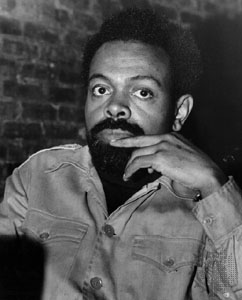
If one wanted a pocket history of late-fifties American avant-garde poetry that was under fifty pages and all by one author, one could do worse than to read LeRoi Jones' 1961 Preface to a Twenty-Volume Suicide Note. A teasing little note at the beginning of the book states that "these poems cover a period from 1957 until 1960 … I have arranged the book in as strict a chronological order as I could manage … for reasons best known to other young (?) poets" (parenthetical question mark Jones's). What this refers to I'm not entirely clear, but it's certainly true that Preface to a Twenty-Volume Suicide Note, more even than most books of poetry so arranged, is clarified enormously by proceeding chronologically. Jones covered a lot of distance in those three years, ending up, on the surface at least, at almost the diametrically opposite point to where he began.

The early poems have a casualness and humor that brings to mind the Beats and Frank O'Hara (all of whom were personal friends of Jones, and published by his Totem Press and Yugen magazine), as well as bearing plenty of traces of E.E. Cummings' easygoing satire. "Hymn for Lanie Poo," the second poem in the book, is a good example: a record of a black man's experiences in white urban bohemia, it features a provocative epigraph from Rimbaud ("Vous etes de faux Négres") and has references to John Coltrane, offhand travesties of academic "high" culture ("Read Garmanda's book, '14 Tribes of / Ambiguity,' didn't like it") and a generally breezy tone. Except for the heightened racial consciousness and occasional dips into a more Gothic register ("Beware the evil sun… / turn you black // crawl your eyeballs // rot your teeth"), this could be a late-fifties poem by O'Hara.

But Jones (like O'Hara himself, in fact) eventually becomes interested not just in expressing his personality but in critiquing it, a process which begins with the (great) sixth poem, "Look For You Yesterday, Here You Come Today." It begins: "Part of my charm: / envious blues feeling / separation of church & state / grim calls from drunk debutantes," the beginning of a poem-long anatomy of Jones' personality and lifestyle which is intricately bound up, not just with his status as a black man in a mostly white subculture, but with his role as literary editor as well:

terrible poems come in the mail. Descriptions of celibate parties
torn trousers: Great Poets dying
with their strophes on. & me
incapable of a simple straightforward
anger.

It's so diffuse
being alive. (15)

From there, Jones goes on to muse O'Hara-ishly about not being a painter, quote O'Hara himself on the value of quietism, contra Kerouac ("Frank walked off the stage, singing / 'My silence is as important as Jack's incessant yatter'"), associate his thoughts with Baudelaire's ("All these thots / are Flowers Of Evil"), get lost in a nostalgic reverie ("What has happened to box tops?"), and finally imagine his own death ("F. Scott Charon / will soon be glad-handing me / like a legionaire / My silver bullets all gone / My black mask trampled in the dust"). Thus the interior movement of this one poem anticipates the movement of Jones' development on the level of oeuvre.

What happens there is unexpected. As I read it, it entails a move away from O'Hara towards an engagement with the canonical texts of High Modernism: in particular, with exactly the quality of Modernism that poets like O'Hara, Ginsberg, Ashbery and Koch were most concerned to protest, its thoroughgoing depressiveness. Two poems in the middle of the book, "Way Out West" and "The Bridge," initiate a new phase in Jones' poetry by imitating and investigating what I'm going to call here the mode of "FUBAR Modernism," the sense of an entire environment gone to pot that in Eliot expresses itself elegiacally and, often through the use of the affective fallacy, lyrically as well. This return to Eliot, who Koch would later call "the Great Dictator / Of literature" (and not even exactly a return: let's keep in mind that Eliot was still alive in 1961, and if he was out of fashion with the avant-garde he was, in many ways, at the peak of his cultural power in the literary mainstream), is pretty surprising in a fellow-traveler of the Beats, Black Mountain and New York School, none of whom had much use for Eliot, preferring Pound and Williams if they had to have Modernist forebears at all.

I feel I could make a case for Eliot's pervasiveness throughout the whole second half of Preface to a Twenty-Volume Suicide Note, but for simplicity's sake I'll stick to the two poems aforementioned. Here's "Way Out West" in its entirety:

As simple an act
as opening the eyes. Merely
coming into things by degrees.

Morning: some tear is broken
on the wooden stairs
of my lady's eyes. Profusions
of green. The leaves. Their
constant prehensions. Like old
junkies on Sheridan Square, eyes
cold and round. There is a song
Nat Cole sings … This city
& the intricate disorder
of the seasons.

Unable to mention
something as abstract as time.

Even so, (bowing low in thick
smoke from cheap incense; all
kinds questions filling the mouth,
till you suffocate & fall dead
to opulent carpet.) Even so,

shadows will creep over your flesh
& hide your disorder, your lies.

There are unattractive wild ferns
outside the window
where the cats hide. They yowl
from there at nights. In heat
& bleeding on my tulips.

Steel bells, like the evil
unwashed Sphinx, towing in the twilight.
Childless old murderers, for centuries
with musty eyes.

I am distressed. Thinking
of the seasons, how they pass,
how I pass, my very youth, the
ripe sweet of my life; drained off…

Like giant rhesus monkeys;
picking their skulls,
with ingenious cruelty
sucking out the brains.

No use for beauty
collapsed, with moldy breath
done in. Insidious weight
of cankered dreams. Tiresias'
weathered cock.

Walking into the sea, shells
caught in the hair. Coarse
waves tearing the tongue.

Closing the eyes. As
simple an act. You float (24)

That the poem describes the contemplation of suicide should be obvious (even if Jones' book title didn't nudge us toward that reading). But it also narrates the passing of a day, beginning with "opening the eyes" and ending with "closing" them, though both are understood as "simple … act[s]" that contain within them the possibility of death, which is just as easy to bring on as wakefulness or sleep. As in Eliot, there is a constant toggling between dramatic or autobiographical details and purer image-making. There is also a tension between lyric and jeremiad, if we take the former to be the questioning of the self and the latter to be the questioning of the world. The textbook lyrical move of describing his "lady's eyes" leads him first to the natural world ("The / leaves. Their constant prehensions") and then to a corruption of it, as those eyes are in turn compared to "old / junkies on Sheridan Square" in a way that gives a wider characterization of the urban landscape in which our narrator dwells, a landscape which, as in Eliot, undermines the lyric impulse while paradoxically strengthening its effects (cf. Kant on disgust). The speaker, thrown once again into this sordid world, thinks of but does not quote from one of its more pleasant manifestations, a "Nat [King] Cole" song (an obvious update of the music hall numbers Eliot inserted into The Waste Land), and then free-associates across an ellipsis about "[t]his city / & the intricate disorder / of the seasons": an intricate disorder which recalls that which "breeds lilacs out of the dead land," the "stony rubbish" of "The Burial of the Dead." (I take it as significant that there is natural growth in Eliot's poem: it just appears as perverse, unnatural.) Writing a poem in what he sees as a waste land, but after Eliot, and after the avant-garde reaction against Eliot, Jones feels unentitled to the later Eliot's devices for coping with such misery: he is "[u]nable to mention / something as abstract as time" as in the redemptive Four Quartets (though of course Jones, in asserting this, has just mentioned it). Moving a little faster, we find "creep[ing]" "shadows," a personal "intricate disorder" ("your disorder") to match that of the city's, a dip into the rhetoric of pastoral elegy ("Thinking / of the seasons, how they pass, / how I pass, my very youth, the / ripe sweet of my life; drained off…"), horrible visceral images of the kind Eliot's early poetry is full of ("Childless old murderers," "giant rhesus monkeys") and then a final double echo, first of The Waste Land ("No use for beauty / collapsed … Tiresias' / weathered cock") and then, climactically, of "Prufrock" ("Walking into the sea, shells / caught in the hair. Coarse / waves tearing the tongue"): walk, sea, hair, drowning.

The next poem in the book, "The Bridge," takes up a different High Modernist author, one less eminent and influential than Eliot but perhaps even better as a symbol of the FUBAR aesthetic, since he actually killed himself: Hart Crane. The poem is not formally much like Crane, but it pays him unmistakable homage in its title and in its imagery.

I have forgotten the head
of where I am. Here at the bridge. 2
bars, down the street, seeming
to wrap themselves around my fingers, the day,
screams in me: pitiful like a little girl
you sense will be dead before the winter
is over.

I can't see the bridge now, I've past
it, its shadow, we drove through, headed out
along the cold insensitive roads to what
we wanted to call "ourselves."
"How does the bridge go?"

Here the bridge is also a musical bridge, and the poem can be understood as written from the perspective of a jazz musician. This realization renders the first strophe almost Metaphysical in its playfulness, with existential confusion figured as losing one's way in a song ("I have forgotten the head / of where I am") and "bars" meaning both measures of time in music and places where you drink alcohol, both of which are felt as mysteriously constricting ("seeming to wrap themselves around my fingers"). But music really appeals to Jones as a symbol of the unfreezable flow of time, a forward-rushing movement that cannot be seized at any one moment without losing its integrity: "The changes are difficult, when / you hear them, & know they are all in you, the chords // of your disorder meddle with your would be disguises." The obvious play is on "changes" as both chord changes and historical changes, both of which are "difficult" in the sense of jarring but which are felt as corresponding to some innate and inchoate need of the self, "your disorder" as opposed to "your would be disguises." My claim, a little bit of a stretch maybe, is that it's not just free jazz — and the postwar, postmodern moment associated with it — that Jones is talking about here, but also Crane's The Bridge, and Modernism. This has been left behind for what is already, by the late 50s, observable on the horizon as the coming of Confessionalism, which Jones presciently sees as abandoning monumental expression to travel down "the cold insensitive roads to what / we wanted to call 'ourselves.'"

The second half of the poem starts: "(Late feeling)," indicating a kind of postscript I suppose, the morning after the jazz performance maybe, but also continuing the theme of time, and of belatedness. It continues:

Way down till it barely, after that rush of
wind & odor reflected from hills you have forgotten the color
when you touch the water, & it closes, slowly, around your head.

Another image of immersion, death by water, suicide. But:

The bridge will be behind you, that music you know, that place,
you feel when you look up to say, it is me, & I have forgotten,
all the things, you told me to love, to try to understand, the
bridge will stand, high up in the clouds & the light, & you,

(when you have let the song run out) will be sliding through
unmentionable black. (26)

"The bridge will be behind you": literally in time (because the performance is over) but also figuratively in memory (because the forward-looking avant-garde is leaving The Bridge behind, and The Waste Land, or so they think). I read the passage, then, as expressing a certain melancholy for the moment of 20s/30s Modernism — a time when, arguably, jazz and avant-garde writing were more closely socially associated; in any case, a monumental timelessness ("the bridge will stand") placed in opposition to contemporary triviality, "all the things, you told me to love, to try to understand" (the pop cultural detritus celebrated in O'Hara's work, and in Preface's first six poems). Without the fixity and permanence of "the bridge" (a bridge between white and black experience? a testament to the potential of communal, human making?), the speaker of the poem is doomed to slide into solipsism, to racial and social isolation, "unmentionable black."

I guess what interests me most about this reading of Jones (which could be totally off the mark: I should admit I don't know almost any of his later, more militant work) is that it really fucks with the historical narrative that sees postwar poets, particularly ones with political leanings, rebelling against the High Modernist aesthetic of Eliot, Pound, Crane, etc. I'd argue that this is truer of essentially apolitical poets like Robert Lowell and (gulp) John Ashbery, who refuse High Modernism for affective reasons — it's not the mood, the tone they want to project — rather than because they see it is ideologically or communicatively faulty. This doesn't have to be a question of competing metaphysics, or its objectification ("poetics"), it's just rhetoric: the language of and
The Waste Land and The Bridge is more "political" — i.e. more strident, stirring, closer to agitprop and soapbox speeches — than the language of Life Studies and Self-Portrait in a Convex Mirror. Even if "the personal is the political," the persons involved have to speak to and convince each other: as Eliot puts it in Sweeney Agonistes, "I gotta use words when I talk to you."

For the trajectory of influence in
Preface to a Twenty-Volume Suicide Note is so clearly from O'Hara to Eliot, and not the other way around: that is, from personality to impersonality. And it is exactly personality, in O'Hara's sense, which is rejected by Jones as hegemonic, pedagogical, and totalizing ("all the things, you told me to love, to try to understand"). The mode of Eliot (and the example of Crane), on the other hand, offer him a different kind of expression.

Monday, September 24, 2007

"Dare not decline" - costs of going local


"Poet appointed dare not decline
to walk among the bogus"

So begins the second section of Basil Bunting's Briggflatts, and it sets an injunction the poet cannot keep precisely because "who appointed him?" is the next question. "Decline" - which by the poem's 1966 publication is a deeply troubled term for national devolution in post-War, post-imperial English national topology - can mean two things here: "don't refuse to walk among the bogus" or "don't descend down among the bogus". Either a self-harming injunction to wallow or a self-deceiving presumption of authenticity in a world dirtily without.

This strikes me as paradigmatic of the poet's choices who would attempt epic, even the modernist/Poundian "poem including history", when he (or she) is confronted with a national history that has both shrunk to rocky Saxon particularity and exploded to a global dialogue of plural histories. The rich and gorgeous language of the first section of Briggflatts uncovers a deep and local continuity that could be the epic poet's material (and has Pound's version of and use in the Cantos of "The Seafarer" as a predecessor): "By such rocks/ men killed Bloodaxe." It can be carved in stone and, as in section V's echo of Four Quartets, "Then is diffused in Now" (echo of the Quartets, but diminished -- not about presence and chronological fusion so much as "diffusion", dispersal, weakening).


The poem, called an "autobiography," includes in the second section a reference to Bunting's time as a spy for the British, who "decodes/ thunder, scans/ porridge bubbling, pipes clanking". Eliot, secretive but no spy, could once simply hear what the thunder said. Left the porridge alone. Bunting, in this role among the bogus, must detail the impoverished surround, laying "sick, self-maimed, self-hating,/ obstinate, mating/ beauty with squalor to beget lines still-born." The local, which is the ground of the poem and its primary linguistic audience, forms a substrate of filth rather than a solid ground in which to grow a regional epic. The poem begins to clog with fecal matter, which composts any number of rotting decapitated heads (as the poem's opening describes, "Decay thrusts the blade,/ wheat stands in excrement/ trembling"). As Bunting writes in section IV, "Today's posts are piles to drive into the quaggy past/ on which impermanent palaces balance."

The figure of the still-born, or as another possibility of this "mating", the monstrous is the abiding concern of the poem, itself then a half-product of a region (with the potential for epic) and of the deaths that register that region's deep history (with their potential for elegy). The tomb carved in section one is for the deceased child of the young couple who ride with the mason across Rawthey, and the poem gives gory details about the bestiality that brought us the Minotaur.

I'd like to explore the poem's conjoined topoi of monstrosity and hybridity in the formation of subjective declension. But I'll leave that for now and make a note about the "still-born" as a description of both poem and nation. Though the "sun rises on an acknowledged land" the poem ends with a coda that brings this diurnal recognition into the symbolic sweep of a completed elegiac movement, initiated in such an extended fashion as to make it hard to perceive until *blammo* he's playing off the end of "Lycidas". In the Coda,

A strong song tows
us, long earsick.
Blind, we follow
rain slant, spray flick
to fields we do not know.

Lycidas has its own coda -- its last eight lines zoom out to the third person to describe how "thus sang the uncouth swain" all that had come before. The gesture toward "fresh woods, and pastures new" complete the consolatory purpose of the elegy and declare closed the literary apprenticeship of the lyric speaker, who thereby promises and indeed begins to perform the consummation of his voice in writing the great work (the last 8 lines = one ottava rima stanza of italian epic). In Bunting, the coda works in the opposite direction, marshalling community in blind servile following of the song, and ends with a reworking of the "pastures new" from promise to disillusionment:

Where we are who knows
of kings who sup
while day fails? Who,
swinging his axe
to fell kings, guesses
where we go?

It's Lycidas rewritten with a proleptic view of the heads that would roll in the coming years, both the need for protestant revolution and an acknowledgment of its costs (esp. in post-industrial -- notice how these poems of local epic or thwarted epic have so much interest in work, in craft).

Oh, i'm getting tired of writing this. Something something. The political economy of the commonweal (see the etymology of "bogus" in the OED, as it emerges as a major point of reactionary possibility in English late-mod. epics in this period (see also Hill's Mercian Hymns, lots of Hughes's poems I think) and as a grounding moment in the portraits of community and region that are all over the place in America at this point (Paterson, Howl, Brooks's sketches of Bronzeville, Hughes's "Portrait of a Dream Deferred").

Sorry to cop out but I got other work to do. May come back and edit this eventually. Could continue in the comments, since i'm sure i haven't made myself very clear.

In literary love

Below is the basic argument of Leslie Fiedler's essay War, Exile, and the Death of Honor from his book Wating For the End: A portrait of Twentieth-Century American Literature and Its Writers". I want his brain.


"It is tempting to think of the practice of our writers of the Twenties as representing a decisive disavowal of the temptations of avant-gardism, and, in a sense, this is true; but it is not true enough. Hemingway and Gertrude Stein may have become at last, symbolically as well as personally, enemies; yet the example of her war on syntax and coherence made him to the end a more insidious subverter of common speech than the readers of Life magazine could ever permit themselves to recognize even if they were capable of doing so. And however stubbornly Faulkner insisted on reinventing stream-of-consciousness in his own home-made terms, the experiments of Joyce surely inspired the effort. The ostensible rejection and the abiding nostalgia, the pride and shame of the generation of the Twenties in its encounter with Europe, is, in fact, the reaction of the tourist, the provincial tourist. It matters little whether the writers played abroad for a long time like Fitzgerald, or retreated immediately to their home towns like Faulkner, or kept seeking on foreign continents images of Montana and Upper Michigan like Hemingway--the writers who came of age in WWI remained what they were to begin with: country boys perpetually astonished at meeting the Big City and the Great World, provincials forever surprised to discover themselves in London or Paris or Antibes, and afterward dazzled to remember that they had ever been in such improbable places."

Fiedler than goes on to recount the long tradition of American writers abroad (From Franklin to Irving, Hawthorne and Melville to Baldwin and Burroughs) "It is, indeed, astonishing how many especially American fictions were conceived or actually executed abroad from Rip Van Winkle through the Leather Stocking Tales, the Marble Faun of Hawthorne, Twain's Pudd'nhead Wilson to Fitzgerald's Tender Is the Night and The Sun Also Rises of Hemingway.

"Such novels of exile and return reflect the deepest truth, the mythical truth of the experience of Americans abroad, a truth of art which life does not always succeed in imitating, though it is one to which it aspires. TS Eliot may never go back to St. Louis to live out his declining years, while Pound, released from captivity in the States, seems set on dying in Rapallo. And if Rapallo looks, as Karl Shapiro has somewhere observed, just like Santa Barbara, California, that is just one of those irrelevant jokes which history plays on us all"

He goes on to flush out this theme of exile and return. "Even Eliot, Anglo-Catholic and Royalist, returns home in his imagination, making a pilgrimage in the Four Quartets not only to New England, but even, less forseeably, to Huck Finn's Mississippi, beside which he was born."

"In Paris, obviously different from the dream of Paris, the American discovers he can bear Kansas City, which he began knowing was different from all dreams of it; and this is worth his fare plus whatever heartache he pays as surtax."

"And though there is a sense in which the anti-war novel is merely a late sub-variety of the international theme (and another in which it is a sub-genre of the class-struggle book), we are compelled how to recognize it as the greatest and most characteristic literary invention of the Twenties."

"But pacifism, too, was a fiction of WWII, which saw thousands of young men, who earlier had risen in schools and colleges to swear that they would never bear arms, march off to battle--as often as not with copies of anti-warbooks in their packs. Those books were real enough, like the passion that prompted them, and the zeal with which they were read; only the promises were illusory."

"We inhabit for the first time a world in which men begin wars knowing that their avowed ends will not be accomplished, a world in which it is more and more difficult to believe that the conflicts we cannot avert are in any sense justified. And in such a world, the draft dodger, the malingerer, the goldbrick, the crap-out, all who make what Hemingway was the first to call 'a separate peace,' all who somehow survive the bombardment of shells and cant, become a new kind of anti-heroic hero. And it is precisely such sad sacks, such refugees from honor and glory, who returned to American to beget or become the generation of the Thirties."

Friday, September 7, 2007

Era-Prone

Let me take this opportunity to recommend to both of you Marjorie Perloff's "Pound/Stevens: Whose Era?," the first piece in her 1985 collection The Dance of the Intellect: Studies in the Poetry of the Pound Tradition (the subtitle of which sort of gives away her answer to the essay's question, but never mind). Among other things, it's a very helpful recapitulation of where things stood Modernism-wise in the academic critical establishment of the early 80s. Basically, the findings can be summarized as follows: Pound stands for anti-Symbolism, form as content, acknowledgment of other minds, making it new, and "constatation of fact"; Stevens stands for the Romantic tradition, matter over manner (!), withdrawal from reality, "desperately triumphant humanism," and having a paraphrasable meaning. You cannot like both, or at least can't consider them both truly Modern.

Funny, this critical obsession with "eras," and with dominant figures to embody those eras; I guess this is what those New Modernist Studies people with their emphasis on "modernisms" rather than "modernism" are trying to sweep away, and good for them (us?). What seems particularly "80s" about this question to me is the assumption that canonical considerations like quality, cultural exemplarity and historical importance can be neatly subsumed under the heading of metaphysical correctness: the poet with the best theory of poetry is therefore the greatest of the era, and ergo is the only one we should read. One only needs to step back from this idea a little way to see that it's just as unsatisfactory as the idea that it's only the writers with the best political views (the closest to "ours") that we should read, which I guess was very "70s." And speaking of politics: Perloff, interestingly, ends her essay by proposing and then quickly dismissing Eliot as an alternative poster-boy to Pound and Stevens: "no one today, whether we look to critics like Bloom or Kenner or Vendler or poets like John Ashbery or James Merrill or Adrienne Rich or Allen Ginsberg, seems eager to call the first half of the twentieth century the Eliot Era." Perloff goes on to speculate that this is "because Eliot's poetry does not fully pose the problem that came to obsess Modernism: whether poetry should be lyric or collage, meditation or encyclopedia, the still moment or the jagged fragment" (23). But would it be too contrarian or anti-formalist to claim instead that this reluctance to enshrine Eliot is because his poetic and philosophical world view, objectionable and conservative as it is, actually makes sense and was well-developed and thus difficult to either answer or caricature, making him a less attractive representative for combatants in a vicious culture war than the more eccentric and reactionary Pound and Stevens? Just asking.

I want to note one other thing which really stood out, to me, in Perloff's essay: the unlikely temporary alliance between what Perloff calls "Romantic visionary humanism" (Frank Kermode, Helen Vendler) and the first wave of American deconstruction (J. Hillis Miller, Geoffrey Hartman) in the late 70s and early 80s, with Harold Bloom bridging the gap between these camps. A key part of the appeal of deconstruction to US English departments is that it let the recently discredited texts and tenets of Romanticism back into the game, under the cover of a concept to be, you know, problematized. I think in part this is a case of smuggling the poetry in with the philosophy: it's a short hop from Derrida's interest in Rousseau to Hartman's reappraisal of Wordsworth, for instance. Thus a "return of the repressed" could look like radical forward-thinking, and questions of canon formation could be shoved aside to make room for new methodological approaches to previously established texts. This is philosophically one of the meagerest, but structurally one of the most important, elements of the legacy of deconstruction in America.

On a related note, has there been any major, sustained criticism of Modernism from a deconstructionist perspective? (This is not totally a rhetorical question; there really might be some stuff I'm not thinking of.) I guess Derrida himself comes closest, having written on Kafka, Joyce, Ponge and Mallarmé, and Jonathan Culler has that book on Flaubert. Largely, though, it's remarkable how many of the big names connected with deconstruction past and present are Romanticists, or nineteenth-centuryists anyway (Miller, Hartman, de Man, Ronell, our buddy Eduardo). And given that deconstruction — it might be better just to say "Derrida" — emerged at roughly the historical point at which Modernism was shaped as a coherent canon of texts and concepts, it's particularly surprising that there hasn't been more overlap. (Marxism, on the other hand, which predates Modernism as an intellectual tradition, has had quite a lot to say about it over the years: Lukács, Benjamin, Adorno, Williams, Jameson, etc.) I guess part of the problem is that so much of the Modernists' philosophy was, as Kenner kindly puts it, "homemade": it's hard to deconstruct "no ideas but in things" because it's, um, not an idea. And so much of the scholarly work involved with Modernism, and especially with figures like Pound and Williams, has been to bring their ideas up to a certain minimal level of intelligibility, or constructedness, without which deconstruction could not begin to take place.

Hmm, this is getting pretty rambly. Maybe I'd better cut it off here. Hi, guys! Looking forward to seeing you soon!

(Final observation: we could never have "the Ashbery Era," because it's too hard to say.)

Thursday, August 30, 2007

Hugh and Ray

OK, so: two ways out of Modernist criticism: Raymond Williams and Hugh Kenner. Both start publishing in the early 50s, in England and America (via Canada) respectively, and can be seen as a sort of transition between the rapidly aging New Critical establishment and the theory-soaked generation that would emerge from the ruins of Existentialism. They both brought new intellectual leanings to the examination of familiar texts and problems and they both engaged, significantly and influentially, with Modernism — Kenner for the whole of his career, Williams at the very end of it.

Hugh first. Kenner liked the Modernists because they were geniuses, and he liked geniuses because he was one. The Marjorie Perloff quote that Adrienne posted last week noting that Kenner posited "a conjunction of literary innovation with that of the other arts, sciences, and technologies" is totally on the money: and while it's certainly a big part of his achievement and the fantastic connections he's able to make, especially in The Pound Era, it also occasionally borders on becoming a gimmick. He also, problematically, assumes that simply by virtue of living through an era in which such scientific revolutions were transpiring, men as Ludditic as Pound and Joyce must have absorbed their innovations by osmosis.

What makes up for this fast-and-loose historicism is his unquestionable awesomeness at close reading, in which he can run circles around the New Critics he succeeded (and whom he mocks in passing in A Homemade World). His typical critical method was dogged patience before the mysteries of a difficult text, coupled with complete faith that its creator had been, in every respect, on to something. (Incidentally, he has one of the most apt names in literature: over the course of his long and tireless career, more and more technical procedures, factoids and acts of random scholarship swim into his ken.) The results of this attitude are its own justification: Kenner finds and explicates problems in Ulysses and The Cantos that other readers hadn't even realized were there, and probably never would have.

But, here's the problem, as I see it, with Kenner's scientistic Modernism: if the Modernists invented a new kind of poem, then they conveniently forgot to tell us how to build one of our own; or rather, the instructions they left are so colored by the first flush of excitement at the discovery that they're often more or less indecipherable. HK admits at much by quoting at length from Williams's "explanatory" prose writing in Spring and All, which he back-handedly compliments as "homemade philosophy," but justifies thusly: "Yet as on a stage where we see nothing but a good mime leaning on the invisible mantelpiece can persuade us he knows where the fireplace would be, so Williams' gesturings around the Imagination are not random nor self-contradictory but compatible with the existence, located and perceived by him, of a reality he may not succeed in making us see" (66). The writing here is so good that you can forget what an easy time he's giving Williams, just as he does Zukofsky's "Sincerity and Objectification" in a later chapter; and, more broadly, how much he has to supply himself in order to make a coherent Modernist Weltanschauung.

In essence, then, he treated the Modernists not like scientists but like scientific phenomena, ineffably but exactly "behaving" the way molecules behave — and not like like people with ideas which could sometimes be drastically wrong. For all his emphasis on science, Kenner lacks any account of how scientific ideas are transmitted from one mind to another: it's all "Eureka" with him, all homemade breakthrough, with almost no interest in that other important aspect of science in the 20th century, the process by which radical new ideas are tested and contested in a public arena. Thomas Kuhn he ain't.

Williams, on the other hand, is all about the communication of ideas. He's considered important for, among other things, finding a synthesis of Leavisism and Marxism to combat the reactionary political climate of Britain in the 50s, which in practice meant rehabilitating the problematic ideas of "culture" and "tradition" for a progressive democratic agenda. In the late 50s and early 60s Williams became a sort of academic celebrity and spokesman for the British New Left, called by Edward Thompson "our best man" (a designation that recalls Auden's position in the mid-30s — there's something very English about this sort of left-wing hero worship, evidently). His 1958 essay "The Masses" (excerpted from the conclusion of Culture and Society), though specifically arguing against "mass-communication" and the conservative fear of a lowering of cultural standards due to the influence of film and television, can also be read as an insistence on communication over aesthetics, intelligent discourse about standards replacing — or rather, constituting — standards themselves. This is a version of Modernism, if it is Modernism, with a politics quite removed from the meritocratic bias of the Pound tradition championed by Kenner. Williams writes that "much of what we call communication is, necessarily, no more in itself than transmisson: that is to say, a one-way sending. Reception and response, which complete communication, depend on other factors than the techniques" (50). Ideas, or poetic styles, in other words, aren't just right or wrong, good or bad, or even qualitatively "of their time"; there are no self-evident "discoveries" in the realm of culture; they take hold only if they are presented and defended in such a way that the people receiving them realize their benefit. (This is close to sounding like John Dewey, but I can't tell if that's me or Williams.) Contra his Canadian contemporary's faith in "a reality [someone else] may not succeed in making us see," Williams would seem to say that there is no reality (in the realm of culture, anyway, which by any definition is where literature belongs) that is not communicated, and communicated well: not, at any rate, for other people.

Well, I hope I'm communicating some kind of reality, at least to myself (hello there, self) in the future. Bottom line: I see Kenner and Williams as engaged in two markedly different attempts to keep Modernism going, Kenner by ensuring that its texts remain influential (and readable), and Williams by keeping the communication channels it opened within the academy free and clear. Kenner makes his name by digging indefatigably into the texts of Pound, Eliot, Joyce, &c, revealing unsuspected depths in them; while, at approximately the same time, Williams takes up the philosophical concepts associated with Modernism, and particularly with Eliot — the volume's editor John Higgins notes that RW's 1958 manifesto "Culture is Ordinary" was a kind of late response to Eliot's 1948 Notes Towards the Definition of Culture — in an attempt to revise and broaden them so they can be applied to new texts and new fields of study (notably politics, sociology and film).

(And now this is really just a suggestion for further study, but it might be interesting to compare Williams and Kenner in the light of the rise of communication theory; Kenner's early association with Marshall McLuhan would be particularly important in such a narrative. And lookee here: that ever-reliable conduit of communication Wikipedia informs me that McLuhan's "interest in the critical study of popular culture was influenced by the 1933 book Culture and Environment by F.R. Leavis and Denys Thompson." It all goes back to Leavis, it appears. Gotta read Leavis now, I guess.)

Sick and tired

I want to throw a passage by Raymond Williams, somewhat haphazardly, at the question of Modernism's Old Man Fetish that we were kicking around way back. This is from "Individuals and Societies," an excerpt from his 1961 book The Long Revolution given in The Raymond Williams Reader, and it clarifies his theoretical distinction between "subjects" and "servants":

"The subject, at whatever violence to himself, has to accept the way of life of his society, and his own indicated place in it, because there is no other way in which he can maintain himself at all … It is not his way of life, in any sense that matters, but he must conform to it to survive. In the case of the servant, the pressure is less severe, though still, to him, irresistible. The subject has no choice; the servant is given the illusion of a choice, and is invited to identify himself with the way of life in which his place is defined. It is an illusion of choice, because again, like the subject, he has no obvious way of maintaining his life if he refuses. Yet the illusion is important, for it allows him to pretend to have an identification with the society, as if the choice had been real. The subject will have few illusions about the relationship which is determining him; he will know that the way of life is not his but must be obeyed. The servant, on the other hand, may come to identify himself with the other way of life that is determining him; he may even, consciously, think of himself as a member … Yet at many levels of his life, and particularly in certain situations such as solitude and age, the discrepancy between the role the individual is playing and his actual sense of himself will become manifest, either consciously or in terms of some physical or emotional disturbance. Given the right conditions, he can play the role as if it were really his, or in situations evoking his deepest personal feelings, the identification breaks down." (77-78)

I'm thinking here in particular of Yeats, in such a poem as "Among School Children," where the "role" of poet as public "servant" (in his own phrase, a "smiling public man") is unexpectedly decimated under the pressure of lyric "disturbance." Is this what Yeats (and maybe Eliot) are trying to embody in their personae — the kind of lack of faith in society experienceable not by rebellious youth (Joyce's/Stephen Dedalus' "Non serviam") but only by old men who've spent themselves in trying to serve?

Wednesday, August 22, 2007

Die, Modernism, Die

Yep, it was literary critics killed Modernism, not poets (though many of them poet-critics: not exactly sure what to make of that). And it was accomplished not through any sort of polemical attack, but through a simultaneous collective lowering of expectations, and a willingness to rest on laurels. We know everything we need to know, the argument ran, to write great poetry now: and if you don't know, you haven't been paying attention. In that case, God help you.

Exhibit A: R.P. Blackmur's "Lord Tennyson's Scissors: 1912-1950," an overview of the Modernist period published in 1951 as the epilogue to his collection Language as Gesture. "Forty years of poetry took their rise in Eliot, Yeats, and Pound," Blackmur says, condensing a half century's worth of complex aesthetic and political wrangling into three Big Names to set alongside Shakespeare-Marlowe-Jonson, Wordsworth-Coleridge-Southey and Shelley-Keats-Blake. I'm just going to quote some (OK, a lot of) stuff from this essay, because some of it is helpful, a lot of it is funny (and unfair), and all of it gives a good index of how even the most pro-Modernist critics wanted to wrap things up and move on to the next thing by the beginning of the 50s:

On Yeats: "neither his vices nor his poetry ever quitted him" (424)

On 1922: "1922 seems the great year of our time — especially if you let the months run a little both ways — for it holds a good many of Yeats' Tower poems, Pound's first eight Cantos, and Eliot's The Waste Land, not to mention Ulysses, the finishing of The Magic Mountain, and the beginning of The Counterfeiters. The year 1922 is almost inexhaustible in all the arts" (426)

On Pound and prosody: "The general prosody of the 'teens and 'twenties had equally little to do with the practice of Yeats, Pound, and Eliot … and with the practice of the old conservatives. The general prosody was perhaps the weakest and least conscious in English since the dead poetry of the mid-sixteenth century. It ran, under various guises and doctrines, toward a combination of absolute doggerel and absolute expressionism. Ezra Pound was as responsible as anyone for this condition, not by the progress of his own work but by the procession of manifestoes which he promulgated by letter and print. His doctrine, however it may have promoted the incentive of writing, only got in the way of full work and when it got stronger, deeply damaged, though it never destroyed, his expressive powers" (427)

On "the ideographic method" and expressionism: "The procedure is very tempting, always, to get rid of what is behind one and what is ahead of one, neither by capitulation nor by mastery, but by declaring an arbitrary substitute. Then expression becomes immediate, which is good, and spontaneous, which is not; for spontaneity is the curse of poetry to at least the same degree that neologism is the curse of language. But the temptation is very deep; Art, as Maritain says, Art bitten by poetry longs to be freed from reason, but so long as nothing is substituted for reason the longing is not fatal and may indeed promote a fresh and rejoicing sense of disorder, as The Waste Land did, or a new underground for reason, as the work of Valéry and Mallarmé did" (428)

On Basic English: "What, should we get rid of our ignorance, of the very substance of our lives, merely in order to understand one another?" (428)

On the "heroization of the sensibility": "What [the modern poets] did was to make just enough of a prosody to heroize the sensibility and not quite enough to make a heroic statement. Just enough meter to make a patter, just enough rhyme to make a noise, just enough reason to make an argument; never enough of anything to bind together what came out of the reservoir of their extraordinary sensibility into possible poetry … This bad poetry is not worth reference in itself; it is here only to represent the condition of the language and the state of ambition in which an unusually large amount of good — or partly good — poetry got written" (428-429)

On flatness/prosiness: "Verse should be written, said Pound, not to the metronome but in the sequence of the musical phrase. The prose tradition alone produces flatness, inhibits song, and excludes behavior; and I see no sense in welcoming these disorders, as Eliot has done in parts of the Quartets and as Schwartz has done in all but his earliest work, as other and desirable forms of order. I do not refer to careless writing but to deliberate flatness; which is only the contemporary form of Georgian deliquescence" (429)
[this opinion will become particularly interesting in the context of Ashbery, I think]

On solipsism and "the real world": "…it seems to have been an age when the sensibility took over much of the task of poetry. That is why we have created so many private worlds each claiming ascendancy over the real world about which nothing, or nearly nothing got said. That is why, too, Yeats and Eliot (though not Pound, except rarely) were almost alone able to express a version — an actual form — of the real world. In each the sensibility had other grounds than itself; the ground of beseeching, history, faith or momentum and the other ground, no less important to poetry, of prosody." (430)


Then there's a long section where RPB runs down all the various "schools" of Modernism (what Graves and Riding call "dead movements"), those not entirely assimilable to the traditions created by Yeats, Eliot or Pound. This is the fun part:

1. "the parallel Old-Timers' school, what we might call the school of Chaucer and the Ballad; think of Hardy, Housman, Robinson, and Frost … Reading them, we see why Pound does not occupy a first position, but a position on one side. The superlative metric of Pound may be a clue to their weakness but it would never furnish an understanding of their imperfect strength. Their work stands ready to infect the work of young men who have not yet found a form for their ambition and who can no longer, since they apprehend what has happened to it, heroize their sensibility. At least I should suppose there might be a coming race of poets who would want to reverse Maritain's phrase and say Art, bitten by reason, longs to be freed from poetry: from the spontaneous and the private and the calculated public worlds. There might be a race of poets, that is, who would woo the excited miracles of absolute statement, not as a refuge, but to get their work done" (432)
[to me, this seems to presage a lot of the most accepted poetry today, in both America and Britain; what Ron Silliman calls the School of Quietude. More on this some other day, maybe.]

2. "the Apocalyptic or Violent school … Here is where we find the remains of Vachel Lindsay, the evangel of enthusiastic rebirth; Robinson Jeffers, the classical Freudian; Roy Campbell the animal, authoritarian evangel of anti-culture; Carl Sandburg, the bard of demagogic anti-culture; and of course others … All these stem poetically and emotionally from Whitman-Vates: and all are marked by ignorance, good will, solipsism, and evangelism … nor should we think of them even so briefly as more than false alarms if it were not for the two extraordinary talents that must be grouped with them … D.H. Lawrence and Hart Crane … Each is a blow in the face but neither can hit you twice" (433)

3. "another school of anti-intelligence … They got rid of too much of their reason, and as a result they effervesced rather than expressed, and what is left is flat. Nameless they shall be here; they belonged only to their principal journal transition. What was wrong with them is clear when you see how weak is their imitation of Apollinaire, Aragon, Cocteau, Soupault [!], and how great their misunderstanding of Mallarmé, Rilke, Joyce, Kafka, and Pirandello: all men who longing to be freed from reason had a kind of bottom supply of it. Neither the English nor the Americans have ever been very good at this sort of thing. Let us say that we have not so much of reason that we can afford to lose any of it; we need it to make our nonsense real as well as genuine; and one would say that in this respect prosody was a form of reason" (433-434)
[obviously, this will have renewed significance in the 60s with New York School et al.]

4. "the school of Donne into which the largest number of individual writers of good verse fall when shaken up and let settle … they are difficult in style, violent in their constructed emotions, private with actual secrecy in meaning. There is in their work a wrestling struggle toward statement, a struggle through paradox and irony … and the detritus of convictions. The statements are therefore impossible to make, but the effort to make them is exciting because genuine …" [here he includes John Crowe Ransom, Allen Tate, John Wheelwright, William Empson and Hugh MacDiarmid]
"The general poetry at the center of our time takes the compact and studiable conceit of Donne with the direct eccentricity, vision, and private symbolism of Blake; takes from Hopkins the incalculable and unreliable freedom … of sprung rhythm, and the concentration camp of the single word; and from Emily Dickinson takes spontaneous snatched idiom and wooed accidental inductableness. It is a Court poetry, learned at its fingertips and full of a decorous willfulness called ambiguity. It is, in a mass society, a court poetry without a court" (434-435)

5. William Carlos Williams: "To him beauty is absolute and falls like the rain, like the dream of rain in a dry year. He is, if you like, the imagism of 1912 self-transcended. He is contact without tact; he is objectivism without objective … The neo-classicist and the neo-barbarian are alike in this: their vitality is without choice or purpose" (435)

6. Stevens/Moore/Cummings
"
Each, so to speak, is full of syllables where [Yeats, Eliot and Pound] are full of words. Each is a kind of dandy, or connoisseur, a true mountebank of behavior made song … let us say they make an equilateral triangle of three styles hung like a pendant from the three major styles" (436)

a. Wallace Stevens
is a dandy and a Platonist … You need an old dictionary and an old ear to get his beauty: as if he had to find an unfamiliar name before the beauty of his perception could emerge; and it is along these lines that you have to think of the French symbolists' influence upon him. They taught Eliot the anti-poetic and the conversational style; Stevens they taught the archaic and the rhetorical; that is, Eliot and Stevens saw the one prosody running in opposite directions. But Stevens is in essence of a very old tradition, French and Platonic, working on a modern substance … He should have lived in the age of Pope; with his sensibility and his syllables he could have made rational statements with more beauty than that age was capable of. But as he is, he is 'the tranquil jewel in this confusion'" (436)

b. Marianne Moore
"has written the most complex syllabic verse of our time: as if she brought French numbers to English rhythms with no principle of equivalence. But she is not the syllabist as dandy but as connoisseur; she is the syllabist of the actual, the metrist of the immediate marvel… There is a correspondence here to the coerced heightened perception (the forced close observation) in the painting of still-life. Poetry is to her, as she says, an imaginary garden with real toads in it. She knows all about the toads because she has imagined the garden; as you look suddenly everywhere there is the disengaged leap of a green or a brown toad, all warts, all soft, all leaping, all real. If there is not much other reality there, and there seldom is in a connoisseur's garden, you bring her, or ignore, the life she hasn't got just because what she has got is do real: you bring or ignore as with a shut-in whom you love" (436-437)
[this is, incidentally, both one of the most eloquent and the most spectacularly condescending statements about MM ever made]

c. E.E. Cummings "is the child turned poet, the child with that terrifying and incomplete dimension. Otherwise put, Cummings is the traditionalist who insists on the literal content of his tradition without re-understanding its sources: this is, of course, the easiest form of eccentricity and the most human form of fanaticism … He has too little a developed self ever to escape from it except waywardly, when you want either to console him or beat him … He was educated by Edmund Spenser, the English sonneteers, Keats, Swinburne, the funny-papers, and John Bunyan; but perhaps he was most educated by the things that were left out that would have gone to make a structured mind. All he knows is by enthusiasm, habit, and aversion. He refuses the job of the full intelligence, preferring intimacy with what he loves and contempt for what he hates; and he accepts what love and hatred give as if they made all the music of a full mind … if he were not part of a going concern larger than he, he would be nothing. Here again is a case where prosody is an instrument of reason. Like the wilder currencies in the age of Veluta (or like the serried marks of Hitler [!!!]) Cummings' experimental typography depends on the constant presence of the standard it departs from and would be worthless if not measured against it" (437-438)
[seems like some of these ideas — or prejudices, if you like — could be usefully applied to Kenneth Koch]


Blackmur finishes up by assessing "the further development and release, still inchoate to these observations, of the doomed school of Auden about 1930" with its "deliberate approach to doggerel through Skelton, the Ballads, the immediate situation, and the multi-valenced distrust of self combined to produce the new flat style" (438-439): again, this suspicion of "flatness," and an interesting offhand use of the rhetoric of "doomedness" so often applied to the poets of 1890s (which, as RPB must be thinking of, produced Yeats). He also looks toward "the generation born between 1913 and 1918: Shapiro, Barker, Schwartz, Thomas, Berryman, Manifold, Lowell, Betjeman, Meredith, and Reed" (I must admit I have no idea who half these people are). Solemnly passing the torch to these promising whippersnappers, Blackmur delivers the New Critic's version of "you kids today don't know how good you've got it": "they have the enormous advantage over their predecessors that there is an idiom ready for them to develop according to their own needs" (439). So this is what it has come to, Modernism is "an idiom," and no longer anything like a movement, or even a set of loosely concatenatable authors and texts. "We might have a great age out of them yet," he reckons, but if they do succeed it will be because they keep ploughing the same furrow as the Big Three (or at least their equilateral pendant): "[t]hey have more than a chance — it is half done for them — to develop out of personality the most objective of all creations, the least arbitrary and spontaneous, a style."

Countdown to "arbitrary and spontaneous" begins now.


From Michael North's book The Dialect of Modernism
"The white vogue for Harlem has long had an accepted place in histories of the 1920s, and the shallow Negrophilia of this period has often been acknowledged in accounts of the Harlem Renaissance. But it is less often acknowledged just how far this racial cross-identification went or how widespread it was. Writers as far from Harlem as T.S. Eliot and Gertrude Stein reimagined themselves as black, spoke in a black voice, and used that voice to transform the literature of their time. In fact, three of the accepted landmarks of literary modernism in English depend on racial ventriloquism of this kind: Conrad's Nigger of the "Narcissus," Stein's "Melanctha," and Eliot's Waste Land. If the racial status of these works is taken at all seriously, it seems that linguistic mimicry and racial masquerade were not just shallow fades but strategies without which modernism could not have arisen.

To see these strategies simply as instances of modern primitivism is to miss a good deal of their importance. That the modern covets the primitive--perhaps even created it--is another frequently acknowledged fact. But to view this attraction merely as a return to nature, a recoil from modernity, is to focus myopically on a rather vapid message while missing its far more intriguing medium. The real attraction of the black voice to writers like Stein and Eliot was its technical distinction, its insurrectionary opposition to the known and familiar in language. For them the artist occupied the role of racial outsider because he or she spoke a language opposed to the standard. Modernism, that is to say, mimicked the strategies of dialect and aspired to become dialect itself...Dialect becomes the prototype for the most radical representational strategies of English-language modernism"

Sunday, August 12, 2007

$$$ ₤₤₤ ₣₣₣ ℳℳℳ

H0w much of the particular character of Modernism can be accounted for by major transformations in the world economy in the first 30 years of the century: e.g., the Panic of 1907 and subsequent bail-out by J.P. Morgan (see Williams' poem on this subject in Spring and All); the slow collapse of Germany's national economy under the mountain of national debts incurred after the First World War; and, climactically, the stock market crash of 1929? Think of some of the individual modernist authors who experienced drastic changes in their financial positions during this period, for these and a variety of other reasons: Proust; Eliot; Yeats; Woolf; Stephen Spender; George Oppen; Nabokov. (You'll have to help me out with the Americans, Adrienne. Didn't Faulkner's family lose a bunch of money? Or was that during Reconstruction?) For these writers, all of whom were raised in an atmosphere of affluence that was later significantly reduced or threatened, how could the expression of despair and cynicism one normally associates with the Modernist moment not also be, in some way, a panic fear about a change in their personal situations? (Others, of course, improved their situations in this period, notably Pound and Joyce — mostly because they were both relatively poor to start with. And how significant is it that, despite living until almost the end of WWII, Joyce never wrote any fiction set later than 1904, when all of these catastrophes were still on the horizon?)

Thus those who become writers during the time of Modernism often give the impression not of entering a new, higher rentier class (which would be the typical role of the author in the eighteenth and nineteenth centuries) but of giving expression to a certain loss of value, a certain fall from grace. (In contrast, the postmodernists — the Americans, anyway — are largely back in the upwardly mobile position, though at this point they are competing for smaller slices of the cultural capital pie, and those usually attached to positions at major American universities. In this context, Nabokov, who grew up as the child of liberal aristocrats, becomes an impoverished European émigré, moves to the U.S. and gets on the academic-job treadmill, and finally finds himself accidentally a Great American Author and rich and famous culture hero, cuts a particularly interesting figure.)

With these circumstances in mind, I can see why Anglo-American Modernism displays such a cautiously exploratory attitude toward the radical positions of Continental Modernism (Surrealism in particular), which by 1920 had largely accepted that important literature was now the province of either the radical Bohemian fringes or the future Marxist state.

So I think we need (if it doesn't exist already) a financial history of these and other relevant figures: an audit of Modernism, as it were. Who got poorer, who got richer, who was in danger and who was not, and how do these various positions affect their writing?

Yes, this has got me thinking.

Tuesday, August 7, 2007

Specters of Eliot

This week it's the 30s. A little depressing after all that terrible honesty and sexy Surrealism, but what are you gonna do, we've got to get to the 60s somehow.

Anyway. Anyone remember two weeks ago when I noted that T.S. Eliot seems to have developed a split personality in the mid-1920s? Well, what's interesting me currently is that these two sides of Eliot seem to have borne fruit in two different writers: significantly, one a novelist, one a poet. I'm reading Henry Green's Living at the moment, which I highly recommend to both of you and to anyone else who may be reading this: it's really an extraordinary book, and certainly a neglected Modernist text (it was first published in 1929). I sort of expected Green to be basically a novel-of-manners type, and I suppose in a way he is, but he's much weirder than I expected. He writes a very spare, almost telegraphic kind of prose, not a million miles away from Hemingway or D.H. Lawrence or even at times Gertrude Stein, full of abbreviated syntax and dropped articles (for example, here are the third and fourth sentences: " 'What we want is go, push,' said works manager to son of Mr. Dupret. 'What I say to them is — let's get on with it, let's get the stuff out,' " 207). But Green pushes it further, and to more striking effect, in my opinion, than any of them. At times it anticipates David Mamet! At other times, William Gaddis! As well as more expected people like Green's friend Graham Greene, especially his early stuff like Brighton Rock.

As the above comparisons should indicate, what Green is especially good at, and what his reputation rests on, is dialogue. The range of voices in Living is pretty extraordinary, encompassing upper-class and lower, young and old, male and female, etc. And he's especially interested in his working-class characters, the rhythm of their speech, their slang, their reflection of motifs and phrases from movies, music, and other pop culture. As I wrote before, this was a talent of Eliot's which he largely neglected to develop after Sweeney Agonistes, perhaps deciding that it wasn't really suitable to lyric poetry: at any rate, I think Green must have read Sweeney, and the relevant sections of The Waste Land, before writing his book. John Updike's introduction makes it seem as if Green wasn't all that avant-garde of a guy (for one thing, he was the managing director of an engineering firm, just like "Mr. Dupret's son" in Living) and suggests that his style is modeled on Charles M. Doughty's 1888 Travels in Arabia Deserta (also a big favorite of Marianne Moore's; clearly I need to take a look at this book); but I'm thinking that there just have to be some Modernist skeletons in Green's closet as well: certainly Eliot and Lawrence, if not Stein. He does admit to reading Proust (and refers to him, very amusingly, on page 261; apparently he was a big tipper) but that influence is more or less undetectable, whereas the English writers — who would, of course, have been right under Green's nose — are all over the place.

At the same time, more or less, W.H. Auden is making the first significant advance on Eliot's style and sensibility in English (as opposed to American) letters. And he does it by taking the bleak, blasted landscapes that Eliot's poetry had colonized (in "What the Thunder Said," "The Hollow Men" and "Ash-Wednesday") and making them more specifically English, both in their descriptive particulars and in their metrical expression. But it largely lacks Eliot's irony, or sense of humor (though Auden would soon manifest one of his own); Auden, at this stage anyway, is not really interested in colloquialism, or vulgarity: he's interested in refining Eliot's style (and "refining" seems like an appropriate word here, since one of the things Auden does is put factories into Eliot's waste lands). The sense of sinister atmosphere that Eliot conjures in his poetry of the 20s becomes absolutely oppressive in Auden's early work: and for the Laforguean Symbolist lightness that Eliot always retains, even when seriously bumming us out, Auden substitutes a very English heaviness, experimenting with alliterative verse in imitation of William Langland's Piers Plowman (e.g., "Doom is dark and deeper than any sea-dingle") and other lugubrious effects. (The Doughty influence seems to sneak in in places as well, particularly in the prose sections of The Orators.)

I will probably write about Auden again soon so I'll stop here. But for now, in order to radically oversimplify everything and help me see what's wrong with my own argument (a useful tactic, I've often noted), I'll say that Eliot, in his early years, was equally interested in the way the modern world talked (which both delighted and repelled him) and the way it looked (which just filled him with disgust). Green is only interested in the former, Auden the latter.

Friday, August 3, 2007

Surrealism

So, Surrealism. This was a fun week, and more cohesive and immediately relevant to the rest of my reading than I expected (or feared) it would be. The thing to realize about the Surrealists is that their intellectual background is, despite the language barrier, in many ways much closer to our own than that of many of the English and American Modernists: they are products of the same French tradition of philosophical education that would later produce Derrida, Foucault, Deleuze, and all the other sacred monsters of High Theory that have been forcibly absorbed, for better or worse, by our discipline in the past forty years. So we are part of the same intellectual tradition, at least by proxy; and even if we don't consider ourselves experts on Descartes or Hegel, the odds are we've picked up more of the gist of their systems and ways of thinking than we have of, I don't know, F.H. Bradley or C.H. Douglas or something.

Add to this the French emphasis on rhetoric and you have a pretty good explanation for the high caliber of the Surrealists' programmatic writing (seen primarily in Breton's manifestoes, of course, but this tone tends to infect their more strictly literary output as well). Eliot, Pound, Stevens, Moore, Lawrence, and Williams, despite their various levels of formal schooling, were all sort of (and of necessity) autodidacts, a fact that accounts for much of the continuing strangeness of their work and their ways of justifying it. By contrast, Breton and Aragon are like confident schoolboys: they know they can encase their artistic efforts in a watertight carapace of theory, and for this reason their self-justifications feel natural in a way that the Modernists' rarely do, in fact more natural than some of the writing it justifies. Even Lautréamont — whose work pre-dates Surrealism proper by about forty years and as far as I can tell was absolutely fucking insane — is just flat-out convincing, able to put together a series of declaratory sentences or marshal a quotation or an epigram in a way that puts most full-faculty-possessing American academics of our time to shame. (The one Anglophone Modernist who shares this tendency, of course, is James Joyce, thanks to his Jesuit training I suppose. No wonder he's always been so big in France.)

The ironic implication of this is that, for me at least, Surrealist writing today often says more about the culture that they supposedly hated so much than it does about their individual campaigns of revolt against it. How much of the attraction of Paris Peasant or Nadja, or even The Magnetic Fields or Soluble Fish, has to do with their "pooling" of a communal poetic subconscious (as Breton puts it in the Second Surrealist Manifesto, 179) and how much of it has to do with the particular debris floating around in that pool, and the fact that it was filled in a time and place that now seems so romantically alien (Paris in the 20s… sighs)? Of all of them, Aragon was probably the most aware of this contradiction, which is why he grounds Paris Peasant in the particulars of the group's milieu; and certainly Walter Benjamin, in his fantastic essay on "Surrealism" from 1929, realizes that it's their specific attitude toward Paris itself ("the most dreamed-of of their objects") that constitutes the Surrealists' real originality. (My pet theory is that the New York School, and particularly Ashbery, was also especially attuned to the culturally exemplary aspect of Surrealism, and it's this that accounts for his strange marriage of insurrectionary European absurdity with homely American sentimental pragmatism. Which in turn has significant effects for contemporary American poetry, much of which is running with one or the other half of Ashbery's synthesis.)

The other thing that fascinates me about the Surrealists is their constant propping up each other's proper names, in a way that would seem to belie Breton's repeated insistence that the individual is of no significance, that none of them have any talent in the usually accepted literary sense. One could certainly (someone probably already has) write a very interesting book on homosociality and Surrealism; Exhibit A would have to be Breton's little phantasmagoria in the first Manifesto about an imaginary castle "in a rustic setting, not far from Paris … [where] a few of my friends are living … as permanent guests," surrounded by "gorgeous women," where "[t]he spirit of demoralization has elected domicile," a place which sounds like a cross between Axel's castle and the Playboy Mansion. (Speaking of guys who live together: this reminds me, I decided that the four major Surrealists each correspond to a Beatle. In case you're interested, here's what I came up with:

ANDRE BRETON = PAUL McCARTNEY
Always trying to keep everything together. Talks a lot about love but you just know he's an asshole.
LOUIS ARAGON = JOHN LENNON
Most realistic, most cynical, perhaps most brilliant. Eventually decides he doesn't really like his friends.
PAUL ELUARD = GEORGE HARRISON
Spiritual, and a little remote.
ROBERT DESNOS = RINGO STARR
The silliest one; the one who has the most troubled solo career.

PHILIPPE SOUPAULT = PETE BEST
Kicked out of the band early on.

I'll add that I tend to think of any grouping of four people in Beatles terms. Anyone want to try this with Joyce, Pound, Eliot and Williams?)

A few other random observations:

Surrealists were the first hipsters (and hippies). In the countercultural realm as well as the academic, the Surrealists seem more our contemporaries than the Modernists. Breton shops at flea-markets for "objects that can be found nowhere else: old-fashioned, broken, useless, almost incomprehensible, even perverse" (Nadja, 52); Aragon drolly observes the ravages of gentrification without being interested in doing much about it; Eluard drops a lot of names ("Max Ernst," "Pablo Picasso," "Arp"); and Desnos, and for that matter all the rest of them too, elevate "love" to the state of a ridiculous transcendental abstraction. We (OK, I) may recognize these attitudes as unsavory, hypocritical, or stupid; but they're certainly familiar.

Surrealism often overlaps with pastoral. Subjects for further study: Lautréamont (op cit.), Aragon's "A Feeling for Nature," Desnos' "Of the Flower of Love and the Wandering Horses," and various passages in Breton's first Manifesto and Soluble Fish. Also: of all animals the Surrealists seem to prefer birds (Eluard) and fish (Breton). Both are small, familiar, and difficult to anthropomorphize, one of them identifiably "poetic," the other conventionally "weird." Compared to the Americans, like Moore and Pound, a surprising dearth of dogs and cats: why? Because they're too domesticable?

Breton may have influenced Nabokov. This never occurred to me before, but the style of Breton's Nadja seems in many ways to be a model for Lolita: an anecdotal first-person account of a love affair with an obviously inappropriate partner (insane woman, underage girl) who is very dubiously portrayed as the chief instigator and controller of the situation, which ends with an extended bout of moral and intellectual self-justification on the part of its self-involved narrator. They even have a similar way of mixing aesthetic, emotional, and dramatic registers, all under a slightly detached, man-of-the-world tone; and they also both use fate and coincidence as the basic framing-device for their narratives (maybe more so in other Nabokov novels, like Pale Fire, than Lolita). The crucial difference is that Breton claims to be writing about himself, and offering us random episodes and coincidences taken from his everyday life, trusting that there is some pattern which neither he nor the reader can immediately perceive; whereas Nabokov uses an unreliable narrator, and reverse-engineers the ephemera from a pre-arranged pattern (I wonder if the link to Breton can be tied in with his famous hatred of Freudian analysis somehow.) Still, the similarities are striking. I don't know off-hand if VN ever made any statements on Surrealism (which I would guess he'd have been skeptical about: then again, he loved Queneau), but he lived in Berlin in the 20s and Paris in the late 30s and presumably would have been aware of the Surrealists in some capacity. In any case, it'd be an interesting avenue to explore, and if I'm right it would be another way Surrealism snuck in through the back-door of the American literary establishment.