 You guys going to this? Maybe Susan can you hook you up.
Saturday, August 18, 2007


Friday, August 17, 2007
Geography is the shit.

 Geography is the shit. That's all I have for now, after reading Lefebvre and this book all day. Look at this book, this shouldn't be interesting at all, right? But goddamn, it's great. I found my lost field...kind of. It basically is all of philosophy, but with a space fetish. So take Hegel and get rid of all that stupid slave stuff, and forget about time cause that doesn't matter. ALL SPACE, ALL THE TIME. Take Marx, get rid of that class stuff and you have...surprisingly enough, GEOGRAPHY!?! Kill Lacan and all the psychoanalysts cause they're wrong. It's not about language, words are late to the game and don't matter, according to geographers. They're so strange because they know so much and so skip around and talk about everything...but just a little bit. Exhausting. More on this later as I know more, maybe.
I also read Jane Jacobs who I love because she's so passionate about really caring about cities without sounding intellectual (she never got her degree in anything, just took classes in everything and gave up cause mastery is futile). She's kind of the anti-geographer who ends up somehow siding with everything the cool Marxists geographers are saying ( kind-of , without being so fucking esoteric about it. Geographers are dry and attached and universal and Jacobs is a heart-breakingly involved and local). So Jacobs is wonderful and exciting while also sounding like your annoying liberal white old woman neighbor down the street who thinks she has the answers to why everything's bad and if she was just in charge everything would be fixed; she's the lady who thinks she knows what's good for all oppressed people without even talking to them (instead she just visits their neighborhoods and sees how happy everyone looks and basis her theories on this) But she means well, bless her soul. And is willing to block a bulldozer with her body if need be to save her city (first New York, then Toronto)

Highlights from the Last Will and Testament of W.H. Auden and Louis MacNeice
 As put down in 1937's Letters from Iceland. It's an amazing poem, a crazy mixture of undergraduate in-jokeyness, sincere political concern, and a sort of passionate desperation to bid farewell to the "low dishonest decade" of the 30s three years early. You get the feeling that Auden and MacNeice really believed they were going to die soon, or that the world would end. These were some of the choicer bits that I copied out in the New York Public Library; I really need to get a copy of this for myself:
"First to our ancestors…
We leave the values of their periods,
The things which seemed to them the things that mattered"
"all the lives by France gently stopped
We leave to Rome"
"Item, to Wittgenstein who writes such hits
As the Tractatus Logico-Philosophicus
We leave all readers who can spare the wits"
"…the Surrealists shall have
J.A. Smith as an Objet Trouvé in disguise."
"To our fellow writers, to the whole literary race
The Interest itself in all its circumstances
That each may see his vision face to face."
"To our two distinguished colleagues in confidence,
To Stephen Spender and Cecil Day-Lewis, we assign
Our minor talents to assist in the defence
Of the European Tradition and to carry on
The Human Heritage."
[W.H.A.] "For my friend Benjamin Britten, composer, I beg
That fortune send him a passionate affair."
"…to Alfred Hitchcock, with sincerest praise of Sabotage"
[L.M.] "a copy of Marx and £1000 a year
And the picture of Love Locked Out by Holman Hunt"
[both] "To Dylan Thomas a leek on a gold plate"
"A terrible double entendre in metre or in prose
To William Empson"
"We leave with our best compliments the Isle of Wight
To Robert Graves and Laura Riding, because
An Italian island is no good place to write."
"The twin towers of the Crystal Palace we would leave
To Leonard and Virginia Woolf"
"our pudenda we leave or rather fling
Our biographers and The Thames Conservancy Board"
"Our humour, all we think is funny,
To Dr. Leavis and almost every psychoanalyst"
[W.H.A.] "hope that Erika, my wife, may have her wish
To see the just end of Hitler and his unjust rule"
[both] "We leave their marvelous native tongue
To Englishmen, and for our intelligent island pray
That to her virtuous beauties by all poets sung
She add at last an honest foreign policy."
"see Sackville Street/ Without the sandbags in the old photos"
"Park your car in Killarney, buy a souvenir
Of green marble or black bog-oak, run up to Clare,
Climb the cliff in the postcard, visit Galway city,
Romanticize on our Spanish blood, leave ten per cent of pity
Under your plate for the emigrant,
Take credit for our sanctity, our heroism and our sterile want
Columba Kevin and briny Brendan the accepted names,
Wolfe Tone and Grattan and Michael Collins the accepted names,
Admire the suavity with which the architect
Is rebuilding the burnt mansion, recollect
The palmy days of the Horse Show, swank your fill,
But take the Holyhead boat before you pay the bill;
Before you face the consequence
Of inbred soul and climactic maleficence
And pay for the trick beauty of a prism
In drug-dull fatalism.
I will exorcize my blood
And not to have my baby-clothes my shroud
I will acquire an attitude not yours
And become as one of your holiday visitors,
And however often I may come
Farewell, my country, and in perpetuum
-- MacNeice, from "Valediction" (Jan 1934)
So I am back, ready for a scouring by Mr. MacNeice. Postcards have arrived in your mailboxes sooner than I thought they would, mailed from the GPO where began the 1916 uprising. There is now one ATM on the Aran Islands, despite what the "Lonely Planet" will tell you about the need to line your pockets before you grab the ferry. We tourists arrive loaded and, once we see the ATM, go sweater-mad and return to the mainland wool-laden, like it was shearing season. Nothing "lonely" about it, as MacNeice is ruefully aware (the sublime "incorrigibly plural" in his important poem "Snow"). I'll write more on MacNeice later today (Muldoon does love him, I love him, all should love him cause he's fabulous).
I don't know where to begin with recommending MacNeice: rather than Autumn Journal, I think you might even get more out of a few poems from Poems (1935) and The Earth Compels (1938), and a few of what Edna Longley calls the "nightmare nursery-rhymes" that appear in his late The Burning Perch (1963).
Of green marble or black bog-oak, run up to Clare,
Climb the cliff in the postcard, visit Galway city,
Romanticize on our Spanish blood, leave ten per cent of pity
Under your plate for the emigrant,
Take credit for our sanctity, our heroism and our sterile want
Columba Kevin and briny Brendan the accepted names,
Wolfe Tone and Grattan and Michael Collins the accepted names,
Admire the suavity with which the architect
Is rebuilding the burnt mansion, recollect
The palmy days of the Horse Show, swank your fill,
But take the Holyhead boat before you pay the bill;
Before you face the consequence
Of inbred soul and climactic maleficence
And pay for the trick beauty of a prism
In drug-dull fatalism.
I will exorcize my blood
And not to have my baby-clothes my shroud
I will acquire an attitude not yours
And become as one of your holiday visitors,
And however often I may come
Farewell, my country, and in perpetuum
-- MacNeice, from "Valediction" (Jan 1934)
So I am back, ready for a scouring by Mr. MacNeice. Postcards have arrived in your mailboxes sooner than I thought they would, mailed from the GPO where began the 1916 uprising. There is now one ATM on the Aran Islands, despite what the "Lonely Planet" will tell you about the need to line your pockets before you grab the ferry. We tourists arrive loaded and, once we see the ATM, go sweater-mad and return to the mainland wool-laden, like it was shearing season. Nothing "lonely" about it, as MacNeice is ruefully aware (the sublime "incorrigibly plural" in his important poem "Snow"). I'll write more on MacNeice later today (Muldoon does love him, I love him, all should love him cause he's fabulous).
I don't know where to begin with recommending MacNeice: rather than Autumn Journal, I think you might even get more out of a few poems from Poems (1935) and The Earth Compels (1938), and a few of what Edna Longley calls the "nightmare nursery-rhymes" that appear in his late The Burning Perch (1963).
Thursday, August 16, 2007
Two Elegies for Delmore Schwartz
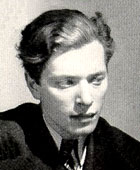

 By two of his former students:
My House
By Lou Reed
The image of the poet's in the breeze
Canadian geese are flying above the trees
A mist is hanging gently on the lake
my house is very beautiful at night
My friend and teacher occupies a spare room
he's dead, at peace at last the wandering Jew
Other friends had put stones on his grave
he was the first great man that I had ever met
Sylvia and I got out our Ouija Board
to dial a spirit, across the room it soared
We were happy and amazed at what we saw
blazing stood the proud and regal name Delmore
Delmore, I missed all your funny ways
I missed your jokes and the brilliant things you said
My Dedalus to your Bloom, was such a perfect wit
and to find you in my house makes things perfect
I really got a lucky life
my writing, my motorcycle and my wife
And to top it all off a spirit of pure poetry
is living in this stone and wood house with me
The image of the poet's in the breeze
Canadian geese are flying above the trees
A mist is hanging gently on the lake
our house is very beautiful at night
Our house is very beautiful at night
our house is very beautiful at night
Our house is very beautiful at night
A Momentary Longing To Hear Sad Advice from One Long Dead
By Kenneth Koch
Who was my teacher at Harvard. Did not wear overcoat
Saying to me as we walked across the Yard
Cold brittle autumn is you should be wearing overcoat. I said
You are not wearing overcoat. He said,
You should do as I say not do as I do.
Just how American it was and how late Forties it was
Delmore, but not I, was probably aware. He quoted Finnegans Wake to me
In his New York apartment sitting on chair
Table directly in front of him. There did he write? I am wondering.
Look at this photograph said of his mother and father.
Coney Island. Do they look happy? He couldn't figure it out.
Believed Pogo to be at the limits of our culture.
Pogo. Walt Kelly must have read Joyce Delmore said.
Why don't you ask him?
Why don't you ask Walt Kelly if he read Finnegans Wake or not.
Your parents don't look happy but it is just a photograph.
Maybe they felt awkward posing for photographs.
Maybe it is just a bad photograph. Delmore is not listening
I want to hear him tell me something sad but however true.
Delmore in his tomb is sitting. People say yes everyone is dying
But here read this happy book on the subject. Not Delmore. Not that rueful man.
It's striking how similar these portraits are, and how both of them express a Yeatsian desire to communicate with Schwartz's spirit. The difference is that Reed is successful in speaking to Delmore — even has him living with him in his house! – while Koch only longs for contact.
It's also interesting to think about how Koch and Reed both cast Schwartz as the epitome of "seriousness," a role he also often claimed for himself (as in 1938's "Father and Son": "My father … taught me to be serious"). And I don't think I'm stretching it to say that the concept of "seriousness" is key for both of them: Koch making an effort to alleviate the monumental seriousness of mid-century American poetry (or rather, as he claimed many times, to give it a new definition of seriousness), and Reed, when he wasn't just trying to get or stay famous, to bring literary seriousness to rock music. In doing this both take enormous risks (Koch of being called trivial, Reed of being called pretentious) which ultimately pay off in some of the most exciting art of their respective fields and eras, at least in this blogger's opinion. What's funny is that both could have derived inspiration for these respective missions — in which they are, as it were, tunneling toward each other from opposite directions — from the same figure, although in different decades and in different cultural circumstances.
In "My House," Reed is settling into his self-consciously "mature" phase, which entails not only writing literary lyrics but also withdrawing from New York City, settling down with a woman after a few decades of bisexuality, and reclaiming the literary heritage of seriousness he had jeopardized by making records like Rock'n'Roll Animal. Schwartz is thus invoked like a guardian angel at the start of the record: "a spirit of pure poetry" to guide his passage back into the land of critical prestige, not so much Dedalus to his Bloom as Virgil to his Dante.
Koch's poem centers even more obviously around the question of seriousness, the value of the seriousness of culture, which of course was a more of a live issue in the "late Forties" (cp. Adorno's Dialectic of Enlightenment, which I'll be trying to wrestle with next week) than it seems to us now. Schwartz, in the scene recalled, shows a 40s intellectual's cautious approval of popular culture ("Believed Pogo to be at the limits of our culture") which nonetheless must still be assumed to spring from a reputable highbrow source ("Walt Kelly must have read Joyce"). Schwartz's uncertainty about the cultural status of Pogo somehow fuses, heartbreakingly, with his uncertainty about his parents' past happiness; and the fact that he is putting either of these questions to a student is, in itself, somewhat sad. Koch, of course, can't answer either of these questions for him: only Walt Kelly and Schwartz's parents can, all of whom are, momentarily or permanently, absent.
But the important thing is not just that Delmore Schwartz was depressed and tortured while Koch is/was saner and happier; I want to resist reading the poem reductively, according to the "Modernism = grumpy and conflicted / Postmodernism = well-adjusted and jouissant" fallacy. The starting point, after all, is the fact that Koch now "want[s] to hear him tell me something sad but however true." Leaving aside any temptation to read biography into it (oh why bother: the poem was written in 2001; New York had been attacked by terrorists and Koch was dying of leukemia), we see that Koch is nostalgic for Schwartz's "rueful" perspective, his High Modernist values, though that nostalgia is as tentative and uncertain as Schwartz's appreciation of Walt Kelly once was. I'll stop myself from going any further than that, for now, but what I'm interested in is the way both works interweave a sympathetic portrait of Schwartz the man with Schwartz — who might also, if we want to push things still further, stand in for "the university poet" as such — the bulwark of seriousness and bearer of cultural capital.
Tuesday, August 14, 2007
The Yiddish Stein


I'm reading some short stories by the American mid-century short story writer (my wheelhouse, if you haven't noticed) Grace Paley. Her first collection, The Little Disturbances of Man came out in 1959 and she's still alive (but I'm not sure if she's still producing). Anyway, she's kind of fallen between the cracks of American lit, even though Roth, Barthelme, Sontag and Angela Carter all sing her praises. I'm only a couple stories in, but I'm already enamored. Unlike O'Connor, Paley isn't interested in the grotesque. She's more like Eudora Welty, interested in generations and in women and a slightly subversive understanding of domesticity. But, like both of them, dialogue is key.
Paley, perhaps because she grew up in the Bronx with Yiddish-speaking parents, versus the Southern twangs of Welty and O'Connor, feels the more modern of the two. Though all share an orality in their story-style, Paley feels closer to the modernist moment of Dos Passos, Henry Roth and perhaps even someone like Jean Toomer because of the focus on the polyglot city and what it sounds like to be immersed in every type of voice. The Southern stories are more about how the homogeneous react to the new or react to the old same. Urban stories are about listening to a new heterogeneous.
Paley's stories gain their force in the Yiddish twinged dialogue which made me think a lot of Stein. Of course we all know she was Jewish, and I've done little to no secondary reading on Jewish, but Stein so often becomes grouped with the holy grail of Eliot and Pound as the PURE CORE OF MODERNISM and disassociated from an ethnic past. Reading Paley, who grew up speaking Yiddish and English (but with parents with a Russian background), I wondered whether Yiddish could have an affect on the way Stein put words together. I know Stein's family was German well off and I have no idea if her parents or any of her family spoke Yiddish, but this is the opening of a Paley story (told in the voice of the protagonist's Jewish immigrant Aunt):
"I was popular in certain circles, says Aunt Rose. I wasn't no thinner then, only more stationary in the flesh. In time to come, Lillie, don't be surprised--change is a fact of God. From this no one is excused. Only a person like your mama stands on one foot, she don't notice how big her behind is getting and sings in the canary's ear for thirty years. Who's listening? Papa's in the shop. You and Seymour, thinking about yourself. So she waits in a spotless kitchen for a kind and word and thinks--poor Rosie..."
"Poor Rosie! If there was more life in my little sister, she would know my heart is a regular college of feelings and there is such information between my corset and me that her whole married life is a kindergarten."
See what I mean, kind of? The slightly off word placement. I guess not so much the repetition. But something...Maybe Paley read Stein and that's that. But got me thinking. See how I can't think at the level of the word? Thank god for you poetry people.
Subscribe to:
Posts (Atom)


